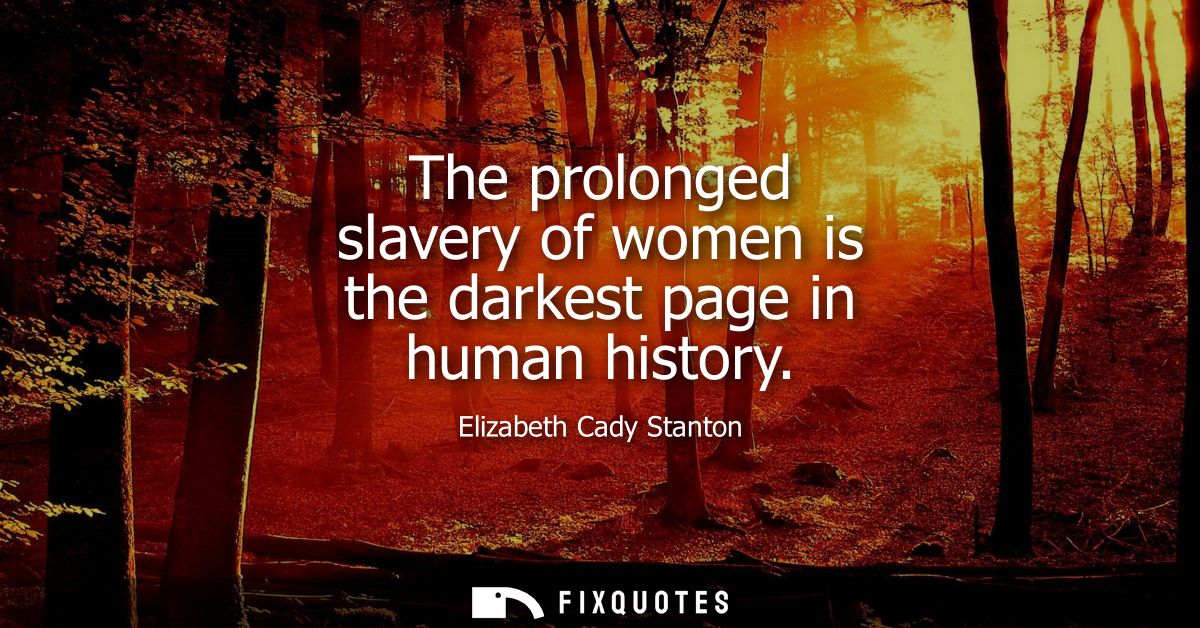
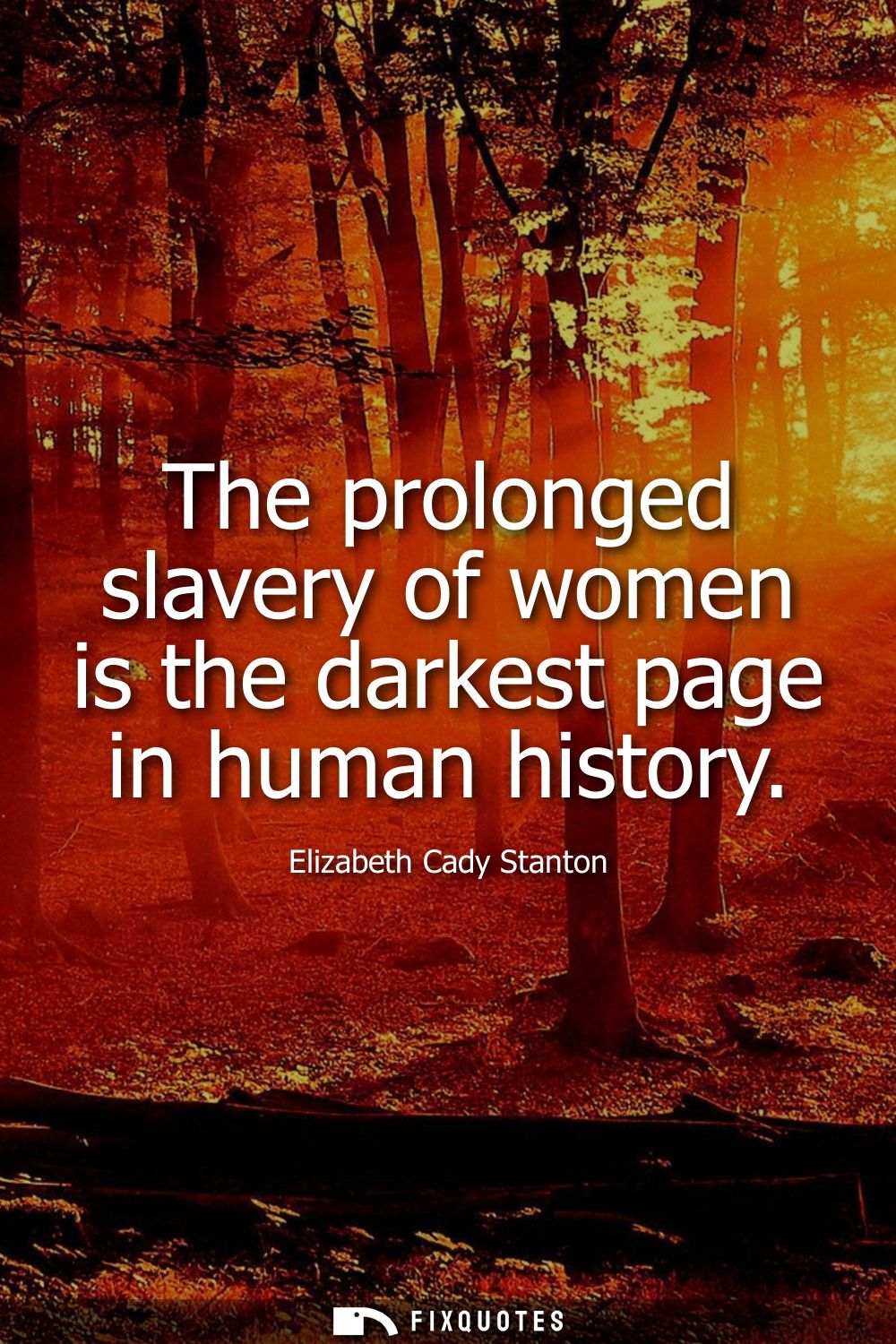
"The prolonged slavery of women is the darkest page in human history"
About this Quote
The phrase “prolonged slavery” is deliberately incendiary in the mid-19th-century United States, when chattel slavery was not an abstraction but a national crisis. Stanton is borrowing the era’s strongest moral vocabulary to force equivalence: women’s lack of property rights, political voice, and bodily autonomy wasn’t a “separate sphere,” it was captivity. The intent is strategic: raise the emotional stakes, collapse any distance between private domestic life and public political violence, and make “women’s rights” sound like an urgent human-rights emergency rather than a genteel cause.
The subtext is also a rebuke to male reformers who could denounce slavery while expecting wives to remain legally invisible. Stanton is staking a claim that the home is a political institution, and that a society cannot congratulate itself on freedom while enforcing dependency as a gendered baseline.
Context matters: Stanton, a central figure at Seneca Falls and beyond, is speaking from inside a movement that learned to weaponize rhetoric. The line isn’t just lament; it’s a demand that history’s moral scoreboard be recalculated, with women’s subjugation counted as the scandal it always was.
Quote Details
| Topic | Equality |
|---|---|
| Source | Verified source: History of Woman Suffrage, Volume I (Elizabeth Cady Stanton, 1881)
Evidence: The prolonged slavery of woman is the darkest page in human history. (Introduction (p. 13 in commonly cited editions; exact pagination varies by edition/reprint)). This sentence appears as the opening line of the Introduction to *History of Woman Suffrage, Volume I*, a work edited/compiled by Elizabeth Cady Stanton, Susan B. Anthony, and Matilda Joslyn Gage. Many modern quote attributions change "woman" to "women," but the earliest wording in this source is singular ("woman"). Wikisource hosts a transcription of the 1887 edition/reprint, but the quote is widely referenced as originating in Volume I first published in 1881; later printings (e.g., 1887) reproduce the same introduction text. Because the line is presented as part of the jointly edited volume’s Introduction, attributing it solely to Stanton can be a simplification; it is safer to attribute it to the *History of Woman Suffrage* editors (Stanton/Anthony/Gage) unless you can verify Stanton as the specific author of the Introduction in a particular edition’s front matter. Other candidates (1) Wise Women (Carole McKenzie, 2013) compilation95.0% ... Elizabeth Cady Stanton Yes. It's partly our own fault. There was a heady time in ... The prolonged slavery of wom... |
| Cite |
Citation Formats
APA Style (7th ed.)
Stanton, Elizabeth Cady. (2026, February 24). The prolonged slavery of women is the darkest page in human history. FixQuotes. https://fixquotes.com/quotes/the-prolonged-slavery-of-women-is-the-darkest-61081/
Chicago Style
Stanton, Elizabeth Cady. "The prolonged slavery of women is the darkest page in human history." FixQuotes. February 24, 2026. https://fixquotes.com/quotes/the-prolonged-slavery-of-women-is-the-darkest-61081/.
MLA Style (9th ed.)
"The prolonged slavery of women is the darkest page in human history." FixQuotes, 24 Feb. 2026, https://fixquotes.com/quotes/the-prolonged-slavery-of-women-is-the-darkest-61081/. Accessed 23 Mar. 2026.