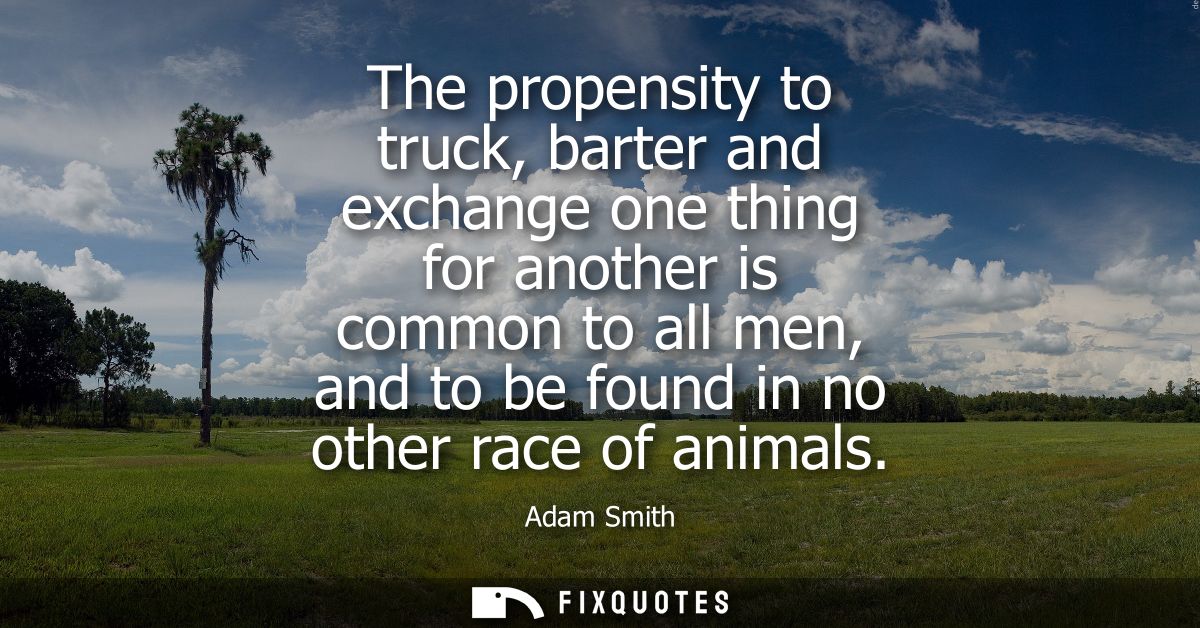
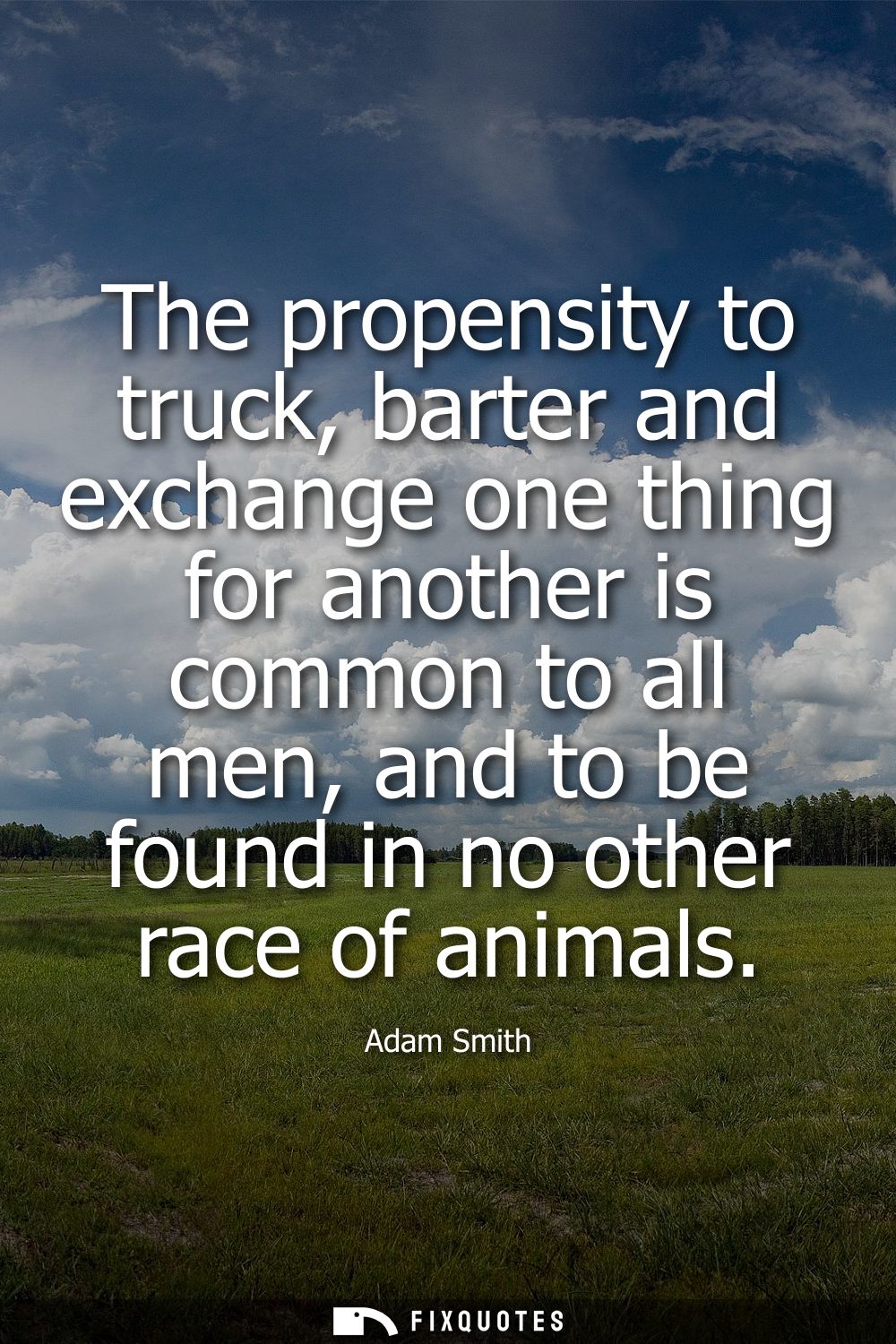
"The propensity to truck, barter and exchange one thing for another is common to all men, and to be found in no other race of animals"
About this Quote
The line’s real edge is the comparison class: “no other race of animals.” Smith is working with the Enlightenment toolkit here, using natural history to draw a hard boundary around the human. Animals may cooperate, hoard, or even gift, but they don’t bargain; they don’t negotiate terms with strangers. That’s the subtextual leap: exchange implies not merely desire but a certain kind of mind - foresight, trust calibration, and the ability to imagine equivalence between unlike things. Money, contracts, and price become extensions of cognition.
Context sharpens the intent. Wealth of Nations is published in 1776, when Britain’s commercial networks, colonial extraction, and early industrialization are turning “barter” into a national worldview. Smith’s claim also quietly rebukes older moral suspicion of trade as greed. He’s not sanctifying merchants; he’s repositioning self-interest as socially productive when routed through exchange. The charm is its simplicity: one sentence converts the marketplace from a potentially corrupting arena into the signature technology of human cooperation.
Quote Details
| Topic | Money |
|---|---|
| Source | Verified source: An Inquiry into the Nature and Causes of the Wealth of Na... (Adam Smith, 1776)
Evidence: Whether this propensity be one of those original principles in human nature, of which no further account can be given; or whether, as seems more probable, it be the necessary consequence of the faculties of reason and speech, it belongs not to our present subject to enquire. It is common to all men, and to be found in no other race of animals, which seem to know neither this nor any other species of contracts. (Book I, Chapter II ("Of the Principle which gives Occasion to the Division of Labour")). Your attributed wording is a stitched/paraphrased combination of two adjacent sentences in the same paragraph. In the primary text, Smith first introduces the phrase “the propensity to truck, barter, and exchange one thing for another” and then (in the next sentence) says “It is common to all men, and to be found in no other race of animals...”. This appears in the first published edition of The Wealth of Nations (1776) in Book I, Chapter II. Other candidates (1) Uprooting the Root of all Evil (John W. Casperson, 2015) compilation96.7% ... Adam Smith, “The propensity to truck, barter and exchange one thing for another is common to all men, and to be f... |
| Cite |
Citation Formats
APA Style (7th ed.)
Smith, Adam. (2026, February 17). The propensity to truck, barter and exchange one thing for another is common to all men, and to be found in no other race of animals. FixQuotes. https://fixquotes.com/quotes/the-propensity-to-truck-barter-and-exchange-one-3006/
Chicago Style
Smith, Adam. "The propensity to truck, barter and exchange one thing for another is common to all men, and to be found in no other race of animals." FixQuotes. February 17, 2026. https://fixquotes.com/quotes/the-propensity-to-truck-barter-and-exchange-one-3006/.
MLA Style (9th ed.)
"The propensity to truck, barter and exchange one thing for another is common to all men, and to be found in no other race of animals." FixQuotes, 17 Feb. 2026, https://fixquotes.com/quotes/the-propensity-to-truck-barter-and-exchange-one-3006/. Accessed 5 Apr. 2026.