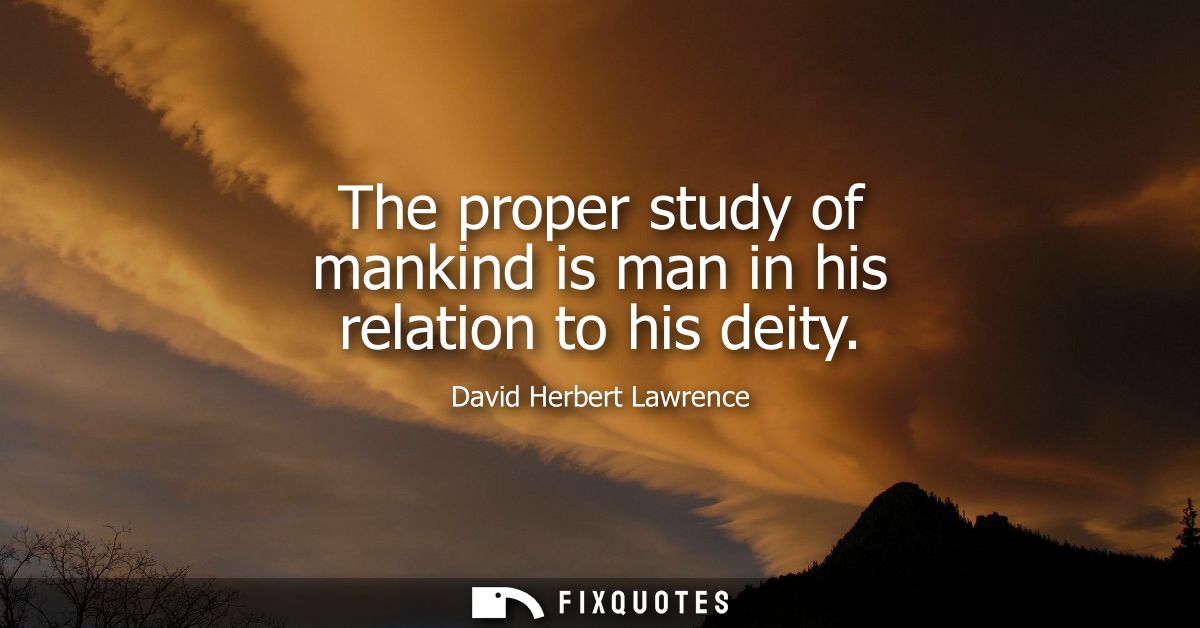
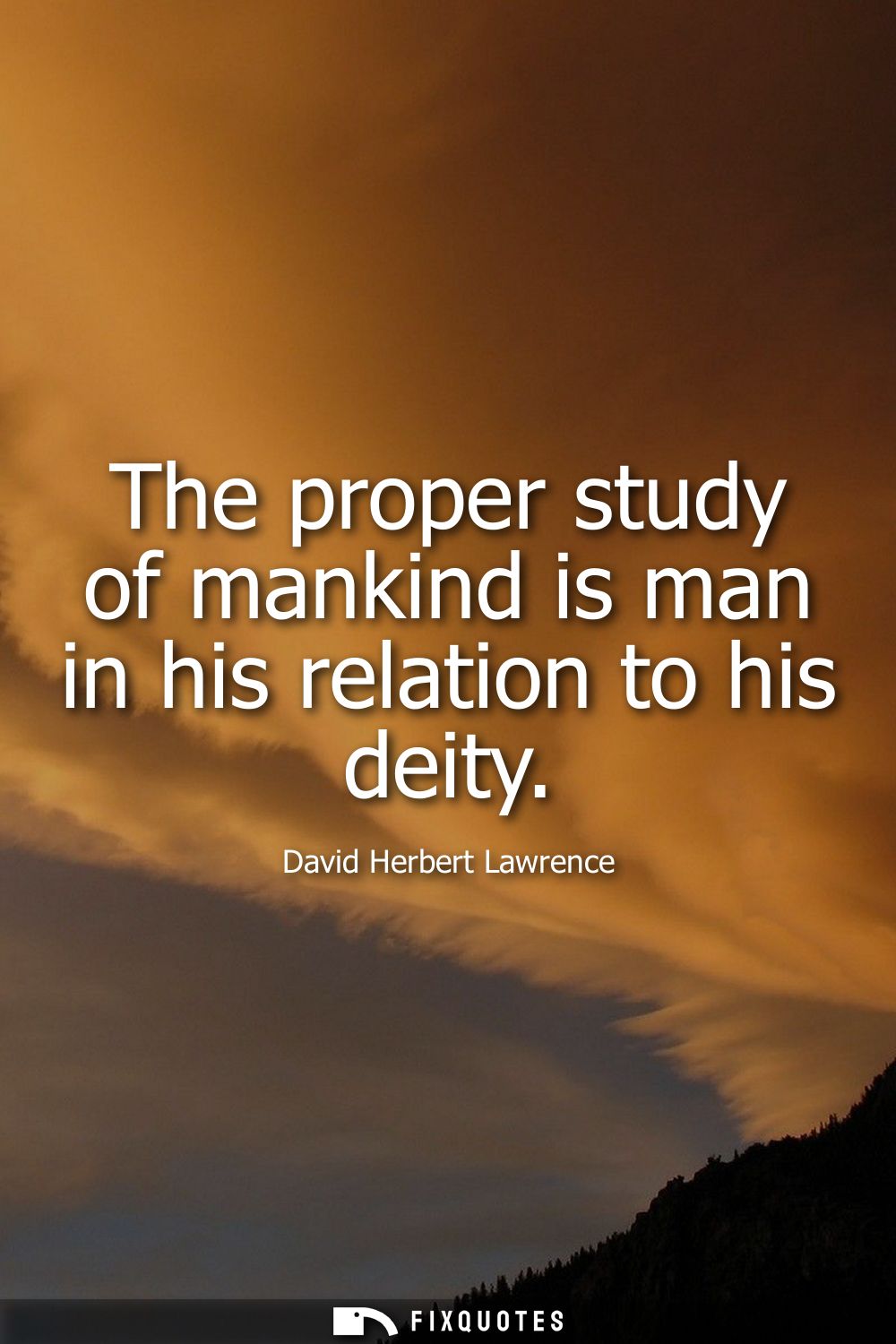
"The proper study of mankind is man in his relation to his deity"
About this Quote
Lawrence’s line tries to rescue “man” from being treated like a lab specimen. The proper study isn’t mankind as data, or society as a machine, but a charged relationship: the human creature measured against whatever it calls divine. That word “proper” is doing the policing. It’s a swipe at the early-20th-century confidence that psychology, industry, and politics could explain everything worth knowing. Lawrence is saying: you can map the nervous system and still miss the nerve.
The subtext is less churchy than it looks. Lawrence wasn’t a tidy doctrinal believer; he was obsessed with intensity, mystery, the bodily and the instinctual, and he distrusted modernity’s habit of shrinking experience into concepts. “Deity” here functions as a name for the unmanageable: the source of awe, dread, eros, moral demand, and cosmic loneliness. If you study humans only in relation to other humans - economics, class, law - you end up with a flattened anthropology. Put “deity” back in, and suddenly the stakes return: guilt, grace, surrender, rebellion. The inner drama becomes culturally legible again.
Context matters: Lawrence wrote in a Europe rattled by mechanization, collapsing certainties, and the spiritual aftershocks of Darwin and World War I. His work keeps asking what’s left when traditional religion thins out but the hunger for transcendence doesn’t. The line works because it’s both prescription and provocation: it dares the modern reader to admit that even in a secular age, we keep inventing gods - nation, art, romance, self - and we reveal ourselves most clearly in what we choose to worship.
The subtext is less churchy than it looks. Lawrence wasn’t a tidy doctrinal believer; he was obsessed with intensity, mystery, the bodily and the instinctual, and he distrusted modernity’s habit of shrinking experience into concepts. “Deity” here functions as a name for the unmanageable: the source of awe, dread, eros, moral demand, and cosmic loneliness. If you study humans only in relation to other humans - economics, class, law - you end up with a flattened anthropology. Put “deity” back in, and suddenly the stakes return: guilt, grace, surrender, rebellion. The inner drama becomes culturally legible again.
Context matters: Lawrence wrote in a Europe rattled by mechanization, collapsing certainties, and the spiritual aftershocks of Darwin and World War I. His work keeps asking what’s left when traditional religion thins out but the hunger for transcendence doesn’t. The line works because it’s both prescription and provocation: it dares the modern reader to admit that even in a secular age, we keep inventing gods - nation, art, romance, self - and we reveal ourselves most clearly in what we choose to worship.
Quote Details
| Topic | God |
|---|---|
| Source | Help us find the source |
| Cite |
Citation Formats
APA Style (7th ed.)
Lawrence, David Herbert. (2026, January 16). The proper study of mankind is man in his relation to his deity. FixQuotes. https://fixquotes.com/quotes/the-proper-study-of-mankind-is-man-in-his-137431/
Chicago Style
Lawrence, David Herbert. "The proper study of mankind is man in his relation to his deity." FixQuotes. January 16, 2026. https://fixquotes.com/quotes/the-proper-study-of-mankind-is-man-in-his-137431/.
MLA Style (9th ed.)
"The proper study of mankind is man in his relation to his deity." FixQuotes, 16 Jan. 2026, https://fixquotes.com/quotes/the-proper-study-of-mankind-is-man-in-his-137431/. Accessed 27 Mar. 2026.
More Quotes by David
Add to List