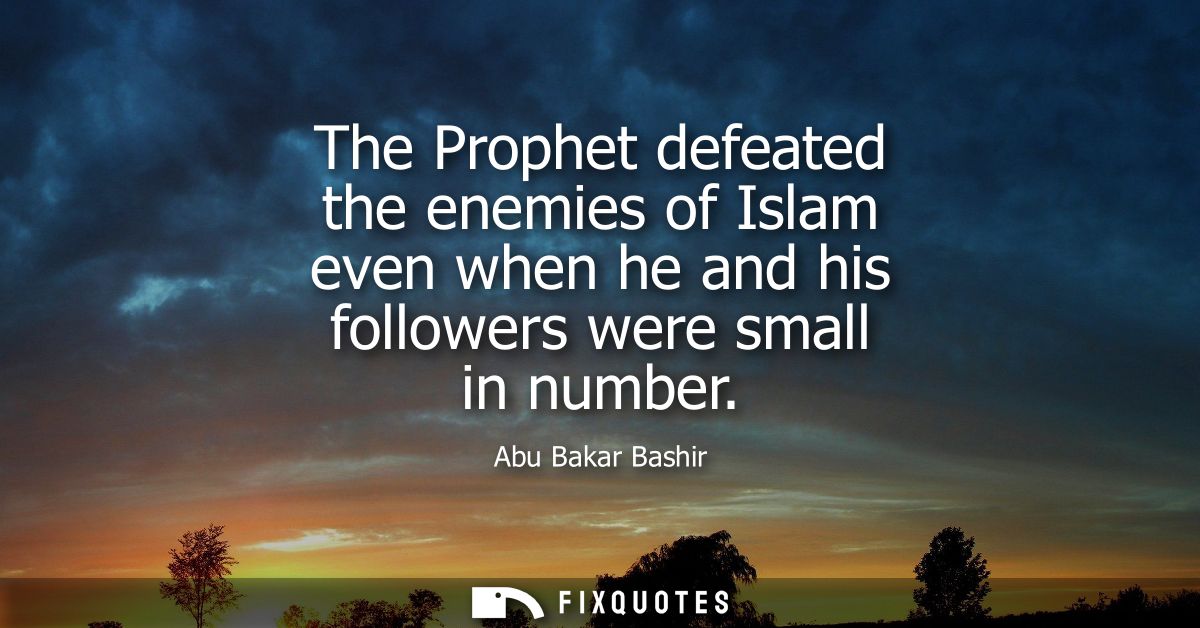
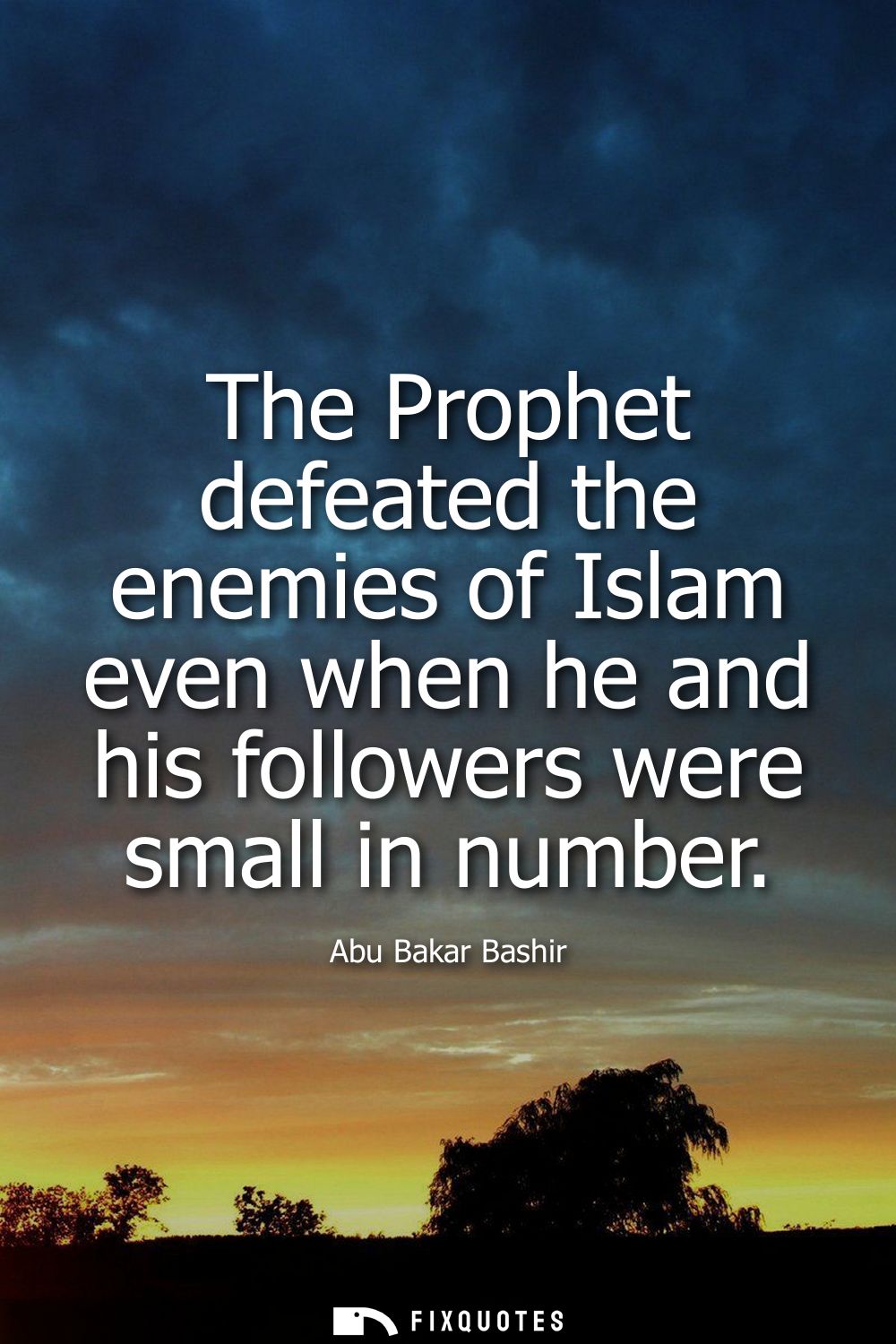
"The Prophet defeated the enemies of Islam even when he and his followers were small in number"
About this Quote
The intent is to launder present-day militancy through sacred precedent. “Enemies of Islam” is doing the heavy lifting here, collapsing a messy modern landscape of states, sects, and grievances into a single, righteous opposition. That vagueness is not a flaw; it’s a feature that allows the phrase to expand to whatever target an activist wants to legitimize. “Defeated” is equally elastic, implying not only military success but moral supremacy - a way to frame confrontation as destiny rather than choice.
Context matters because Bashir is not a neutral commentator; he is widely associated with hardline Islamist politics in Indonesia and has been linked in reporting and court proceedings to militant networks. In that setting, the quote’s subtext is less piety than performance: it reassures sympathizers that being outnumbered signals purity, and it nudges fence-sitters toward action by offering a divine historical template. It’s motivational speech with theological armor, designed to make escalation feel like fidelity.
Quote Details
| Topic | Faith |
|---|---|
| Source | Help us find the source |
| Cite |
Citation Formats
APA Style (7th ed.)
Bashir, Abu Bakar. (2026, January 15). The Prophet defeated the enemies of Islam even when he and his followers were small in number. FixQuotes. https://fixquotes.com/quotes/the-prophet-defeated-the-enemies-of-islam-even-149700/
Chicago Style
Bashir, Abu Bakar. "The Prophet defeated the enemies of Islam even when he and his followers were small in number." FixQuotes. January 15, 2026. https://fixquotes.com/quotes/the-prophet-defeated-the-enemies-of-islam-even-149700/.
MLA Style (9th ed.)
"The Prophet defeated the enemies of Islam even when he and his followers were small in number." FixQuotes, 15 Jan. 2026, https://fixquotes.com/quotes/the-prophet-defeated-the-enemies-of-islam-even-149700/. Accessed 4 Mar. 2026.