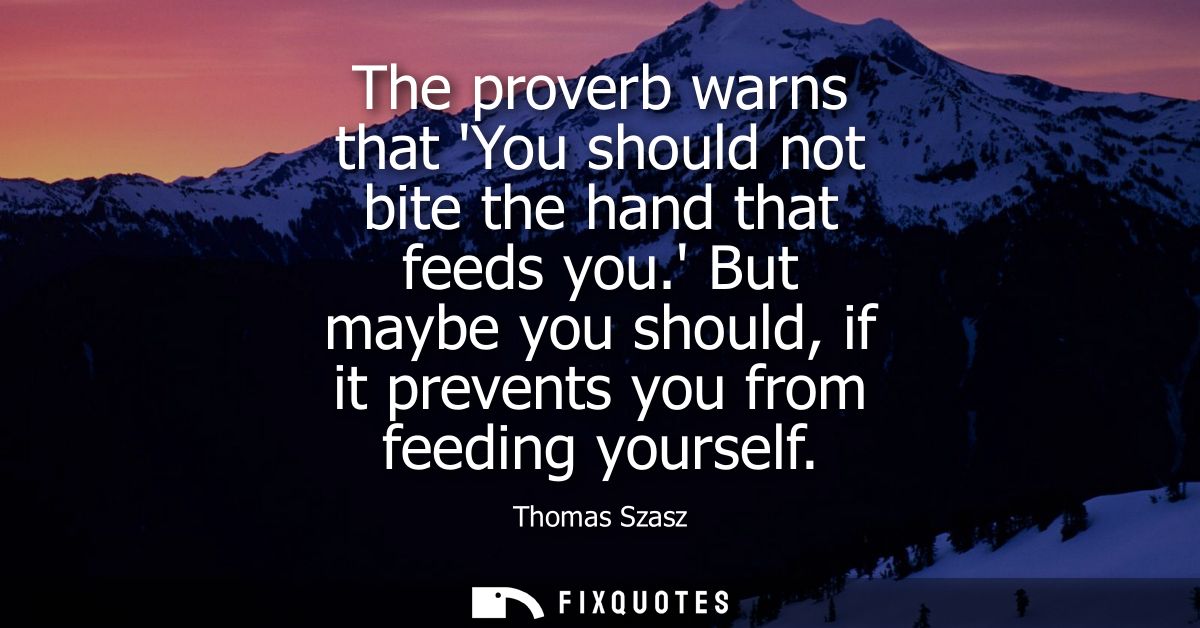
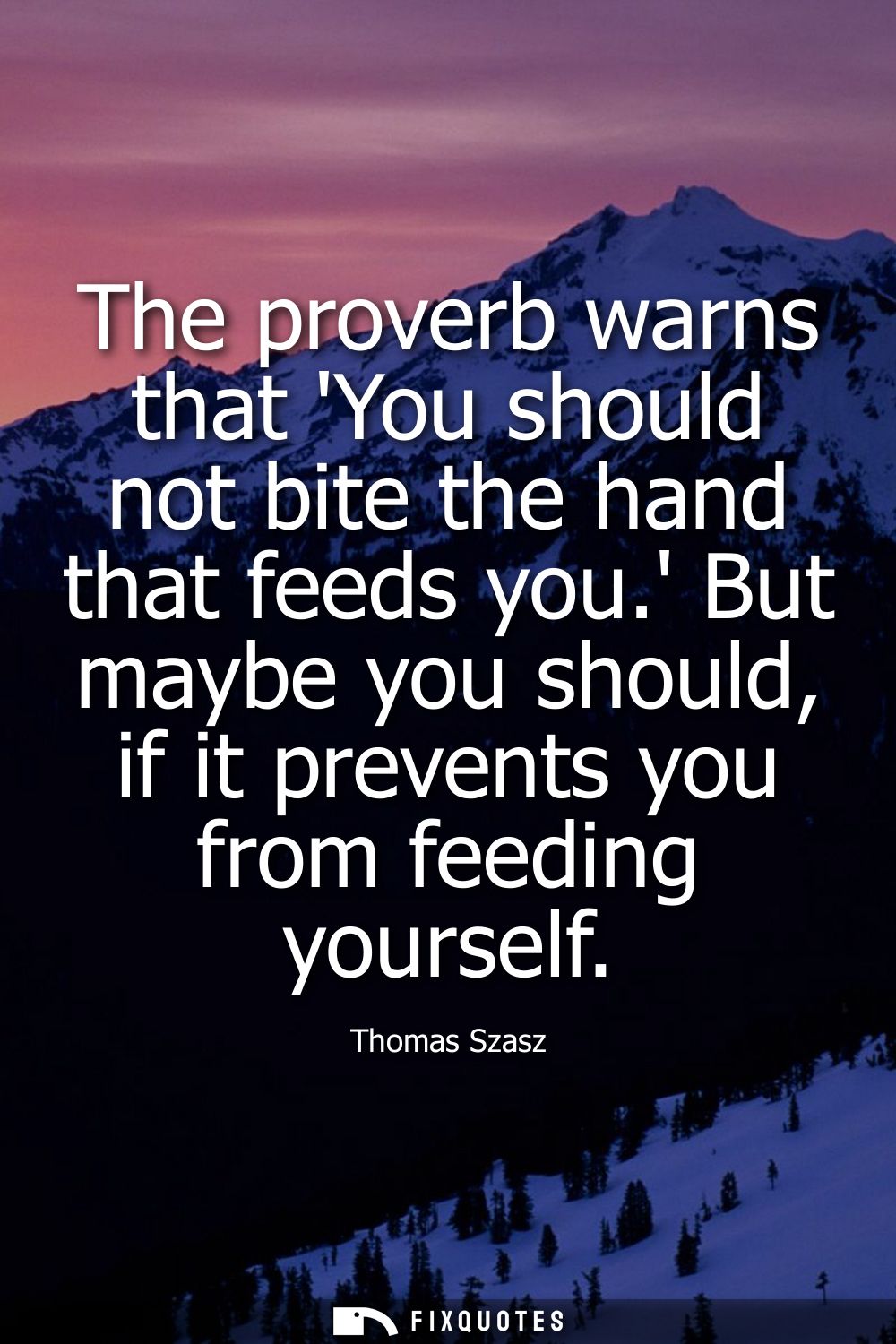
"The proverb warns that 'You should not bite the hand that feeds you.' But maybe you should, if it prevents you from feeding yourself"
About this Quote
The subtext is classic Szasz: suspicion of institutions that present care as virtue while quietly claiming authority over your choices. As a psychiatrist who spent decades attacking coercive psychiatry, he heard "help" and "treatment" as words that can smuggle in control - particularly when the patient is redefined as incompetent to steer their own life. In that context, biting isn't petulance; it's a refusal to accept a relationship where survival depends on pleasing the provider.
The line also works because it stages a trade-off that liberal societies prefer not to look at directly: security can erode agency. "Feeding yourself" stands in for adult autonomy - economic, psychological, political. Szasz doesn't romanticize rebellion; he frames it as prophylaxis. Better a small act of conflict now than a permanent condition of being managed later. The wit is in the inversion, but the sting is in the accusation: sometimes the safest-looking kindness is the thing that keeps you from becoming capable.
Quote Details
| Topic | Ethics & Morality |
|---|---|
| Source | Help us find the source |
| Cite |
Citation Formats
APA Style (7th ed.)
Szasz, Thomas. (2026, January 16). The proverb warns that 'You should not bite the hand that feeds you.' But maybe you should, if it prevents you from feeding yourself. FixQuotes. https://fixquotes.com/quotes/the-proverb-warns-that-you-should-not-bite-the-129354/
Chicago Style
Szasz, Thomas. "The proverb warns that 'You should not bite the hand that feeds you.' But maybe you should, if it prevents you from feeding yourself." FixQuotes. January 16, 2026. https://fixquotes.com/quotes/the-proverb-warns-that-you-should-not-bite-the-129354/.
MLA Style (9th ed.)
"The proverb warns that 'You should not bite the hand that feeds you.' But maybe you should, if it prevents you from feeding yourself." FixQuotes, 16 Jan. 2026, https://fixquotes.com/quotes/the-proverb-warns-that-you-should-not-bite-the-129354/. Accessed 7 Mar. 2026.