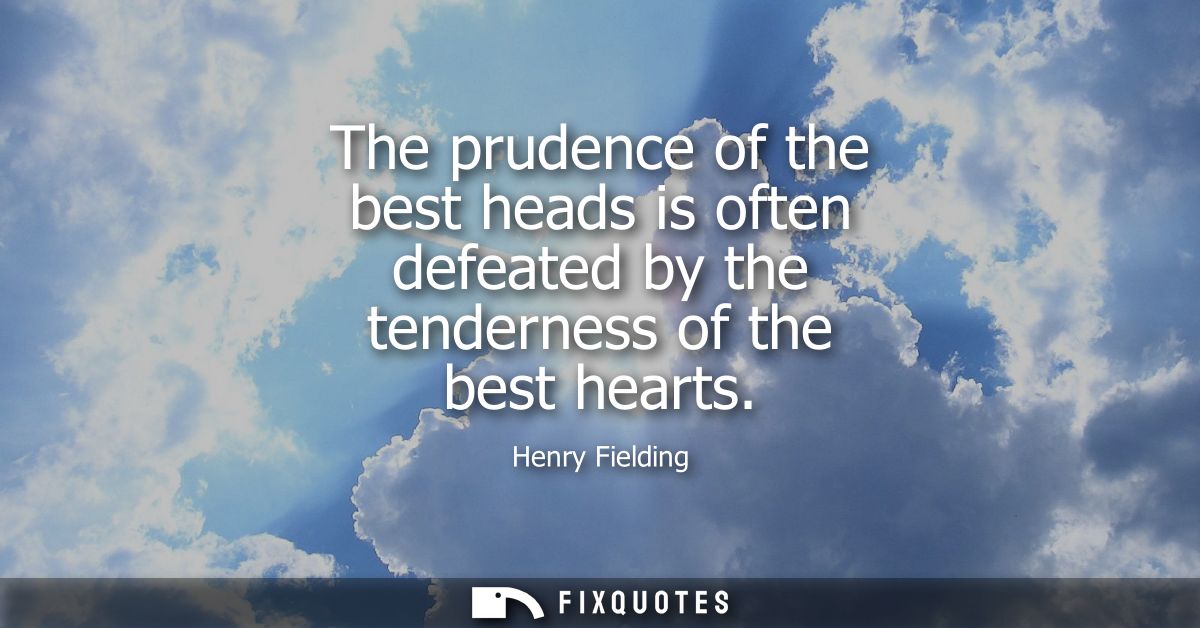
"The prudence of the best heads is often defeated by the tenderness of the best hearts"
About this Quote
The line works because it refuses to flatter either side. It isn’t the Enlightenment slogan that reason should rule, and it isn’t the sentimental novel’s promise that feeling will save us. Fielding, a comic anatomist of hypocrisy, understands how compassion can be exploited and how self-image ("I am kind") can override calculation ("this will go badly"). The subtext is about vulnerability as a social force: tenderness makes us porous, and porous people are easier to maneuver, guilt, or charm into choices they already know they’ll regret.
In Fielding’s century, that tension was everywhere: a culture loudly celebrating sensibility while running on patronage, debt, and strict hierarchies. His fiction is crowded with good-hearted characters whose generosity becomes an invitation for predators and parasites. The line lands as both warning and acknowledgment: the best human motives aren’t safe from consequence. Sometimes the tragedy isn’t that we didn’t know better; it’s that we did, and we couldn’t bear to act like it.
Quote Details
| Topic | Kindness |
|---|---|
| Source | Later attribution: Wisdom for the Soul (Larry Chang, 2006) modern compilationISBN: 9780977339105 · ID: -T3QhPjIxhIC
Evidence:
... The prudence of the best heads is often defeated by the tenderness of the best hearts . ~ Henry Fielding , 1707-1754 Prudence keeps life safe , but does not often make it happy . ~ Samuel Johnson , 1709-1784 ~ Prudence operates on ... |
| Cite |
Citation Formats
APA Style (7th ed.)
Fielding, Henry. (2026, April 2). The prudence of the best heads is often defeated by the tenderness of the best hearts. FixQuotes. https://fixquotes.com/quotes/the-prudence-of-the-best-heads-is-often-defeated-67533/
Chicago Style
Fielding, Henry. "The prudence of the best heads is often defeated by the tenderness of the best hearts." FixQuotes. April 2, 2026. https://fixquotes.com/quotes/the-prudence-of-the-best-heads-is-often-defeated-67533/.
MLA Style (9th ed.)
"The prudence of the best heads is often defeated by the tenderness of the best hearts." FixQuotes, 2 Apr. 2026, https://fixquotes.com/quotes/the-prudence-of-the-best-heads-is-often-defeated-67533/. Accessed 4 Apr. 2026.