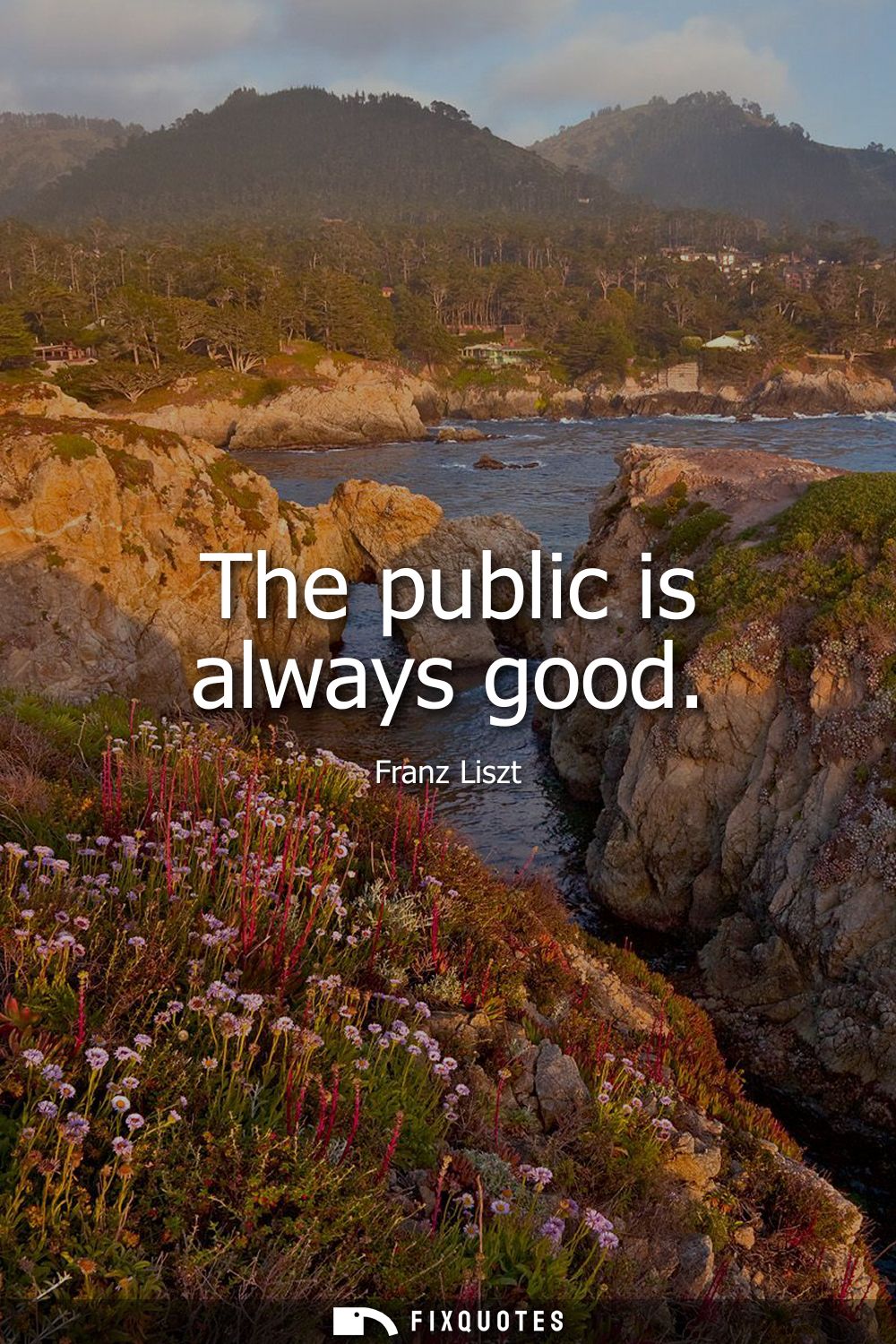
"The public is always good"
About this Quote
A composer declaring "The public is always good" sounds less like naïve gratitude than a shrewd bit of self-defense from the most famous musical celebrity of his century. Liszt wasn’t just writing scores; he was managing a phenomenon. “Lisztomania” turned concert halls into something closer to pop arenas, with swooning fans, souvenir hunting, and a press that treated virtuosity like scandal. In that environment, the line works as both compliment and control: sanctify the audience and you neutralize the moral panic around it.
The absolute “always” is the tell. It’s rhetorically overconfident, which makes it useful. Liszt is pushing back against the reflex of cultural gatekeepers who insisted the crowd was tasteless, fickle, easily duped. By insisting on the public’s goodness, he flips the usual hierarchy: the audience isn’t a problem to be educated by critics; critics are the ones out of step with lived enthusiasm. It’s a democratic posture, but also a tactical one. If the public is “good,” then their applause becomes a kind of ethical verdict, not merely a popularity metric.
There’s subtext, too, about performance as a social contract. Liszt depended on touring, spectacle, and mass attention to fund new work and later philanthropy. Praising the crowd turns commerce into communion: you’re not selling tickets, you’re meeting a collective appetite that deserves respect. In a culture anxious about modern celebrity and mass taste, the sentence is a smooth, elegant insistence that pleasure can be a serious form of judgment.
The absolute “always” is the tell. It’s rhetorically overconfident, which makes it useful. Liszt is pushing back against the reflex of cultural gatekeepers who insisted the crowd was tasteless, fickle, easily duped. By insisting on the public’s goodness, he flips the usual hierarchy: the audience isn’t a problem to be educated by critics; critics are the ones out of step with lived enthusiasm. It’s a democratic posture, but also a tactical one. If the public is “good,” then their applause becomes a kind of ethical verdict, not merely a popularity metric.
There’s subtext, too, about performance as a social contract. Liszt depended on touring, spectacle, and mass attention to fund new work and later philanthropy. Praising the crowd turns commerce into communion: you’re not selling tickets, you’re meeting a collective appetite that deserves respect. In a culture anxious about modern celebrity and mass taste, the sentence is a smooth, elegant insistence that pleasure can be a serious form of judgment.
Quote Details
| Topic | Wisdom |
|---|---|
| Source | Help us find the source |
| Cite |
Citation Formats
APA Style (7th ed.)
Liszt, Franz. (2026, January 15). The public is always good. FixQuotes. https://fixquotes.com/quotes/the-public-is-always-good-90022/
Chicago Style
Liszt, Franz. "The public is always good." FixQuotes. January 15, 2026. https://fixquotes.com/quotes/the-public-is-always-good-90022/.
MLA Style (9th ed.)
"The public is always good." FixQuotes, 15 Jan. 2026, https://fixquotes.com/quotes/the-public-is-always-good-90022/. Accessed 26 Mar. 2026.
More Quotes by Franz
Add to List