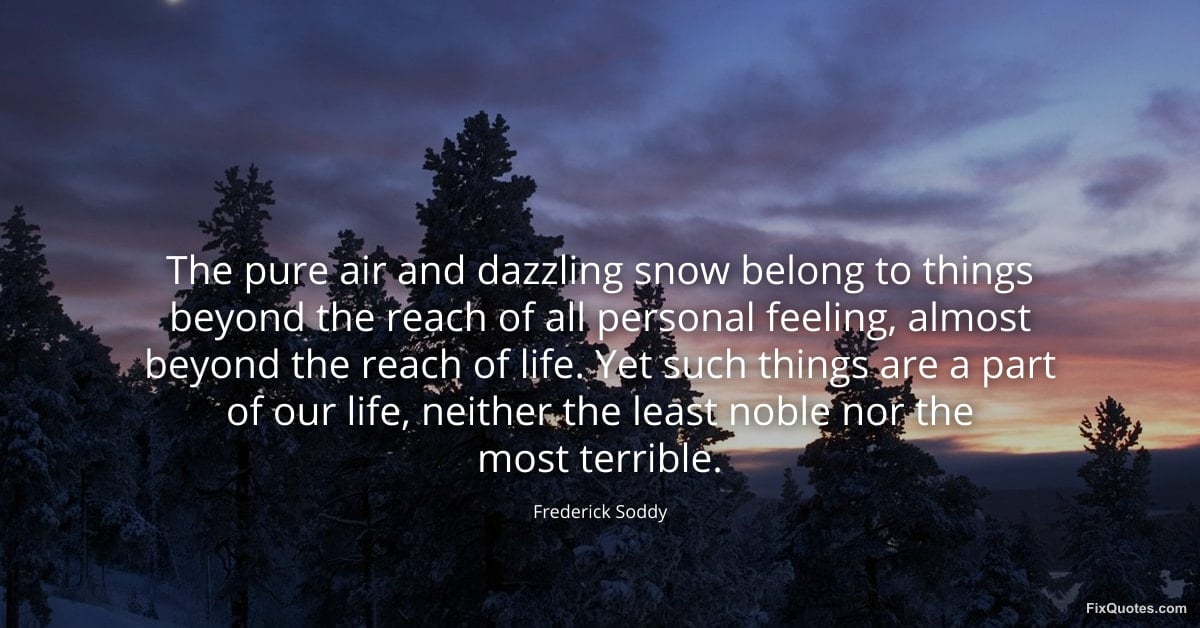
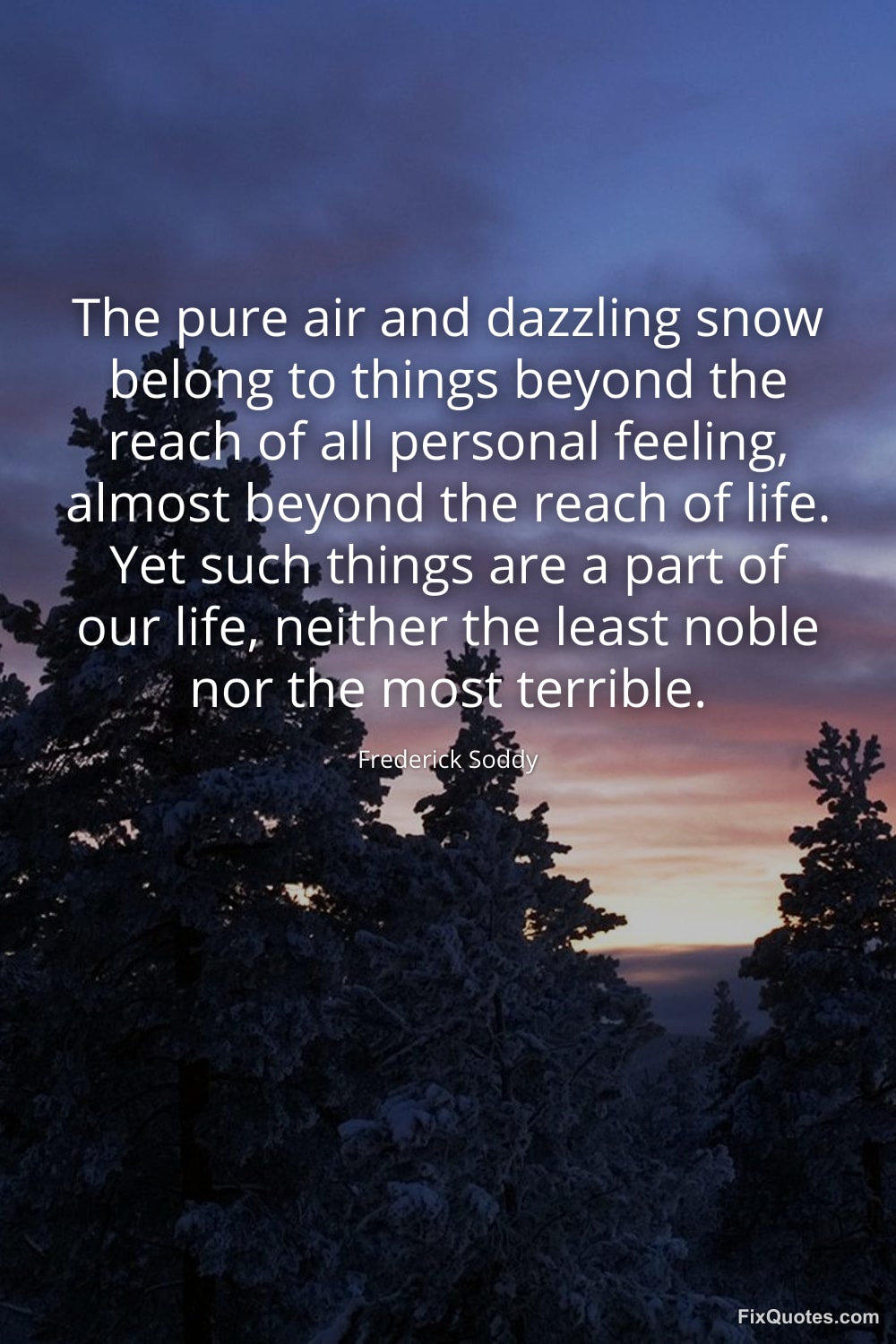
"The pure air and dazzling snow belong to things beyond the reach of all personal feeling, almost beyond the reach of life. Yet such things are a part of our life, neither the least noble nor the most terrible"
About this Quote
The craft is in the double move. First, he banishes these elements to a realm “almost beyond the reach of life,” pushing them toward the abstract and absolute. Then he snaps them back: “Yet such things are a part of our life.” That pivot is the subtext. Modernity (and especially modern science) tempts us to split reality into two bins: the human story, full of meaning, and the nonhuman world, cold and value-free. Soddy refuses the split. He’s making room for a kind of belonging that doesn’t require sentimentality.
The final clause, “neither the least noble nor the most terrible,” is quietly combative. It rejects melodrama - no romantic worship of nature as purity, no doom-laden fear of it as menace. Coming from a scientist who lived through the early 20th century’s acceleration of technology and catastrophe, the line reads like an ethical check: if we’re going to wield new powers over the material world, we need the humility to see the nonhuman not as backdrop, but as a dignified participant in what we call “life.”
Quote Details
| Topic | Wisdom |
|---|---|
| Source | Help us find the source |
| Cite |
Citation Formats
APA Style (7th ed.)
Soddy, Frederick. (2026, January 16). The pure air and dazzling snow belong to things beyond the reach of all personal feeling, almost beyond the reach of life. Yet such things are a part of our life, neither the least noble nor the most terrible. FixQuotes. https://fixquotes.com/quotes/the-pure-air-and-dazzling-snow-belong-to-things-95619/
Chicago Style
Soddy, Frederick. "The pure air and dazzling snow belong to things beyond the reach of all personal feeling, almost beyond the reach of life. Yet such things are a part of our life, neither the least noble nor the most terrible." FixQuotes. January 16, 2026. https://fixquotes.com/quotes/the-pure-air-and-dazzling-snow-belong-to-things-95619/.
MLA Style (9th ed.)
"The pure air and dazzling snow belong to things beyond the reach of all personal feeling, almost beyond the reach of life. Yet such things are a part of our life, neither the least noble nor the most terrible." FixQuotes, 16 Jan. 2026, https://fixquotes.com/quotes/the-pure-air-and-dazzling-snow-belong-to-things-95619/. Accessed 31 Mar. 2026.