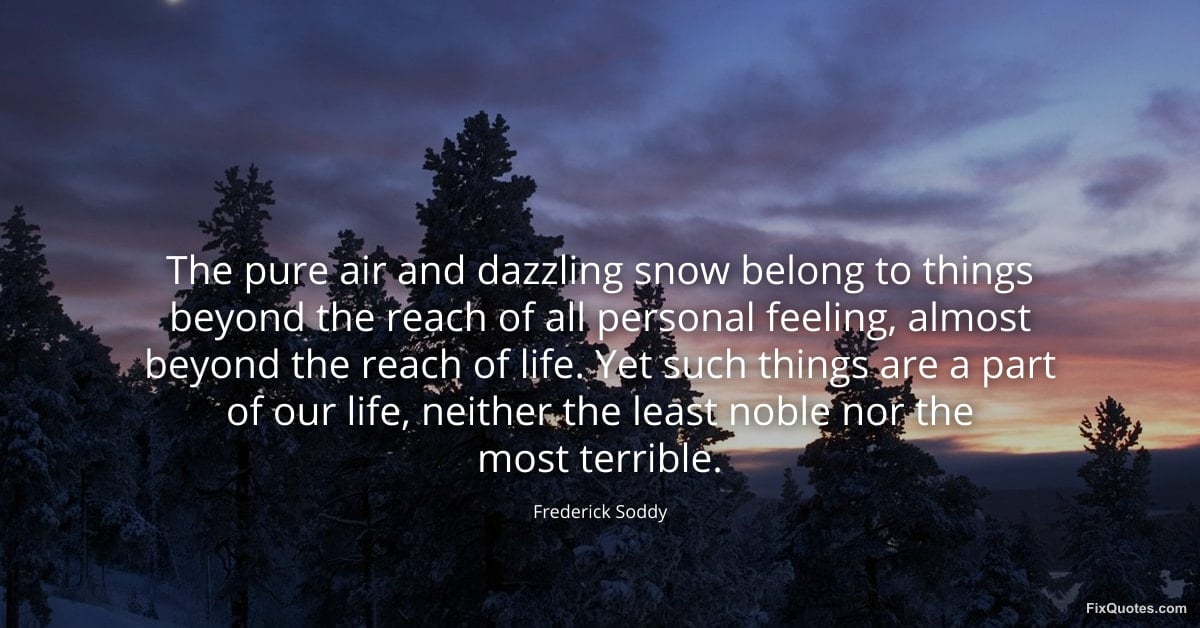
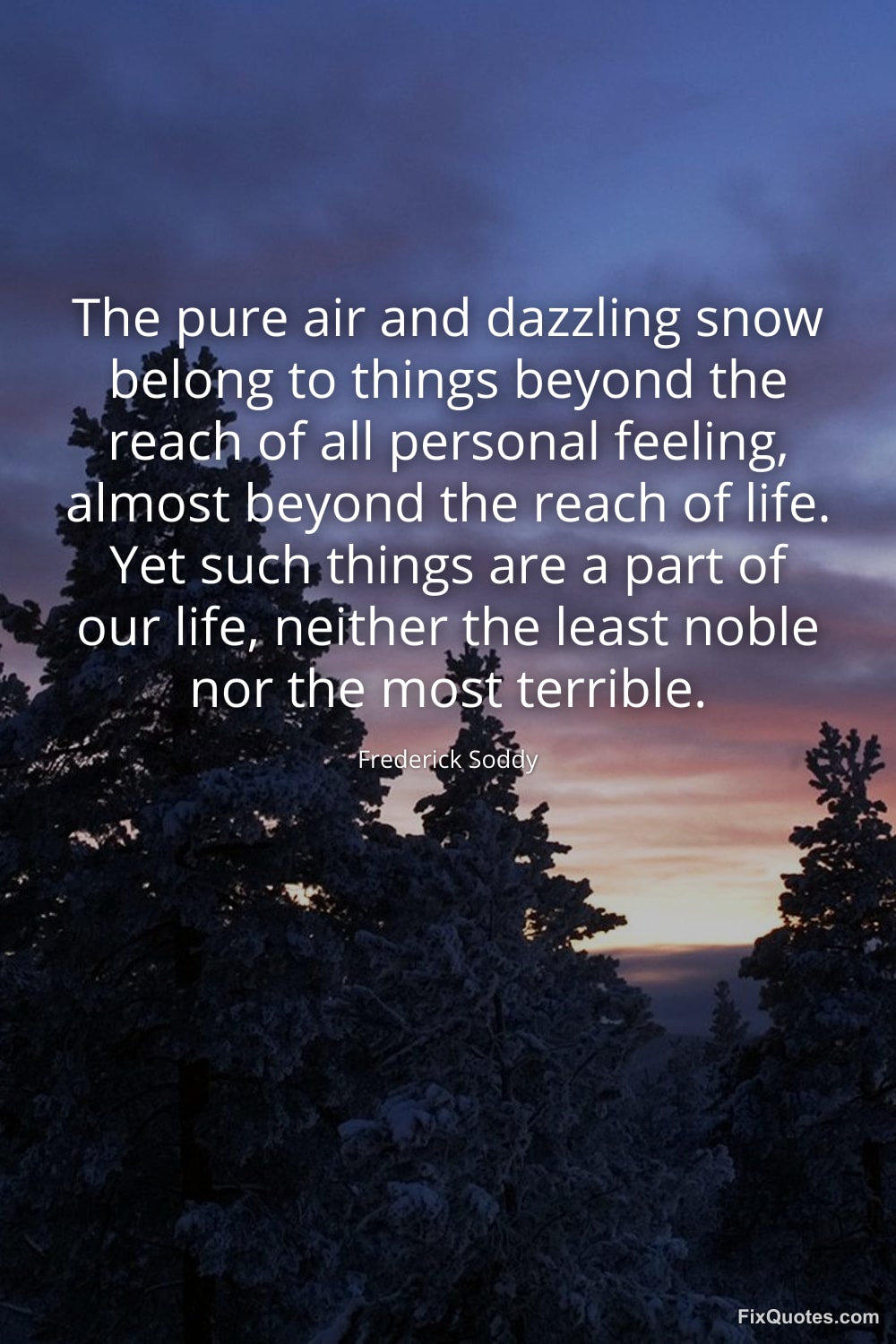
"The pure air and dazzling snow belong to things beyond the reach of all personal feeling, almost beyond the reach of life. Yet such things are a part of our life, neither the least noble nor the most terrible"
About this Quote
Pure air and dazzling snow stand for realms that do not care about us. They are beautiful and severe at once, existing at the edges where life thins out: high altitudes, polar spaces, the stark atmospheres of clarity and cold. Their indifference strips away our projections. No comfort, no malice, only a brilliance that can both cleanse and blind. That is why they feel almost beyond the reach of life, because they refuse to answer to our moods, needs, or stories.
Yet they are inseparable from human life. We breathe the air and depend on the snows that feed rivers and regulate climate. Even metaphorically, we rely on the kinds of clarity they suggest: exactness of thought, crispness of judgment, the cool light in which illusions melt. They are not peripheries but conditions, the silent background that makes our dramas possible. To recognize this is to admit that what sustains us is often impersonal and that what moves us most deeply may be what does not notice us at all.
The refusal to call them either the least noble or the most terrible is a rebuke to sentimental extremes. Purity can tempt us to sanctify nature; severity can tempt us to fear it. Both are forms of projection. Their nobility or terror arises not from the things themselves but from our encounter with them. The mature stance is a clear-eyed acknowledgment: these forces are real, they exceed us, and our task is to live intelligently with them.
Frederick Soddy, a chemist who revealed the impersonal laws of radioactivity and later questioned the illusions of economic life, speaks from a habit of mind that trusts what lies beyond opinion. The air and the snow suggest a wider order that is not human-centered yet indispensable to human flourishing. To meet that order without flattery or dread is a form of dignity.
Yet they are inseparable from human life. We breathe the air and depend on the snows that feed rivers and regulate climate. Even metaphorically, we rely on the kinds of clarity they suggest: exactness of thought, crispness of judgment, the cool light in which illusions melt. They are not peripheries but conditions, the silent background that makes our dramas possible. To recognize this is to admit that what sustains us is often impersonal and that what moves us most deeply may be what does not notice us at all.
The refusal to call them either the least noble or the most terrible is a rebuke to sentimental extremes. Purity can tempt us to sanctify nature; severity can tempt us to fear it. Both are forms of projection. Their nobility or terror arises not from the things themselves but from our encounter with them. The mature stance is a clear-eyed acknowledgment: these forces are real, they exceed us, and our task is to live intelligently with them.
Frederick Soddy, a chemist who revealed the impersonal laws of radioactivity and later questioned the illusions of economic life, speaks from a habit of mind that trusts what lies beyond opinion. The air and the snow suggest a wider order that is not human-centered yet indispensable to human flourishing. To meet that order without flattery or dread is a form of dignity.
Quote Details
| Topic | Wisdom |
|---|
More Quotes by Frederick
Add to List