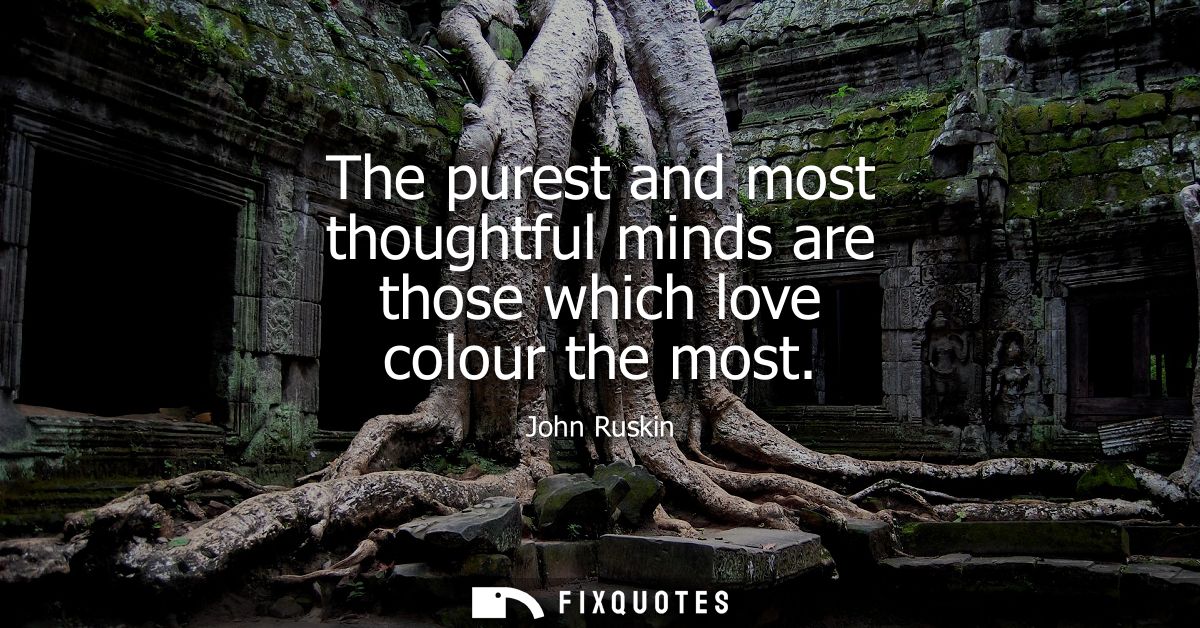
"The purest and most thoughtful minds are those which love colour the most"
About this Quote
The line works because it weaponizes purity - a word Victorians adored - while refusing the usual puritan bargain of purity-as-denial. “Purest” here doesn’t mean washed-out or austere; it means uncorrupted by dead habit, by the desire to dominate experience into tidy categories. “Thoughtful,” too, is redefined. Thought isn’t the greyscale activity of the study; it’s a full-spectrum attention, the capacity to register nuance without reducing it.
The subtext is a cultural argument about art’s legitimacy. Ruskin, defender of Turner and the Pre-Raphaelites, was battling a mechanizing modernity that prized utility, standardization, and easy legibility. Color becomes his proxy for complexity: nature’s refusal to be simplified, the artist’s refusal to be merely illustrative, the mind’s refusal to confuse restraint with depth.
It’s also a subtle class critique. Loving color implies a kind of sensory literacy that industrial society trains people to distrust, especially if their role is to produce rather than perceive. Ruskin insists the highest intellect doesn’t flatten life; it intensifies it.
Quote Details
| Topic | Art |
|---|---|
| Source | Help us find the source |
| Cite |
Citation Formats
APA Style (7th ed.)
Ruskin, John. (2026, January 15). The purest and most thoughtful minds are those which love colour the most. FixQuotes. https://fixquotes.com/quotes/the-purest-and-most-thoughtful-minds-are-those-18412/
Chicago Style
Ruskin, John. "The purest and most thoughtful minds are those which love colour the most." FixQuotes. January 15, 2026. https://fixquotes.com/quotes/the-purest-and-most-thoughtful-minds-are-those-18412/.
MLA Style (9th ed.)
"The purest and most thoughtful minds are those which love colour the most." FixQuotes, 15 Jan. 2026, https://fixquotes.com/quotes/the-purest-and-most-thoughtful-minds-are-those-18412/. Accessed 26 Mar. 2026.