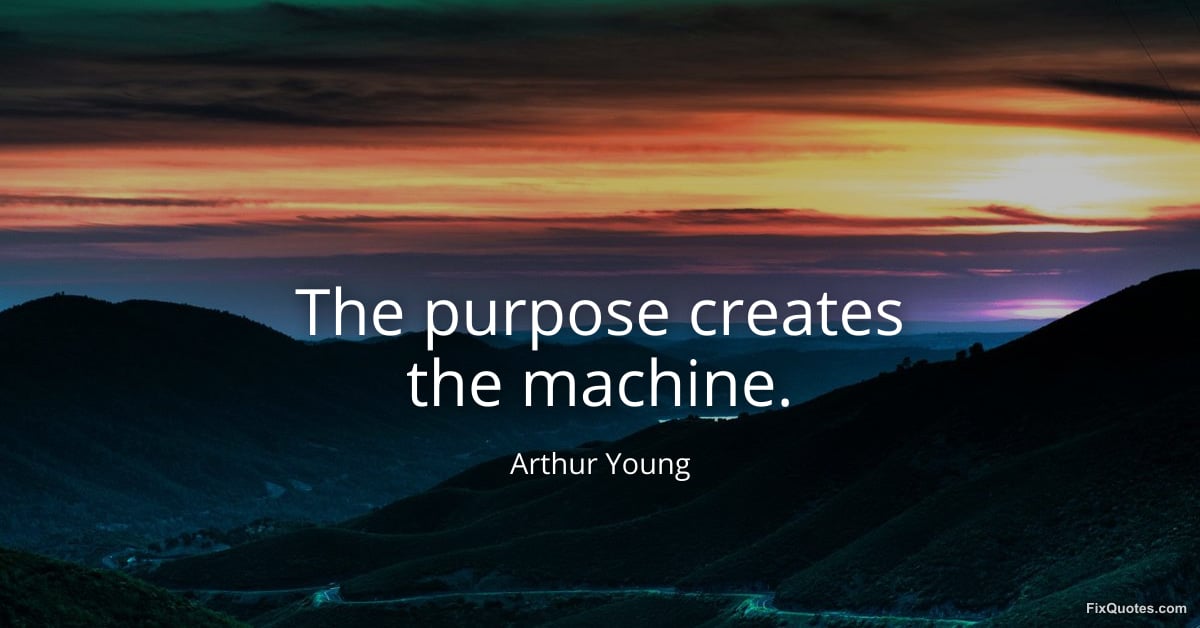
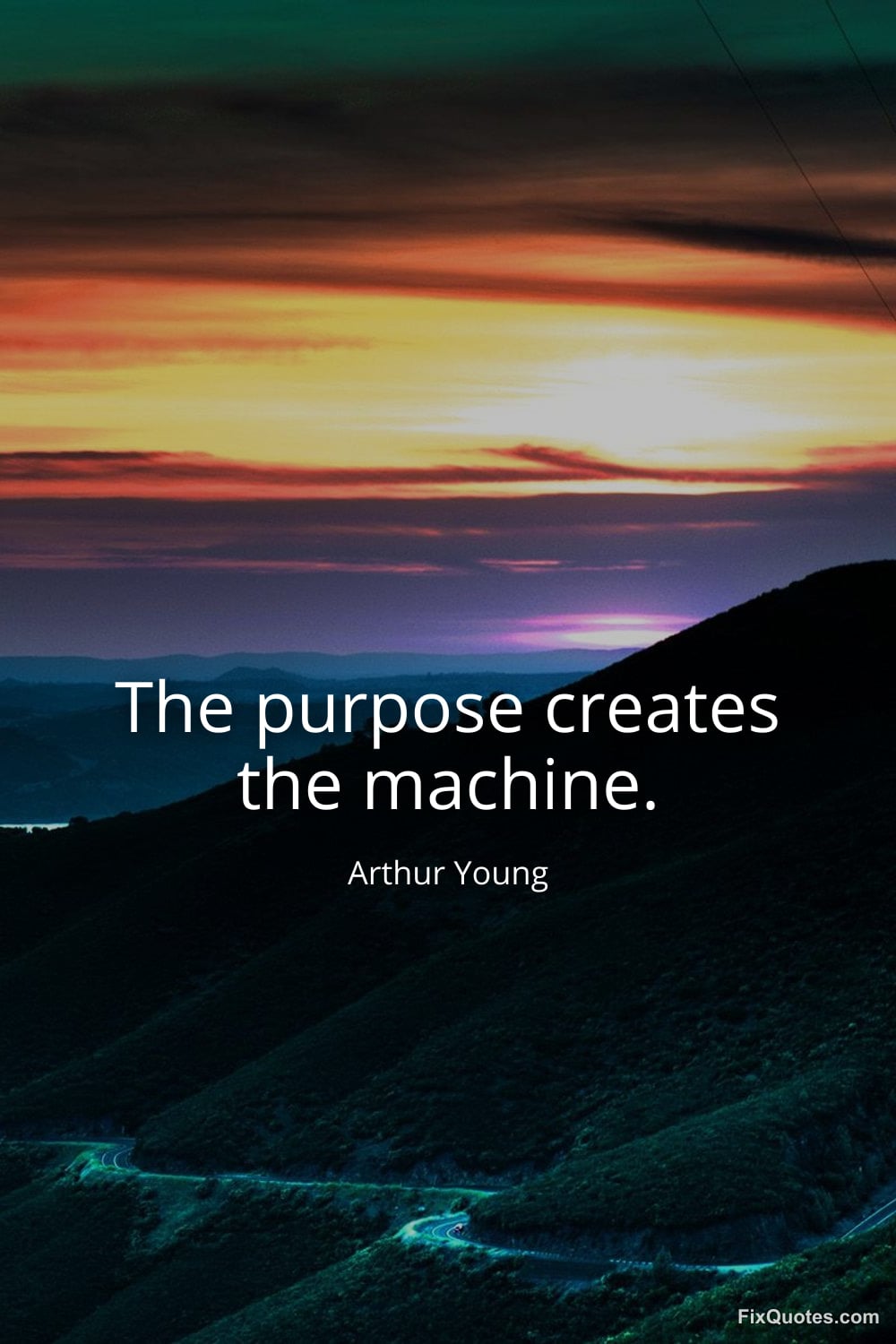
"The purpose creates the machine"
About this Quote
“The purpose creates the machine” flips the usual story we tell about progress. We like to imagine tools arriving first, then people scrambling to invent reasons to use them. Young, an Enlightenment-era writer watching Britain’s agricultural and early industrial transformations, argues the opposite: intent is the true engine. The “machine” here isn’t just gears and iron; it’s any system that gets built once a goal hardens into necessity.
Young’s period matters. He traveled widely as an agricultural commentator, observing how new methods and devices didn’t spread because they were clever, but because landowners, markets, and state pressures demanded output. Purpose is economics with a moral alibi: when the aim is higher yields, cheaper labor, faster transport, the world obligingly reorganizes itself into mechanisms that deliver. The line carries a quiet warning about inevitability. If purpose is allowed to be defined by profit, war, or prestige, the resulting “machine” will feel natural, even neutral, when it’s actually the material shape of a decision.
The subtext is also psychological. People don’t just build tools; they build justifications. Once a purpose is named, invention becomes less an act of genius than an act of compliance, a community of minds converging on the same solution because the same end is rewarded. Young’s aphorism works because it’s spare and slightly unsettling: it makes technology look less like destiny and more like desire with engineering credentials.
Young’s period matters. He traveled widely as an agricultural commentator, observing how new methods and devices didn’t spread because they were clever, but because landowners, markets, and state pressures demanded output. Purpose is economics with a moral alibi: when the aim is higher yields, cheaper labor, faster transport, the world obligingly reorganizes itself into mechanisms that deliver. The line carries a quiet warning about inevitability. If purpose is allowed to be defined by profit, war, or prestige, the resulting “machine” will feel natural, even neutral, when it’s actually the material shape of a decision.
The subtext is also psychological. People don’t just build tools; they build justifications. Once a purpose is named, invention becomes less an act of genius than an act of compliance, a community of minds converging on the same solution because the same end is rewarded. Young’s aphorism works because it’s spare and slightly unsettling: it makes technology look less like destiny and more like desire with engineering credentials.
Quote Details
| Topic | Wisdom |
|---|---|
| Source | Help us find the source |
| Cite |
Citation Formats
APA Style (7th ed.)
Young, Arthur. (2026, January 16). The purpose creates the machine. FixQuotes. https://fixquotes.com/quotes/the-purpose-creates-the-machine-134961/
Chicago Style
Young, Arthur. "The purpose creates the machine." FixQuotes. January 16, 2026. https://fixquotes.com/quotes/the-purpose-creates-the-machine-134961/.
MLA Style (9th ed.)
"The purpose creates the machine." FixQuotes, 16 Jan. 2026, https://fixquotes.com/quotes/the-purpose-creates-the-machine-134961/. Accessed 5 Mar. 2026.
More Quotes by Arthur
Add to List