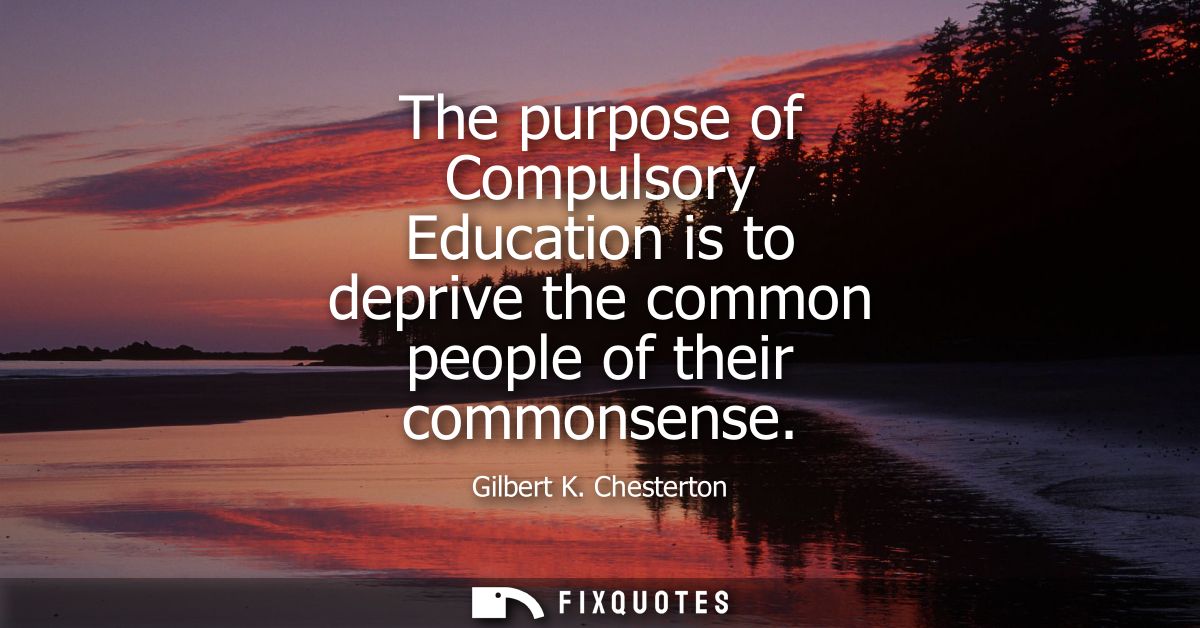
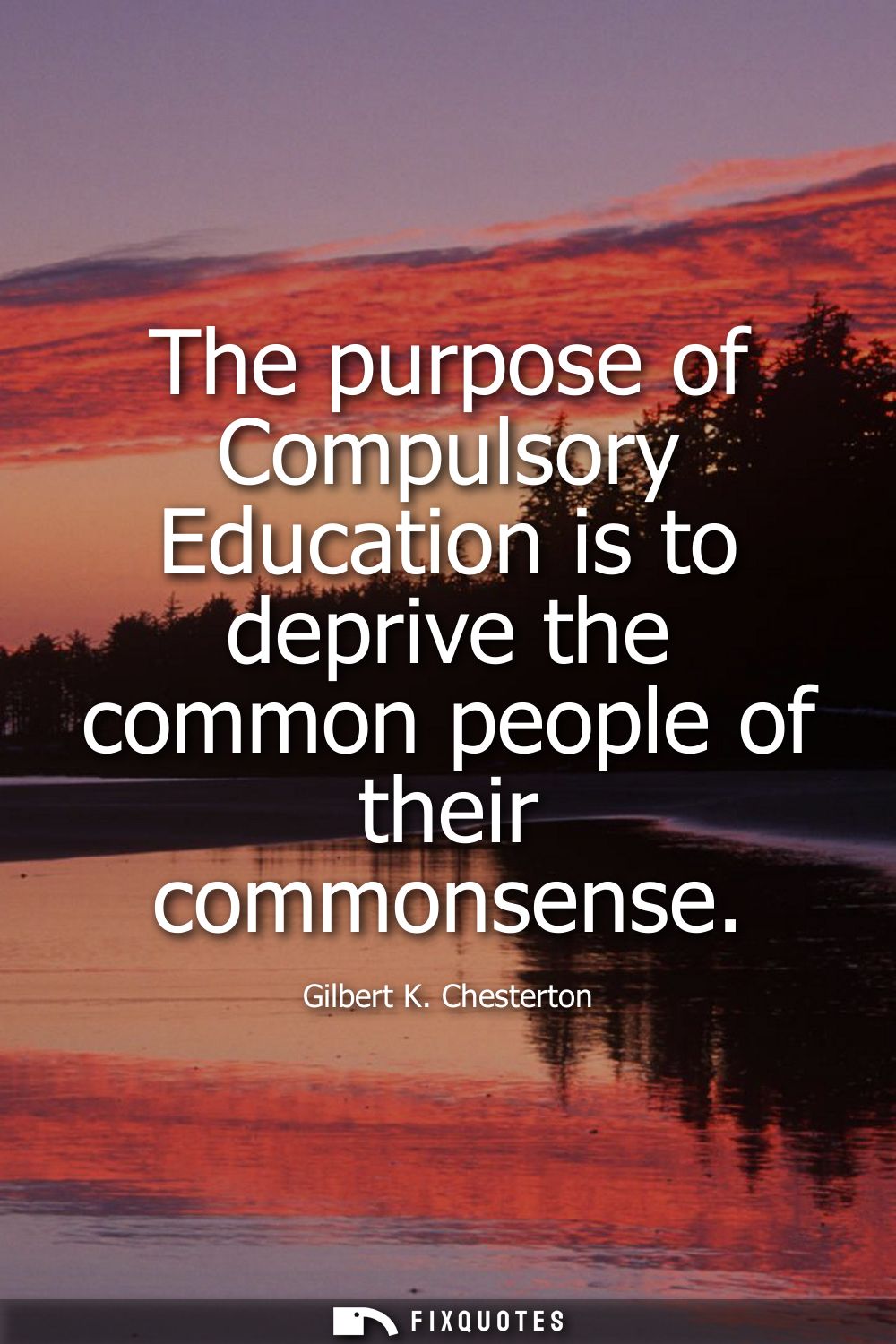
"The purpose of Compulsory Education is to deprive the common people of their commonsense"
About this Quote
Chesterton lands this line like a pub-table jab that’s funny until you notice it’s aimed at your nervous system. “Compulsory Education” isn’t framed as a public good that occasionally misfires; it’s cast as an instrument with a clear, almost conspiratorial purpose: to unteach “commonsense,” that scrappy, lived intelligence people develop outside official channels. The shock is in the inversion. Education, the sacred cow of modern liberal society, becomes a kind of factory for confusion.
The wording does a lot of work. “Compulsory” is the trigger: the problem isn’t learning but mandate. Chesterton is needling the modern state’s claim to moral authority, suggesting that once schooling becomes an obligation, it can function less like empowerment and more like domestication. “Common people” is deliberately blunt, even affectionate; he’s defending a class-based intuition that elites routinely patronize. And “commonsense” is the key Chestertonian virtue: a stubborn, pre-ideological clarity that resists fashionable theories.
The subtext is an argument about power disguised as a joke. If you can define what counts as “knowledge,” you can also define what counts as “reasonable.” A curriculum doesn’t just teach facts; it trains deference, rewires instinct, and normalizes bureaucratic thinking as maturity. In Chesterton’s era, mass schooling was expanding alongside technocratic governance and expert culture; his Catholic, distributist skepticism treated centralized systems as spiritually and socially flattening.
It’s also a warning shot at credentialism before the term existed: when the passport to legitimacy is institutional approval, commonsense becomes a kind of heresy.
The wording does a lot of work. “Compulsory” is the trigger: the problem isn’t learning but mandate. Chesterton is needling the modern state’s claim to moral authority, suggesting that once schooling becomes an obligation, it can function less like empowerment and more like domestication. “Common people” is deliberately blunt, even affectionate; he’s defending a class-based intuition that elites routinely patronize. And “commonsense” is the key Chestertonian virtue: a stubborn, pre-ideological clarity that resists fashionable theories.
The subtext is an argument about power disguised as a joke. If you can define what counts as “knowledge,” you can also define what counts as “reasonable.” A curriculum doesn’t just teach facts; it trains deference, rewires instinct, and normalizes bureaucratic thinking as maturity. In Chesterton’s era, mass schooling was expanding alongside technocratic governance and expert culture; his Catholic, distributist skepticism treated centralized systems as spiritually and socially flattening.
It’s also a warning shot at credentialism before the term existed: when the passport to legitimacy is institutional approval, commonsense becomes a kind of heresy.
Quote Details
| Topic | Teaching |
|---|
More Quotes by Gilbert
Add to List