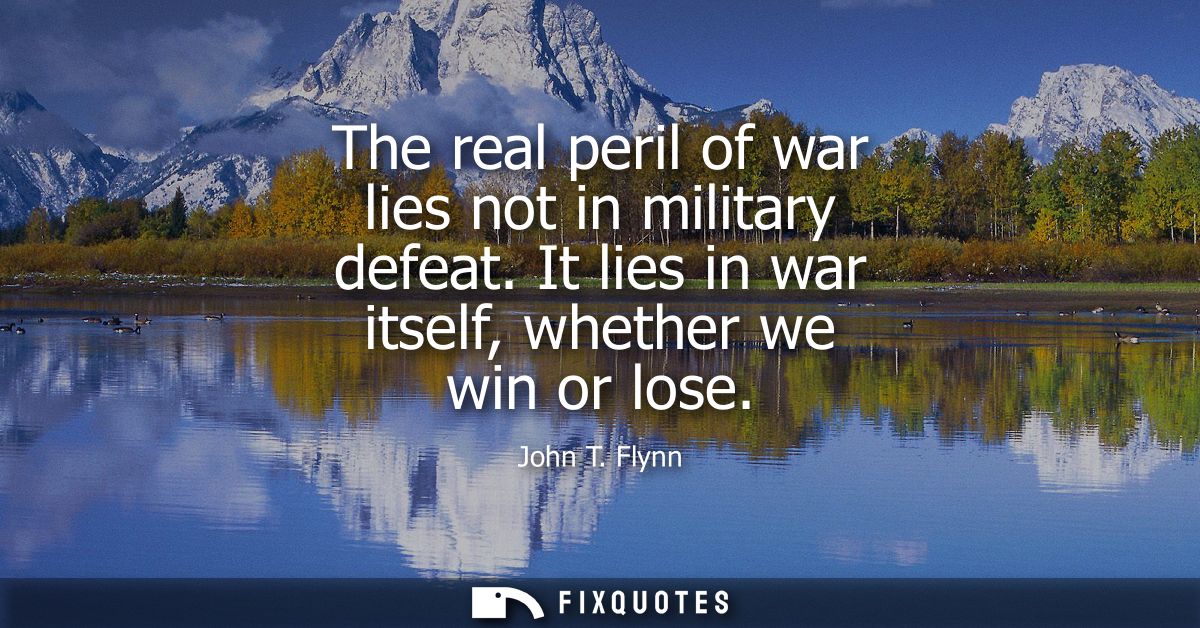
"The real peril of war lies not in military defeat. It lies in war itself, whether we win or lose"
About this Quote
The subtext is pointedly anti-romantic. Even victory carries a rot: centralized power justified by emergency, a public trained to accept secrecy and propaganda as patriotism, and an economy warped toward militarization. Flynn, a prominent mid-century critic of interventionism, was writing in a period when “winning” was becoming a blank check for permanent mobilization. His warning anticipates the postwar template: the security state that doesn’t fully demobilize, the political culture that keeps enemies on standby, the moral shortcuts that outlive the battlefield.
Rhetorically, the sentence works because it steals the argument from both hawks and doves. It concedes the hawk’s premise (yes, defeat is bad) only to insist that the deeper hazard is universal, baked into the act itself. “Whether we win or lose” is the kicker: it collapses partisan outcomes into a single, bleak constant. Flynn’s intent isn’t pacifist purity; it’s a demand to count costs that victory narratives systematically hide.
Quote Details
| Topic | War |
|---|---|
| Source | Help us find the source |
| Cite |
Citation Formats
APA Style (7th ed.)
Flynn, John T. (2026, January 15). The real peril of war lies not in military defeat. It lies in war itself, whether we win or lose. FixQuotes. https://fixquotes.com/quotes/the-real-peril-of-war-lies-not-in-military-defeat-146608/
Chicago Style
Flynn, John T. "The real peril of war lies not in military defeat. It lies in war itself, whether we win or lose." FixQuotes. January 15, 2026. https://fixquotes.com/quotes/the-real-peril-of-war-lies-not-in-military-defeat-146608/.
MLA Style (9th ed.)
"The real peril of war lies not in military defeat. It lies in war itself, whether we win or lose." FixQuotes, 15 Jan. 2026, https://fixquotes.com/quotes/the-real-peril-of-war-lies-not-in-military-defeat-146608/. Accessed 12 Feb. 2026.