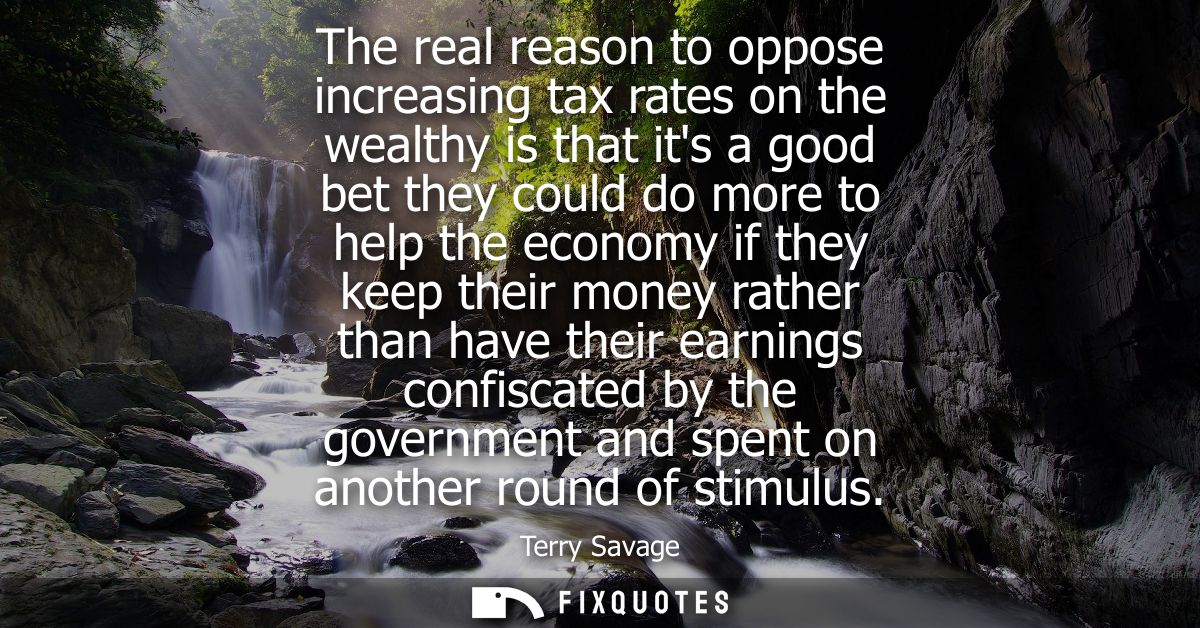
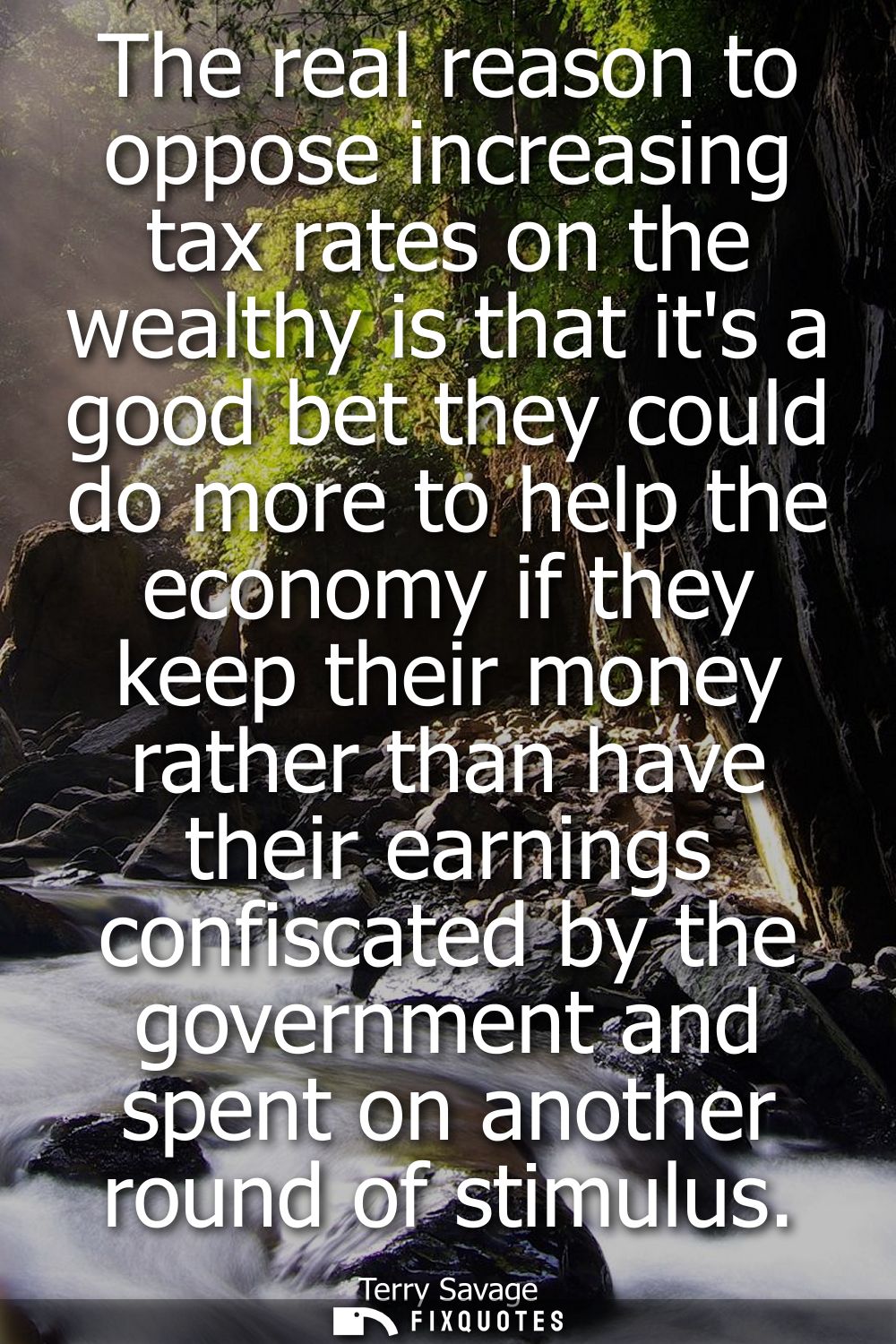
"The real reason to oppose increasing tax rates on the wealthy is that it's a good bet they could do more to help the economy if they keep their money rather than have their earnings confiscated by the government and spent on another round of stimulus"
About this Quote
The subtext hinges on loaded verbs. “Confiscated” doesn’t describe routine taxation; it evokes seizure, punishment, even illegitimacy. That word choice quietly shifts the moral baseline from “taxes fund a shared project” to “the state takes what isn’t theirs.” Then “another round of stimulus” is positioned as a tired, wasteful habit, a bureaucratic relapse. The phrase doesn’t argue about multipliers or employment; it taps stimulus fatigue, implying we’ve already tried this and it didn’t work - or at least didn’t feel like it did.
Contextually, this sits squarely in post-crisis/post-recession politics where “job creators” rhetoric battled with anger over bailouts and rising deficits. Savage’s intent is to make opposition to higher top rates sound like common-sense economic stewardship, not self-interest. The cleverness is in how it reassigns agency: prosperity becomes something the wealthy “do” for the economy when unshackled, while government spending is cast as inert or counterproductive. It’s an argument that asks for faith in private discretion while treating public discretion as suspect by default.
Quote Details
| Topic | Wealth |
|---|---|
| Source | Help us find the source |
| Cite |
Citation Formats
APA Style (7th ed.)
Savage, Terry. (2026, January 16). The real reason to oppose increasing tax rates on the wealthy is that it's a good bet they could do more to help the economy if they keep their money rather than have their earnings confiscated by the government and spent on another round of stimulus. FixQuotes. https://fixquotes.com/quotes/the-real-reason-to-oppose-increasing-tax-rates-on-132466/
Chicago Style
Savage, Terry. "The real reason to oppose increasing tax rates on the wealthy is that it's a good bet they could do more to help the economy if they keep their money rather than have their earnings confiscated by the government and spent on another round of stimulus." FixQuotes. January 16, 2026. https://fixquotes.com/quotes/the-real-reason-to-oppose-increasing-tax-rates-on-132466/.
MLA Style (9th ed.)
"The real reason to oppose increasing tax rates on the wealthy is that it's a good bet they could do more to help the economy if they keep their money rather than have their earnings confiscated by the government and spent on another round of stimulus." FixQuotes, 16 Jan. 2026, https://fixquotes.com/quotes/the-real-reason-to-oppose-increasing-tax-rates-on-132466/. Accessed 29 Mar. 2026.