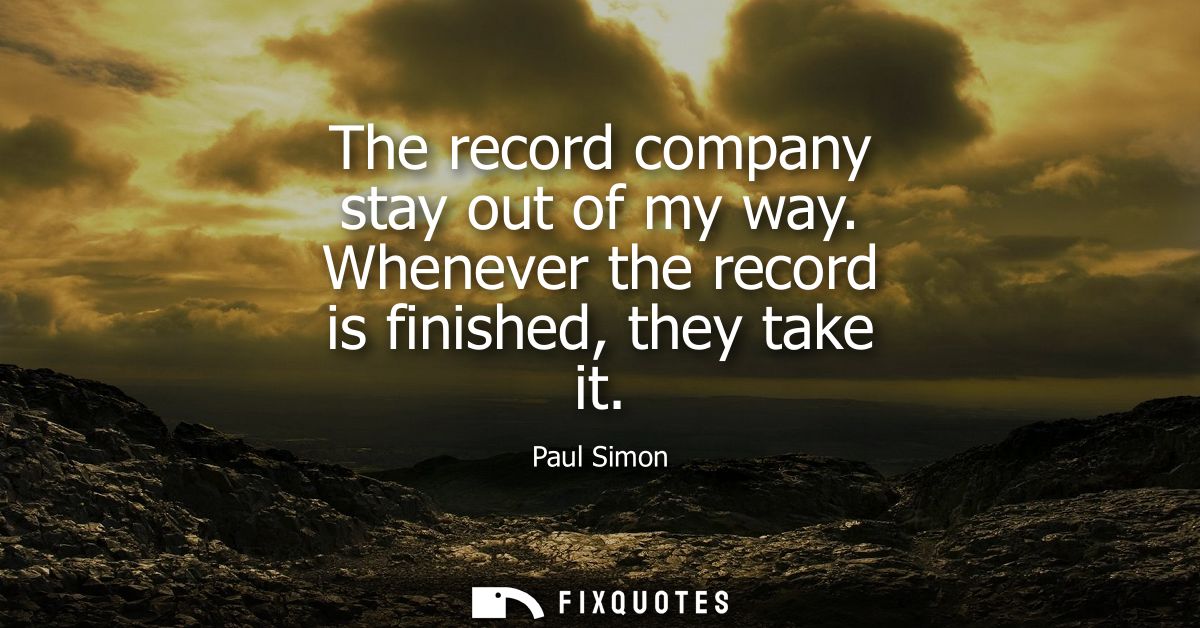
"The record company stay out of my way. Whenever the record is finished, they take it"
About this Quote
The intent is practical and political. Simon is signaling a workflow where the art leads and commerce follows. It’s also a flex of seniority: plenty of artists want labels out of the room; few can actually make that demand stick. The subtext is a critique of institutional meddling - A&R opinions, marketability notes, release-cycle anxieties - the subtle ways companies try to steer songs toward something safer and more sellable. Simon presents the opposite model: make the record, finish it on your terms, then let the machinery distribute it.
Context matters because Simon’s career sits at the crossroads of craft and commerce. He came up in an era when labels could be gatekeepers and taste-makers, then became a name big enough to flip that relationship. It’s not anti-business so much as pro-authorship: the record company gets the product, not the pen. In one blunt couplet, he describes the dream arrangement artists whisper about - and the reality only a few can negotiate.
Quote Details
| Topic | Music |
|---|---|
| Source | Help us find the source |
| Cite |
Citation Formats
APA Style (7th ed.)
Simon, Paul. (2026, January 16). The record company stay out of my way. Whenever the record is finished, they take it. FixQuotes. https://fixquotes.com/quotes/the-record-company-stay-out-of-my-way-whenever-108913/
Chicago Style
Simon, Paul. "The record company stay out of my way. Whenever the record is finished, they take it." FixQuotes. January 16, 2026. https://fixquotes.com/quotes/the-record-company-stay-out-of-my-way-whenever-108913/.
MLA Style (9th ed.)
"The record company stay out of my way. Whenever the record is finished, they take it." FixQuotes, 16 Jan. 2026, https://fixquotes.com/quotes/the-record-company-stay-out-of-my-way-whenever-108913/. Accessed 7 Apr. 2026.