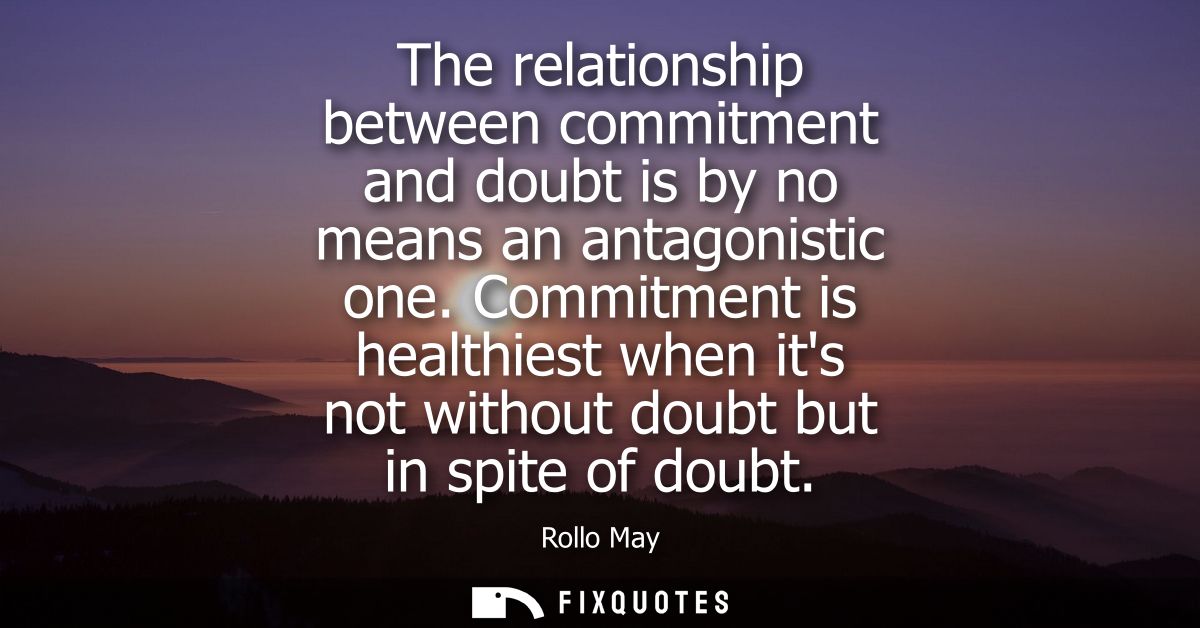
"The relationship between commitment and doubt is by no means an antagonistic one. Commitment is healthiest when it's not without doubt, but in spite of doubt"
About this Quote
The key move is the phrasing “not without doubt but in spite of doubt.” It’s a quiet rebuke to two cultural poses: the zealot who treats certainty as character, and the drifter who treats uncertainty as an excuse to never choose. May’s “in spite of” insists on agency. Commitment, for him, isn’t a mood or a guarantee; it’s an act you renew under pressure. Doubt provides friction, and friction proves the commitment is real rather than performative.
Subtext: a person who never doubts is often protecting something brittle - an identity, a belief, a relationship - from inspection. That kind of “commitment” can curdle into control, because certainty needs enforcement. By contrast, doubt functions like ventilation: it keeps devotion from becoming possession. In love, work, politics, faith, this frames maturity as the capacity to hold competing truths without collapsing into cynicism.
Contextually, May is speaking to modern anxiety: the demand to choose a path while knowing it may disappoint you. He offers a sturdier definition of health - not the absence of inner conflict, but the ability to commit while carrying it.
Quote Details
| Topic | Relationship |
|---|---|
| Source | Help us find the source |
| Cite |
Citation Formats
APA Style (7th ed.)
May, Rollo. (2026, February 20). The relationship between commitment and doubt is by no means an antagonistic one. Commitment is healthiest when it's not without doubt, but in spite of doubt. FixQuotes. https://fixquotes.com/quotes/the-relationship-between-commitment-and-doubt-is-3004/
Chicago Style
May, Rollo. "The relationship between commitment and doubt is by no means an antagonistic one. Commitment is healthiest when it's not without doubt, but in spite of doubt." FixQuotes. February 20, 2026. https://fixquotes.com/quotes/the-relationship-between-commitment-and-doubt-is-3004/.
MLA Style (9th ed.)
"The relationship between commitment and doubt is by no means an antagonistic one. Commitment is healthiest when it's not without doubt, but in spite of doubt." FixQuotes, 20 Feb. 2026, https://fixquotes.com/quotes/the-relationship-between-commitment-and-doubt-is-3004/. Accessed 25 Mar. 2026.