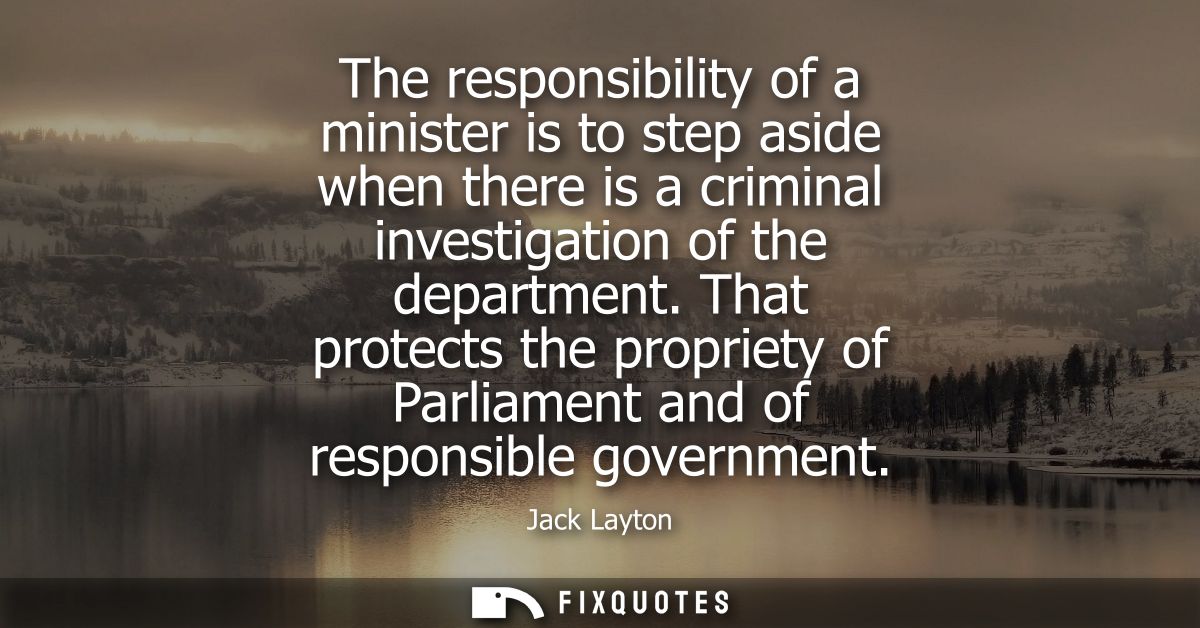
"The responsibility of a minister is to step aside when there is a criminal investigation of the department. That protects the propriety of Parliament and of responsible government"
About this Quote
The phrasing is doing quiet work. “Criminal investigation” is the alarm bell: not a partisan ethics spat, not a media storm, but the kind of scrutiny that can’t be spun away with talking points. Layton’s insistence that stepping aside “protects” Parliament is a rebuke to the modern instinct to treat resignation as surrender. He’s arguing the opposite: temporary withdrawal is an act of stewardship, a way of keeping Parliament from becoming a courtroom and the justice system from becoming a political weapon.
Then comes the real subtext: “propriety” and “responsible government” aren’t abstract ideals here; they’re shields against cynicism. Layton is staking out a standard meant to outlast the day’s scandal, telling voters that democratic legitimacy depends on leaders accepting constraints even when inconvenient. It’s also tactical opposition politics at its most effective: if the government refuses, it looks like it’s choosing self-preservation over the rules that justify its authority in the first place.
Quote Details
| Topic | Honesty & Integrity |
|---|---|
| Source | Help us find the source |
| Cite |
Citation Formats
APA Style (7th ed.)
Layton, Jack. (2026, January 15). The responsibility of a minister is to step aside when there is a criminal investigation of the department. That protects the propriety of Parliament and of responsible government. FixQuotes. https://fixquotes.com/quotes/the-responsibility-of-a-minister-is-to-step-aside-168927/
Chicago Style
Layton, Jack. "The responsibility of a minister is to step aside when there is a criminal investigation of the department. That protects the propriety of Parliament and of responsible government." FixQuotes. January 15, 2026. https://fixquotes.com/quotes/the-responsibility-of-a-minister-is-to-step-aside-168927/.
MLA Style (9th ed.)
"The responsibility of a minister is to step aside when there is a criminal investigation of the department. That protects the propriety of Parliament and of responsible government." FixQuotes, 15 Jan. 2026, https://fixquotes.com/quotes/the-responsibility-of-a-minister-is-to-step-aside-168927/. Accessed 15 Mar. 2026.