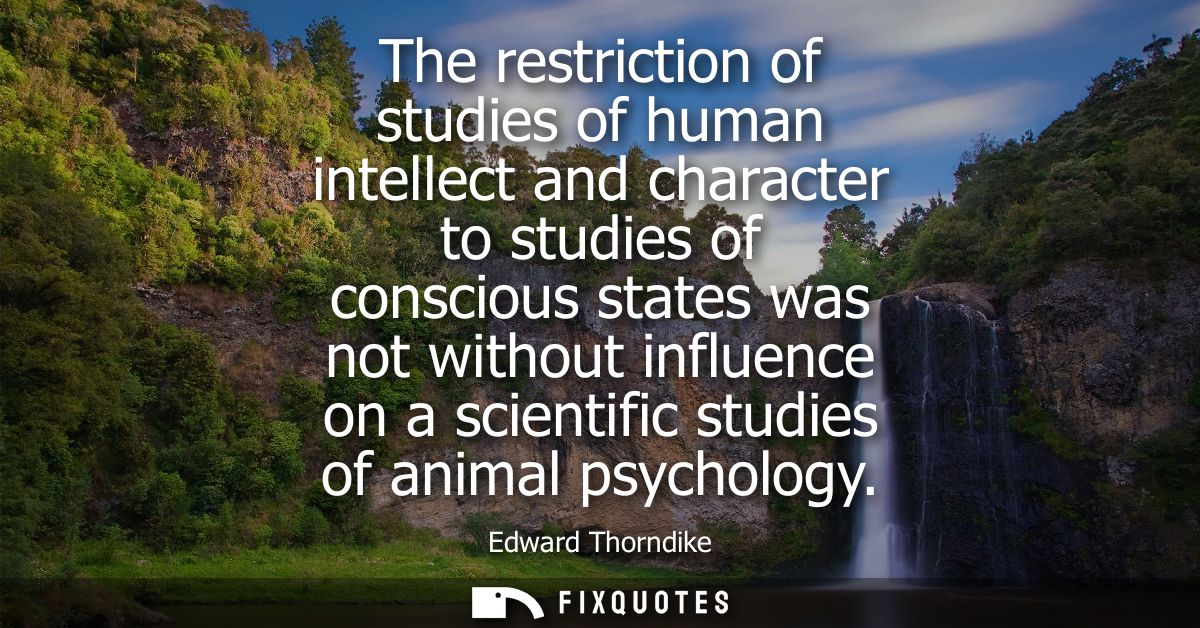
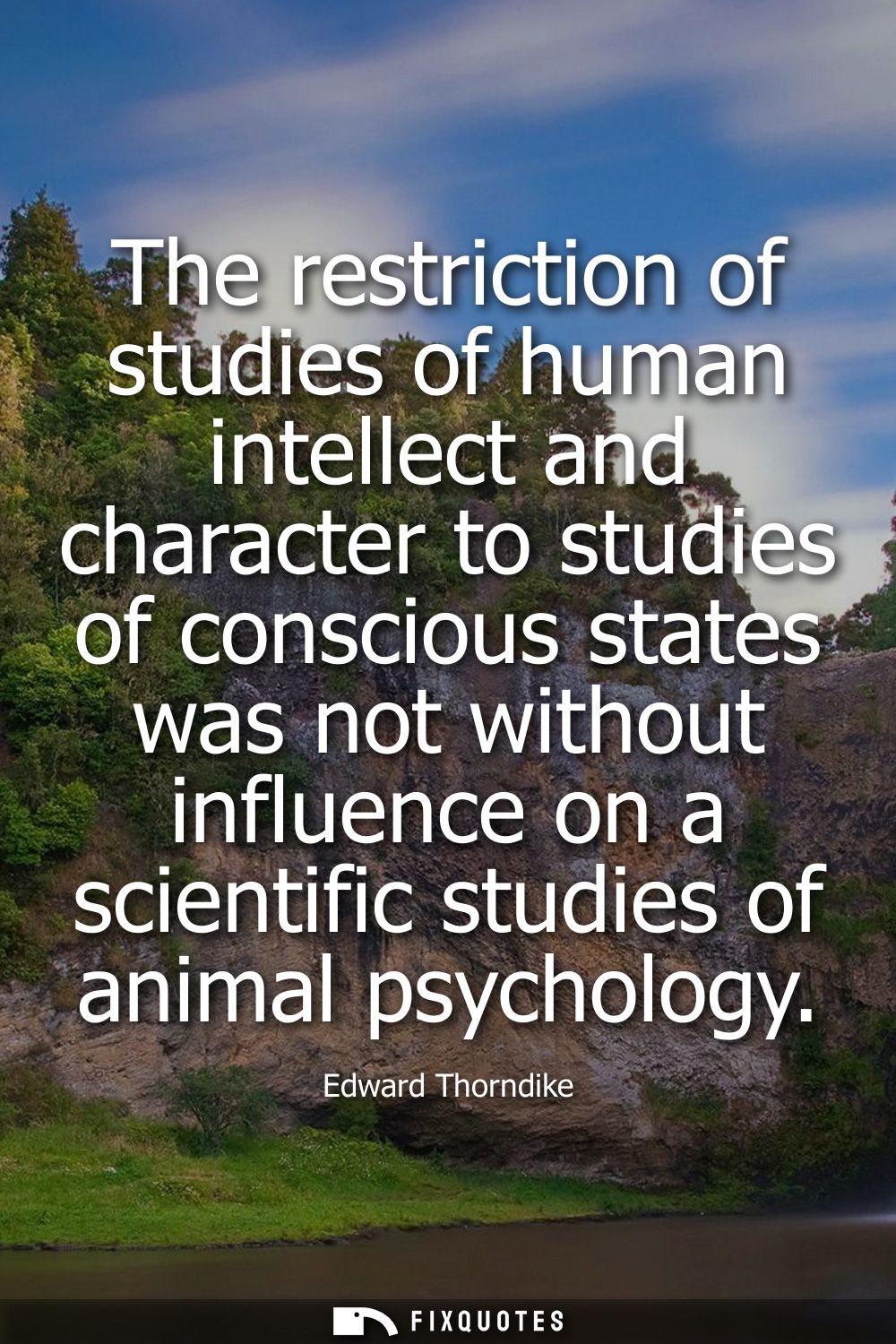
"The restriction of studies of human intellect and character to studies of conscious states was not without influence on a scientific studies of animal psychology"
About this Quote
The sentence’s craft is its understatement. “Not without influence” is academic restraint masking a sharper point: if you insist that psychology is the study of consciousness, then animal psychology becomes either impossible or forced into flimsy guesswork. You end up projecting human-like feelings onto animals (“the dog is jealous”) because you have no sanctioned way to talk about learning as observable change. Thorndike is signaling a pivot away from that cul-de-sac.
Subtextually, he’s also legitimizing his own program. Thorndike’s puzzle-box experiments and “law of effect” helped build behaviorism’s early foundations: a psychology grounded in measurable actions and consequences, not private experience. By framing human psychology’s introspective bias as shaping animal research, he implies that methodological choices are political choices inside a discipline: define the mind as consciousness and you crown the talkers; define it as learning and you can finally treat animals as proper scientific subjects.
Context matters because it’s a transitional moment. Thorndike writes at the hinge where psychology starts shedding philosophy’s parlor tools and building lab instruments. This line reads like a quiet manifesto for that turn.
Quote Details
| Topic | Science |
|---|---|
| Source | Help us find the source |
| Cite |
Citation Formats
APA Style (7th ed.)
Thorndike, Edward. (2026, January 16). The restriction of studies of human intellect and character to studies of conscious states was not without influence on a scientific studies of animal psychology. FixQuotes. https://fixquotes.com/quotes/the-restriction-of-studies-of-human-intellect-and-111767/
Chicago Style
Thorndike, Edward. "The restriction of studies of human intellect and character to studies of conscious states was not without influence on a scientific studies of animal psychology." FixQuotes. January 16, 2026. https://fixquotes.com/quotes/the-restriction-of-studies-of-human-intellect-and-111767/.
MLA Style (9th ed.)
"The restriction of studies of human intellect and character to studies of conscious states was not without influence on a scientific studies of animal psychology." FixQuotes, 16 Jan. 2026, https://fixquotes.com/quotes/the-restriction-of-studies-of-human-intellect-and-111767/. Accessed 31 Mar. 2026.