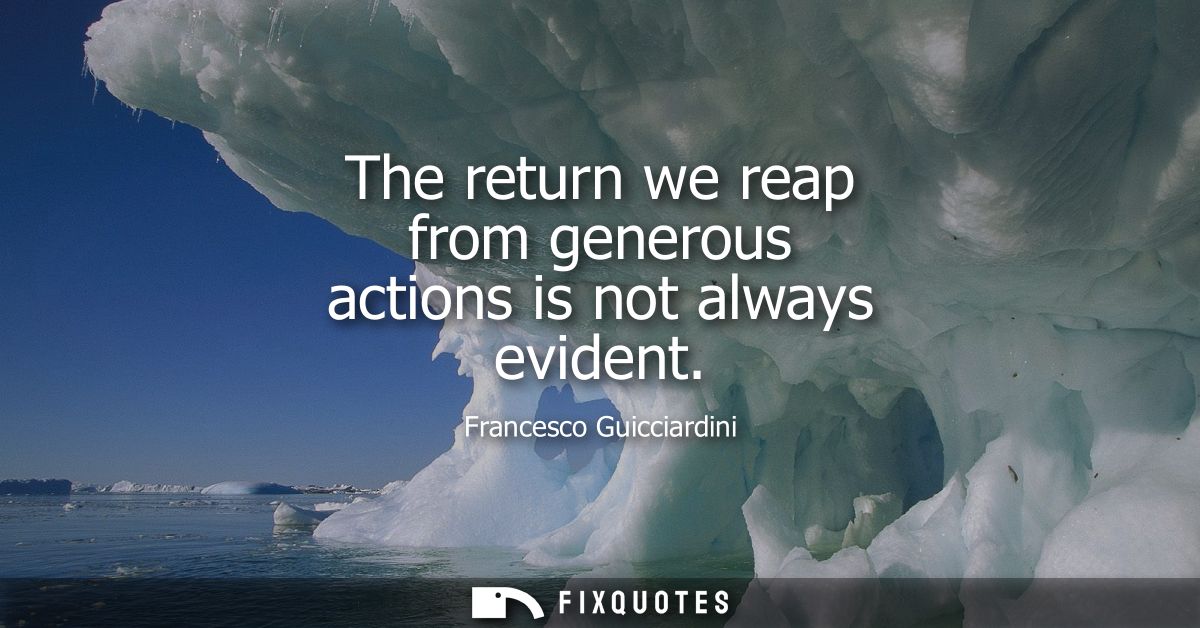
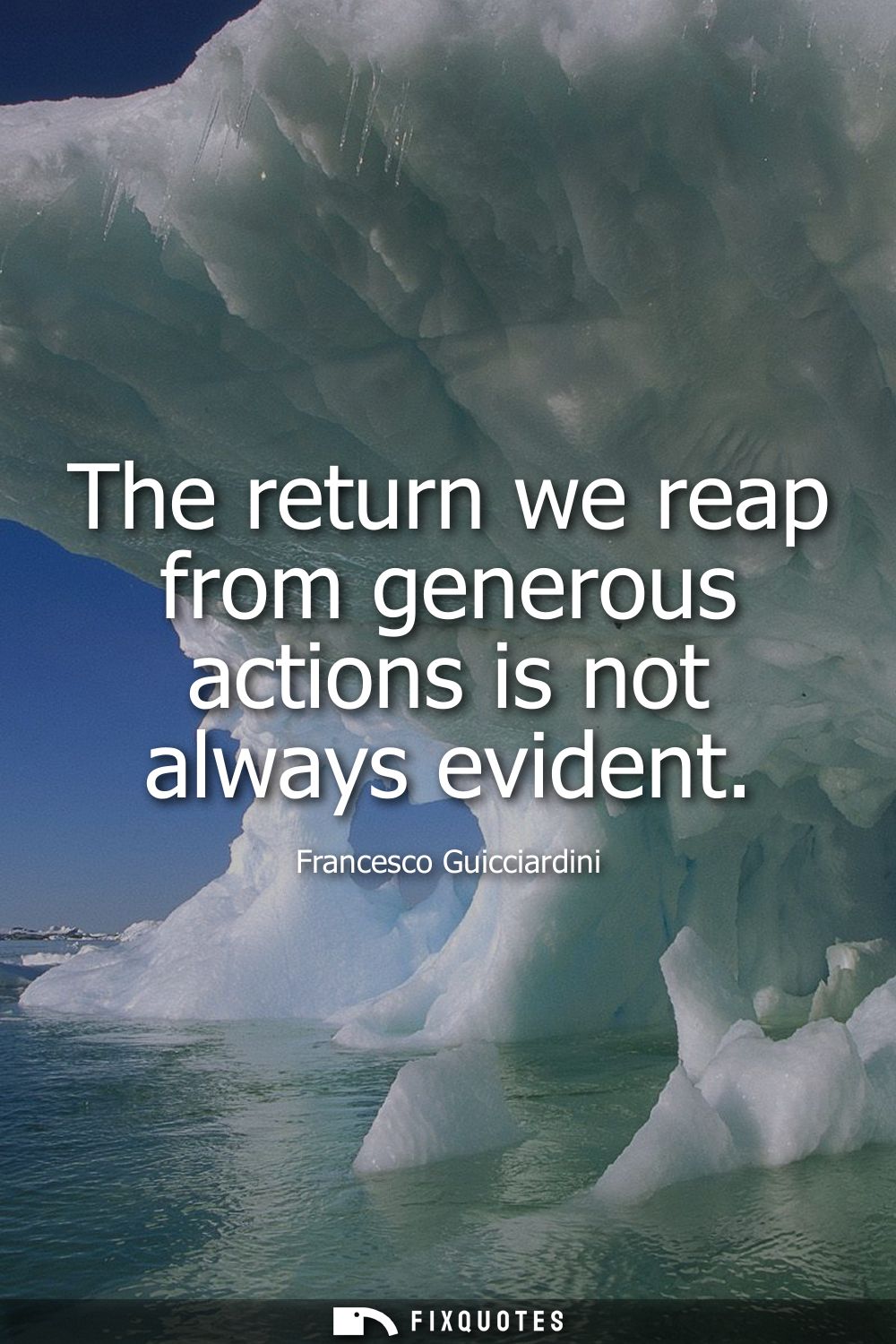
"The return we reap from generous actions is not always evident"
About this Quote
A Renaissance historian doesn’t offer generosity as a halo; he offers it as a wager with delayed, often invisible payoff. Guicciardini is writing from inside the Italian city-states, where patronage, favors, and alliances were the real currency and where “good deeds” routinely doubled as strategic positioning. In that world, the clean moral arithmetic people like to imagine - do good, receive good - collapses under politics, reputation, and time.
The sentence is engineered to puncture a comforting fantasy without fully surrendering to cynicism. “Return” is pointedly economic: generosity is treated like an investment, which immediately reframes virtue as something that operates in systems, not in private purity. Then comes the twist: the return is “not always evident.” He doesn’t deny that generosity pays off; he denies that it pays off on command, on schedule, or in ways the giver can reliably claim. The subtext is a warning against performative benevolence: if you’re being generous for applause, protection, or reciprocal favors, you will often feel cheated. The world doesn’t itemize gratitude.
It also reads as a kind of self-defense for public actors. In court and council, you may sponsor someone who later betrays you, bankroll a civic project that gets credited to a rival, or extend mercy that looks like weakness. Guicciardini’s intent is to train the reader’s expectations: generosity can be real and still be politically costly, misunderstood, or only legible years later as accumulated trust. The “not evident” is where history lives - consequences that only emerge in retrospect, when the ledger finally balances, or doesn’t.
The sentence is engineered to puncture a comforting fantasy without fully surrendering to cynicism. “Return” is pointedly economic: generosity is treated like an investment, which immediately reframes virtue as something that operates in systems, not in private purity. Then comes the twist: the return is “not always evident.” He doesn’t deny that generosity pays off; he denies that it pays off on command, on schedule, or in ways the giver can reliably claim. The subtext is a warning against performative benevolence: if you’re being generous for applause, protection, or reciprocal favors, you will often feel cheated. The world doesn’t itemize gratitude.
It also reads as a kind of self-defense for public actors. In court and council, you may sponsor someone who later betrays you, bankroll a civic project that gets credited to a rival, or extend mercy that looks like weakness. Guicciardini’s intent is to train the reader’s expectations: generosity can be real and still be politically costly, misunderstood, or only legible years later as accumulated trust. The “not evident” is where history lives - consequences that only emerge in retrospect, when the ledger finally balances, or doesn’t.
Quote Details
| Topic | Kindness |
|---|---|
| Source | Help us find the source |
| Cite |
Citation Formats
APA Style (7th ed.)
Guicciardini, Francesco. (2026, January 17). The return we reap from generous actions is not always evident. FixQuotes. https://fixquotes.com/quotes/the-return-we-reap-from-generous-actions-is-not-54181/
Chicago Style
Guicciardini, Francesco. "The return we reap from generous actions is not always evident." FixQuotes. January 17, 2026. https://fixquotes.com/quotes/the-return-we-reap-from-generous-actions-is-not-54181/.
MLA Style (9th ed.)
"The return we reap from generous actions is not always evident." FixQuotes, 17 Jan. 2026, https://fixquotes.com/quotes/the-return-we-reap-from-generous-actions-is-not-54181/. Accessed 11 Mar. 2026.
More Quotes by Francesco
Add to List