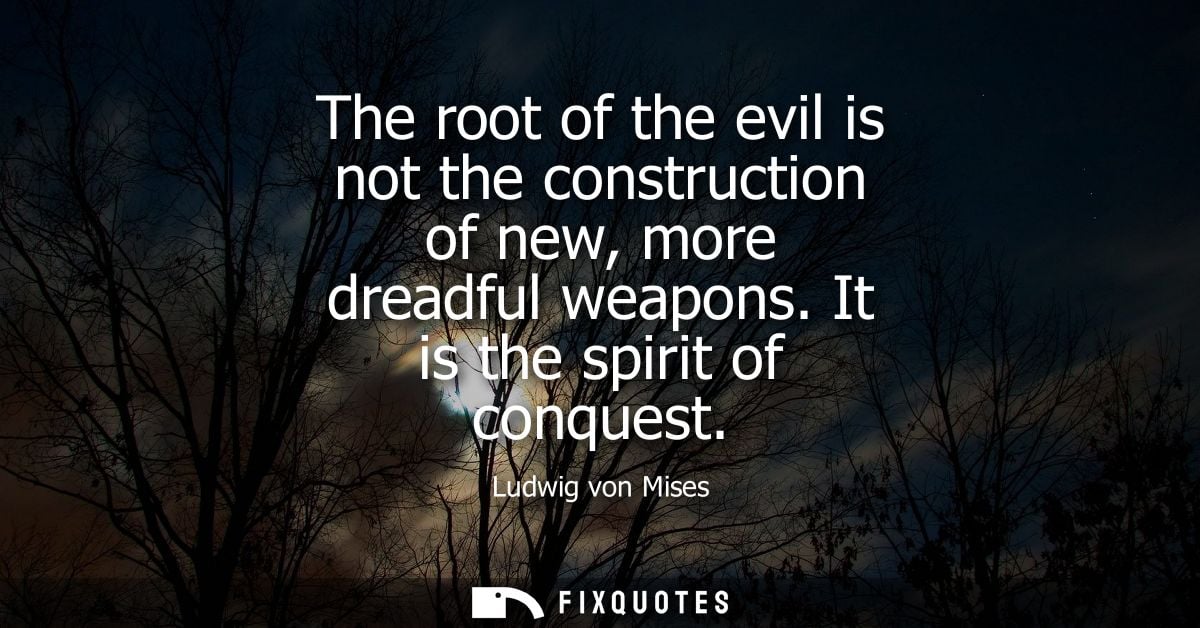
"The root of the evil is not the construction of new, more dreadful weapons. It is the spirit of conquest"
About this Quote
As an economist writing in the shadow of Europe’s catastrophes, Mises is also making an institutional argument. Conquest isn’t a mood; it’s a political project with incentives, propaganda, and payoffs. Empires don’t stumble into expansion because someone invented a better bomb. They cultivate a public appetite for domination, then justify the bill. That’s the subtext: disarmament treaties can cap arsenals, but they don’t cap motives. A society can dismantle a weapons program and still remain organized around grievance, entitlement, and the fantasy of zero-sum glory.
There’s an implicit rebuke here to technocratic fixes and moral outsourcing. If the problem is “dreadful weapons,” responsibility shifts to scientists and factories. If the problem is conquest, responsibility returns to leaders and citizens who reward it. Mises’ target is the militarized imagination: the belief that other peoples exist as resources, buffers, or trophies.
Quote Details
| Topic | Peace |
|---|---|
| Source | Help us find the source |
| Cite | Cite this Quote |
Citation Formats
APA Style (7th ed.)
Mises, Ludwig von. (n.d.). The root of the evil is not the construction of new, more dreadful weapons. It is the spirit of conquest. FixQuotes. https://fixquotes.com/quotes/the-root-of-the-evil-is-not-the-construction-of-148955/
Chicago Style
Mises, Ludwig von. "The root of the evil is not the construction of new, more dreadful weapons. It is the spirit of conquest." FixQuotes. Accessed February 1, 2026. https://fixquotes.com/quotes/the-root-of-the-evil-is-not-the-construction-of-148955/.
MLA Style (9th ed.)
"The root of the evil is not the construction of new, more dreadful weapons. It is the spirit of conquest." FixQuotes, https://fixquotes.com/quotes/the-root-of-the-evil-is-not-the-construction-of-148955/. Accessed 1 Feb. 2026.