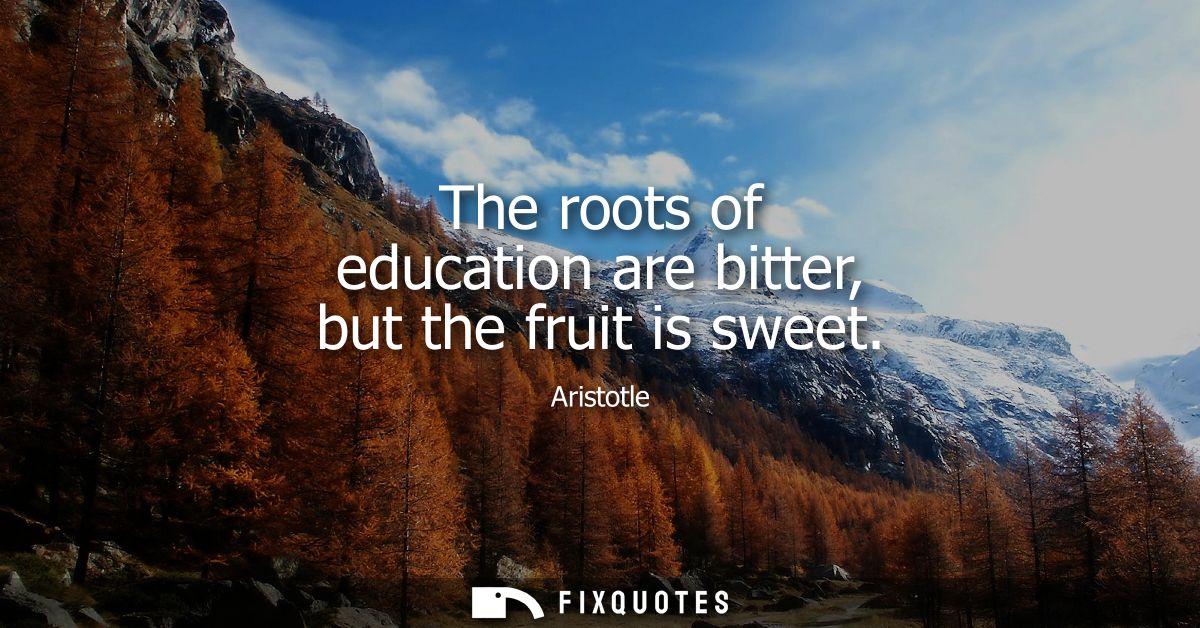
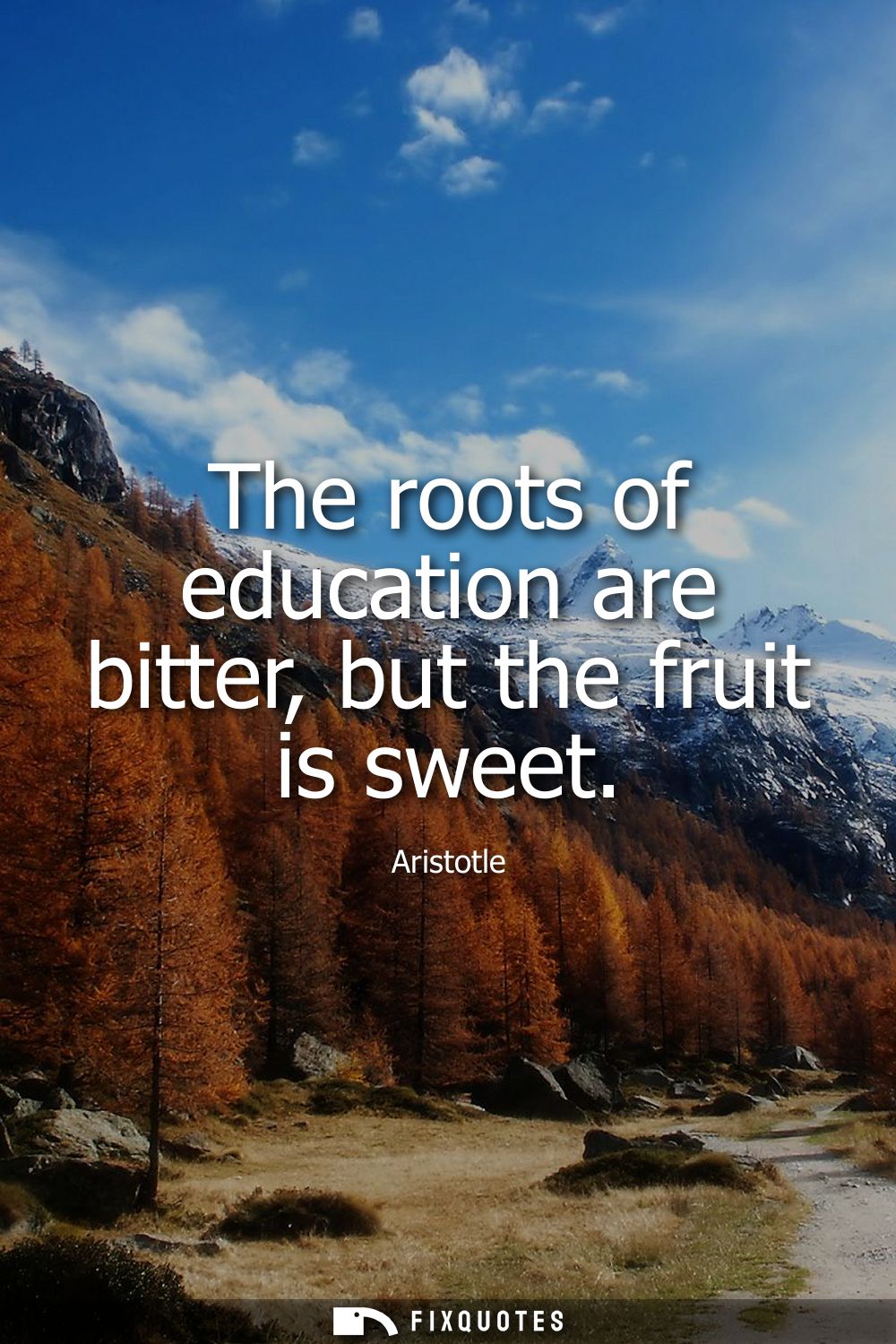
"The roots of education are bitter, but the fruit is sweet"
About this Quote
Education, for Aristotle, is not a lifestyle accessory. It is training: abrasive, repetitive, and often unpleasant in the moment, the way a regimen is unpleasant when it’s working. Calling the “roots” bitter is a deliberately bodily metaphor. Learning starts underground, in the dark parts of discipline: memorization, correction, embarrassment, the ego’s steady bruising as reality refuses to bend. He’s stripping away the romantic idea that knowledge arrives as inspiration. It arrives as effort.
The sweetness, importantly, is not just personal uplift. In Aristotle’s world, education is tied to telos: the purpose a thing is for. A citizen isn’t born ready for the polis; they’re cultivated into it. The “fruit” is competence, judgment, character - the capacity to deliberate well, to act virtuously, to be free in a meaningful sense. That’s why the metaphor matters. Fruit implies a harvest that can be shared: education yields private benefit, but it also feeds a public life.
The subtext is a rebuttal to impatience. Aristotle is writing against the temptation to treat early struggle as proof of failure. Bitter roots don’t mean the plant is wrong; bitterness is evidence of growth doing its unglamorous work. It’s also a quiet argument for hierarchy and guidance: roots need tending. Someone who already sees the fruit - the teacher, the legislator, the elder - is justified in demanding the grind from those who can’t yet taste the payoff.
The sweetness, importantly, is not just personal uplift. In Aristotle’s world, education is tied to telos: the purpose a thing is for. A citizen isn’t born ready for the polis; they’re cultivated into it. The “fruit” is competence, judgment, character - the capacity to deliberate well, to act virtuously, to be free in a meaningful sense. That’s why the metaphor matters. Fruit implies a harvest that can be shared: education yields private benefit, but it also feeds a public life.
The subtext is a rebuttal to impatience. Aristotle is writing against the temptation to treat early struggle as proof of failure. Bitter roots don’t mean the plant is wrong; bitterness is evidence of growth doing its unglamorous work. It’s also a quiet argument for hierarchy and guidance: roots need tending. Someone who already sees the fruit - the teacher, the legislator, the elder - is justified in demanding the grind from those who can’t yet taste the payoff.
Quote Details
| Topic | Study Motivation |
|---|---|
| Source | Later attribution: Aristotle (Aristotle) modern compilation
Evidence: diogenes laërtius the roots of education are bitter but the fruit is sweet i ha Other candidates (1) Lives of the Eminent Philosophers (Aristotle, 1925)50.0% “The roots of education,” he said, “are bitter, but the fruit is sweet.” (Book V (Aristotle), §18 (often cited as 5.1... |
| Cite |
Citation Formats
APA Style (7th ed.)
Aristotle. (2026, February 8). The roots of education are bitter, but the fruit is sweet. FixQuotes. https://fixquotes.com/quotes/the-roots-of-education-are-bitter-but-the-fruit-34527/
Chicago Style
Aristotle. "The roots of education are bitter, but the fruit is sweet." FixQuotes. February 8, 2026. https://fixquotes.com/quotes/the-roots-of-education-are-bitter-but-the-fruit-34527/.
MLA Style (9th ed.)
"The roots of education are bitter, but the fruit is sweet." FixQuotes, 8 Feb. 2026, https://fixquotes.com/quotes/the-roots-of-education-are-bitter-but-the-fruit-34527/. Accessed 7 Apr. 2026.
More Quotes by Aristotle
Add to List