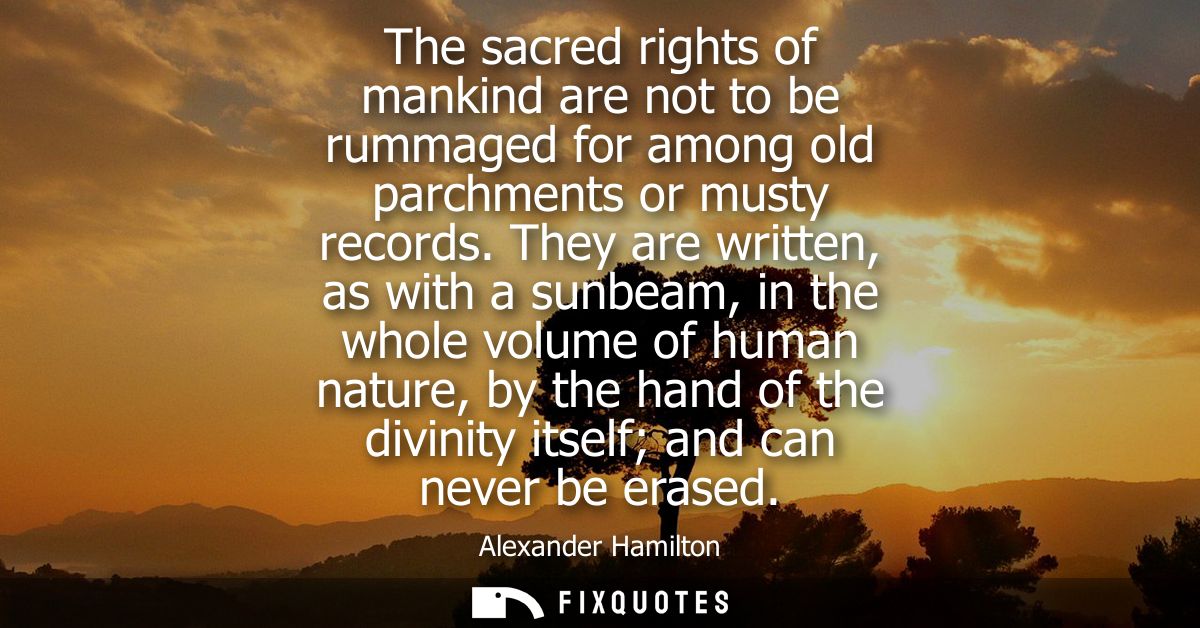
"The sacred rights of mankind are not to be rummaged for among old parchments or musty records. They are written, as with a sunbeam, in the whole volume of human nature, by the hand of the divinity itself; and can never be erased"
About this Quote
The line works because it pivots from the brittle authority of paperwork to something grander and harder to confiscate: human nature itself. "Written, as with a sunbeam" is Hamilton doing rhetorical theater with a purpose. Sunbeam suggests visibility and inevitability; you don’t debate it into existence, you notice it. That image also implies speed and clarity, a rebuke to the slow, self-serving procedures by which governments rationalize cruelty. Rights aren’t a privilege granted after review. They’re obvious in the way daylight is obvious.
The theological language is doing political work. By crediting "the hand of the divinity", Hamilton anchors rights above any king, parliament, or court. In the revolutionary era, that’s a tactical elevation: if rights come from God (or nature’s God), no earthly institution can legitimately revoke them. The subtext is insurgent but disciplined: revolution isn’t lawless, it’s obedience to a higher law when human law becomes an instrument of domination.
Context matters: Hamilton is speaking from a world where British constitutional tradition and precedent were constantly invoked to narrow colonial claims. His retort is that freedom isn’t a footnote. It’s the text.
Quote Details
| Topic | Human Rights |
|---|---|
| Source | Alexander Hamilton, 'The Federalist No. 84' (The New York Packet, July 16, 1788) — passage: 'The sacred rights of mankind... can never be erased.' |
| Cite |
Citation Formats
APA Style (7th ed.)
Hamilton, Alexander. (2026, January 15). The sacred rights of mankind are not to be rummaged for among old parchments or musty records. They are written, as with a sunbeam, in the whole volume of human nature, by the hand of the divinity itself; and can never be erased. FixQuotes. https://fixquotes.com/quotes/the-sacred-rights-of-mankind-are-not-to-be-28160/
Chicago Style
Hamilton, Alexander. "The sacred rights of mankind are not to be rummaged for among old parchments or musty records. They are written, as with a sunbeam, in the whole volume of human nature, by the hand of the divinity itself; and can never be erased." FixQuotes. January 15, 2026. https://fixquotes.com/quotes/the-sacred-rights-of-mankind-are-not-to-be-28160/.
MLA Style (9th ed.)
"The sacred rights of mankind are not to be rummaged for among old parchments or musty records. They are written, as with a sunbeam, in the whole volume of human nature, by the hand of the divinity itself; and can never be erased." FixQuotes, 15 Jan. 2026, https://fixquotes.com/quotes/the-sacred-rights-of-mankind-are-not-to-be-28160/. Accessed 19 Mar. 2026.