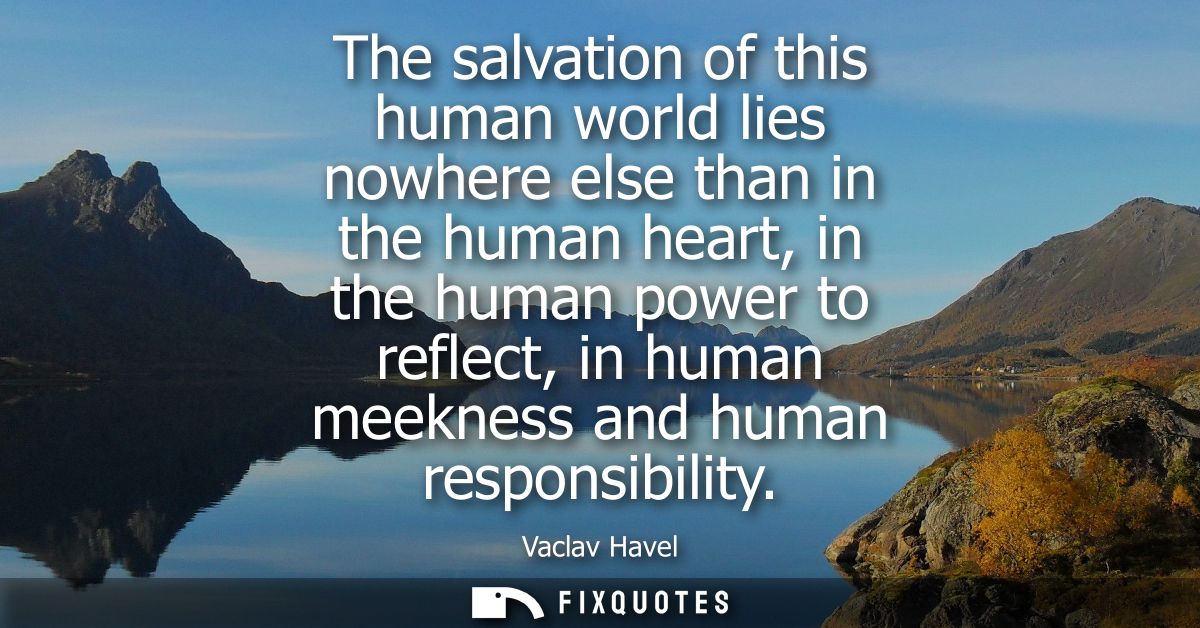
"The salvation of this human world lies nowhere else than in the human heart, in the human power to reflect, in human meekness and human responsibility"
About this Quote
The triad he builds is quietly strategic. “The human power to reflect” elevates thinking beyond mere intellect; it’s moral self-audit, the capacity to notice when we’re lying to ourselves and calling it realism. “Meekness” is the surprising word, and it’s doing the most work. For a political leader, meekness reads as a counter-virtue to the swagger of power: humility before complexity, restraint in the face of revenge, the refusal to treat opponents as disposable. It’s also an anti-totalitarian posture - the opposite of certainty.
Then comes “responsibility,” Havel’s core obsession: the idea that freedom without accountability curdles into vanity. The subtext is that modern catastrophes aren’t only caused by villains; they’re enabled by ordinary people surrendering their agency, one rationalization at a time. Contextually, this is post-occupation, post-propaganda Central Europe speaking, where “truth” was not a concept but a daily risk. Havel isn’t romanticizing the heart; he’s demanding it.
Quote Details
| Topic | Ethics & Morality |
|---|---|
| Source | Help us find the source |
| Cite |
Citation Formats
APA Style (7th ed.)
Havel, Vaclav. (2026, January 15). The salvation of this human world lies nowhere else than in the human heart, in the human power to reflect, in human meekness and human responsibility. FixQuotes. https://fixquotes.com/quotes/the-salvation-of-this-human-world-lies-nowhere-66299/
Chicago Style
Havel, Vaclav. "The salvation of this human world lies nowhere else than in the human heart, in the human power to reflect, in human meekness and human responsibility." FixQuotes. January 15, 2026. https://fixquotes.com/quotes/the-salvation-of-this-human-world-lies-nowhere-66299/.
MLA Style (9th ed.)
"The salvation of this human world lies nowhere else than in the human heart, in the human power to reflect, in human meekness and human responsibility." FixQuotes, 15 Jan. 2026, https://fixquotes.com/quotes/the-salvation-of-this-human-world-lies-nowhere-66299/. Accessed 31 Mar. 2026.