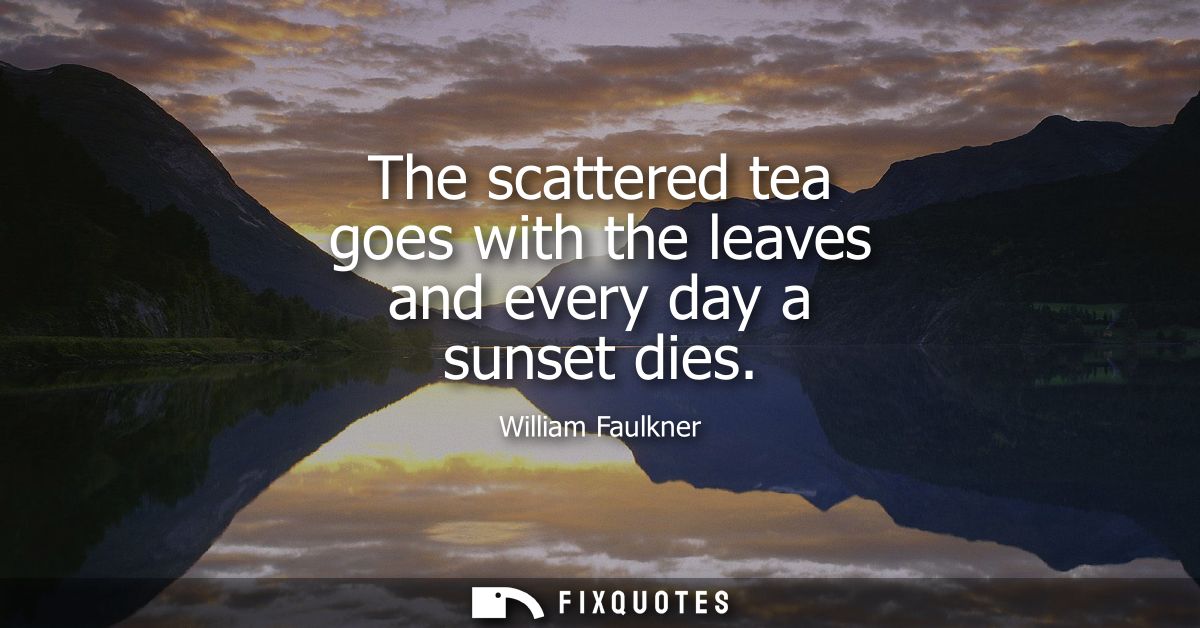
"The scattered tea goes with the leaves, and every day a sunset dies"
About this Quote
The phrasing is deceptively plain. "Goes with" is the key sleight of hand. It makes the tea less a thing to be cleaned up than a thing already claimed by the world outside, as if entropy has jurisdiction over both kitchen and landscape. The tea doesn't just fall; it joins "the leaves", folding into the seasonal cycle of shedding, rot, and return. That coupling dissolves the boundary between interior life and the indifferent South Faulkner keeps circling: porches, yards, weather, and the long, slow decay of old arrangements.
Then he lands the brutal aphorism: "every day a sunset dies". Faulkner could have written "ends" or "passes". He chooses "dies", forcing you to feel the daily close of light as an extinction, not a routine. The subtext is grief with no ceremony, the way loss becomes ordinary when it repeats. In Faulkner's world, time isn't a neutral backdrop; it's an engine of diminishment. This line doesn't romanticize twilight. It accuses it, quietly, of being the most consistent executioner we ever meet.
Quote Details
| Topic | Mortality |
|---|---|
| Source | Help us find the source |
| Cite |
Citation Formats
APA Style (7th ed.)
Faulkner, William. (2026, February 16). The scattered tea goes with the leaves, and every day a sunset dies. FixQuotes. https://fixquotes.com/quotes/the-scattered-tea-goes-with-the-leaves-and-every-11198/
Chicago Style
Faulkner, William. "The scattered tea goes with the leaves, and every day a sunset dies." FixQuotes. February 16, 2026. https://fixquotes.com/quotes/the-scattered-tea-goes-with-the-leaves-and-every-11198/.
MLA Style (9th ed.)
"The scattered tea goes with the leaves, and every day a sunset dies." FixQuotes, 16 Feb. 2026, https://fixquotes.com/quotes/the-scattered-tea-goes-with-the-leaves-and-every-11198/. Accessed 31 Mar. 2026.