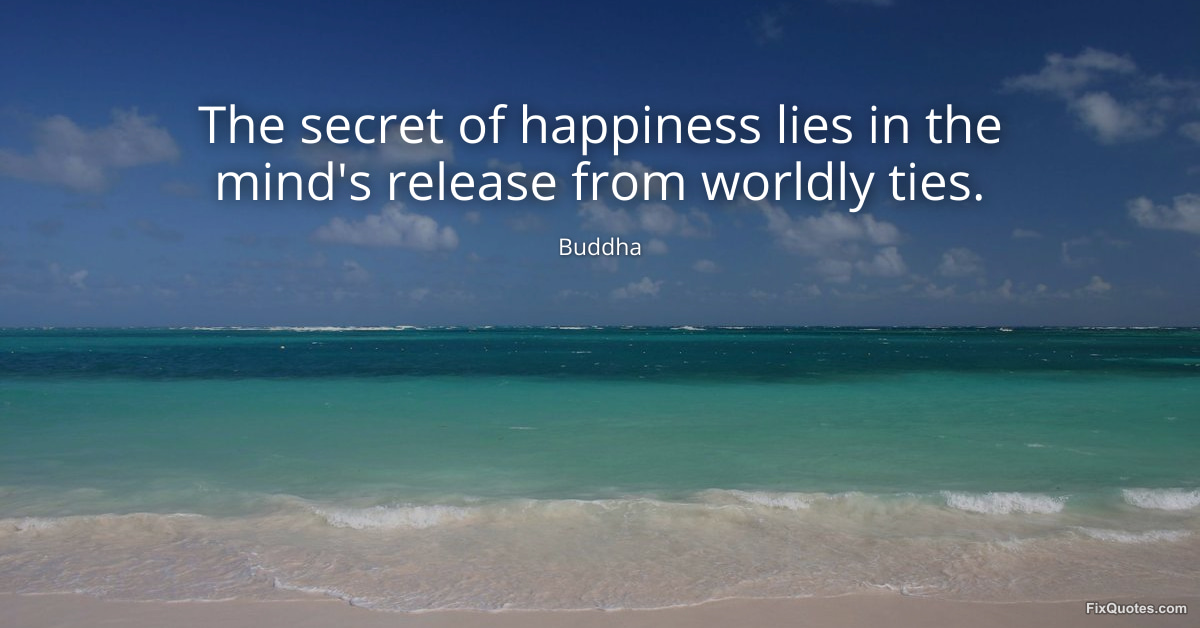
"The secret of happiness lies in the mind's release from worldly ties"
About this Quote
What gives this line its force is how bluntly it overturns ordinary ambition. Most moral systems try to discipline desire; Buddha goes deeper and treats desire itself, and the attachments wrapped around it, as the engine of suffering. "Worldly ties" is not just wealth or status. It includes the entire sticky architecture of craving: possessions, reputation, romantic fixation, even the fantasy that the self can secure lasting satisfaction from unstable things. Happiness, in that frame, is not something acquired. It appears when the mind stops clutching.
That reversal matters in the historical context of early Buddhism. In a culture shaped by ritual, hierarchy, and competing paths to spiritual authority, Buddha's teaching redirected attention inward, toward mental practice and liberation from attachment. The point was not social dropout nihilism or contempt for life. It was diagnosis. Human beings suffer because they misread impermanence as something they can outwit. We keep bargaining with change, then act surprised when change wins.
The subtext is severe but oddly liberating: the prison is cognitive before it is material. You do not need to own much to be owned by it. You do not need power to be trapped by the need for it. That is why the line still lands in a culture built on monetizing restlessness. It challenges the modern promise that better consumption, better branding, better optimization will finally calm the mind. Buddha's answer is harsher and cleaner: peace begins where possession, ego, and endless wanting loosen their grip.
That reversal matters in the historical context of early Buddhism. In a culture shaped by ritual, hierarchy, and competing paths to spiritual authority, Buddha's teaching redirected attention inward, toward mental practice and liberation from attachment. The point was not social dropout nihilism or contempt for life. It was diagnosis. Human beings suffer because they misread impermanence as something they can outwit. We keep bargaining with change, then act surprised when change wins.
The subtext is severe but oddly liberating: the prison is cognitive before it is material. You do not need to own much to be owned by it. You do not need power to be trapped by the need for it. That is why the line still lands in a culture built on monetizing restlessness. It challenges the modern promise that better consumption, better branding, better optimization will finally calm the mind. Buddha's answer is harsher and cleaner: peace begins where possession, ego, and endless wanting loosen their grip.
Quote Details
| Topic | Happiness |
|---|---|
| Source | Help us find the source |
| Cite |
Citation Formats
APA Style (7th ed.)
Buddha. (2026, March 10). The secret of happiness lies in the mind's release from worldly ties. FixQuotes. https://fixquotes.com/quotes/the-secret-of-happiness-lies-in-the-minds-release-185905/
Chicago Style
Buddha. "The secret of happiness lies in the mind's release from worldly ties." FixQuotes. March 10, 2026. https://fixquotes.com/quotes/the-secret-of-happiness-lies-in-the-minds-release-185905/.
MLA Style (9th ed.)
"The secret of happiness lies in the mind's release from worldly ties." FixQuotes, 10 Mar. 2026, https://fixquotes.com/quotes/the-secret-of-happiness-lies-in-the-minds-release-185905/. Accessed 25 Mar. 2026.
More Quotes by Buddha
Add to List