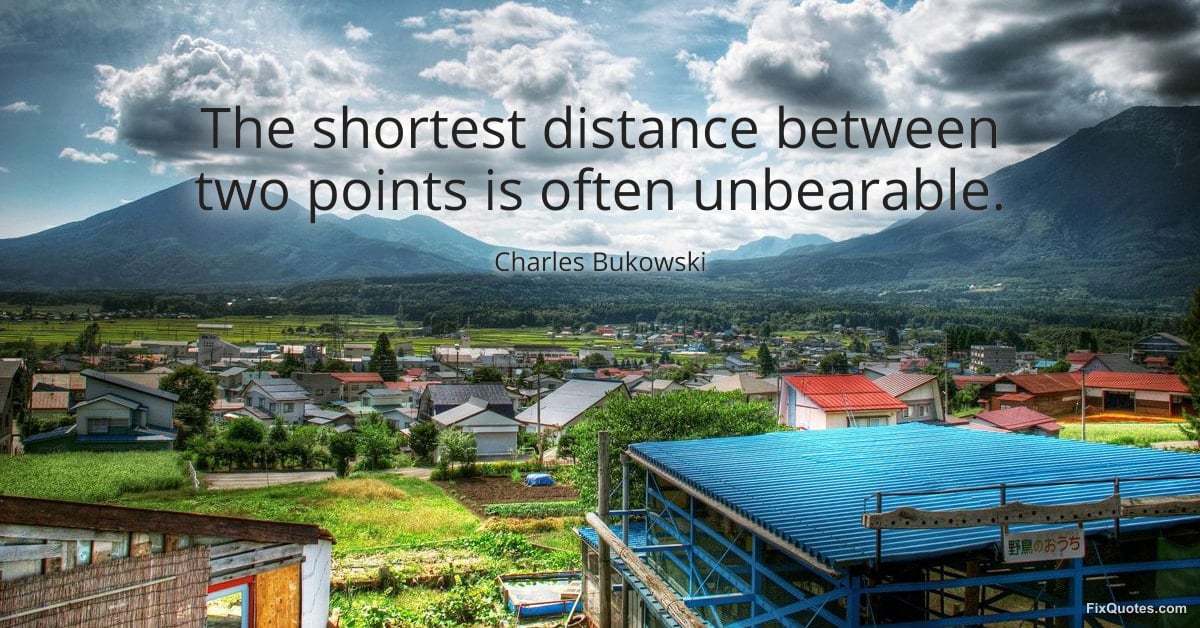
"The shortest distance between two points is often unbearable"
About this Quote
Bukowski takes a piece of clean Euclidean certainty and drags it through the gutter. The “shortest distance” is supposed to be elegant: a straight line, no wasted motion, the rational route between Point A and Point B. He snaps that comforting idea in half with “often unbearable”, a word that isn’t philosophical so much as physical. It suggests nerves exposed, skin rubbed raw. The line may be shortest, but it’s also the one that forces you to feel everything you’ve been avoiding.
The intent is anti-self-help, anti-optimization. Bukowski’s world is full of people trying to hustle their way past pain: drink it down, joke it off, work through it, numb it. Here, he admits what that posture denies: the direct route - honesty, sobriety, intimacy, grief without detours - can be the most punishing. Detours aren’t always cowardice; sometimes they’re how a person stays functional. The subtext is a bitter little defense of coping mechanisms, even the ugly ones, because the clean path demands a kind of emotional cash payment most people can’t afford upfront.
Context matters: Bukowski wrote from a persona built on bluntness and self-inflicted damage, but also on a suspicious respect for truth when it hurts. He’s not romanticizing suffering; he’s accusing simplicity of being a lie. Straight lines look good on paper. In lived experience, they slice.
The intent is anti-self-help, anti-optimization. Bukowski’s world is full of people trying to hustle their way past pain: drink it down, joke it off, work through it, numb it. Here, he admits what that posture denies: the direct route - honesty, sobriety, intimacy, grief without detours - can be the most punishing. Detours aren’t always cowardice; sometimes they’re how a person stays functional. The subtext is a bitter little defense of coping mechanisms, even the ugly ones, because the clean path demands a kind of emotional cash payment most people can’t afford upfront.
Context matters: Bukowski wrote from a persona built on bluntness and self-inflicted damage, but also on a suspicious respect for truth when it hurts. He’s not romanticizing suffering; he’s accusing simplicity of being a lie. Straight lines look good on paper. In lived experience, they slice.
Quote Details
| Topic | Deep |
|---|---|
| Source | Later attribution: Functional Anatomy of Movement (James Earls, 2025) modern compilationISBN: 9781718255456 · ID: df2iEQAAQBAJ
Evidence:
... The shortest distance between two points is often unbearable. —Charles Bukowski “Sagittal” has the same root as “Sagittarius,” from the Latin for arrow. Although its etymology might go back earlier, adoption of the term into anatomy ... |
| Cite |
Citation Formats
APA Style (7th ed.)
Bukowski, Charles. (2026, March 23). The shortest distance between two points is often unbearable. FixQuotes. https://fixquotes.com/quotes/the-shortest-distance-between-two-points-is-often-185222/
Chicago Style
Bukowski, Charles. "The shortest distance between two points is often unbearable." FixQuotes. March 23, 2026. https://fixquotes.com/quotes/the-shortest-distance-between-two-points-is-often-185222/.
MLA Style (9th ed.)
"The shortest distance between two points is often unbearable." FixQuotes, 23 Mar. 2026, https://fixquotes.com/quotes/the-shortest-distance-between-two-points-is-often-185222/. Accessed 27 Mar. 2026.
More Quotes by Charles
Add to List