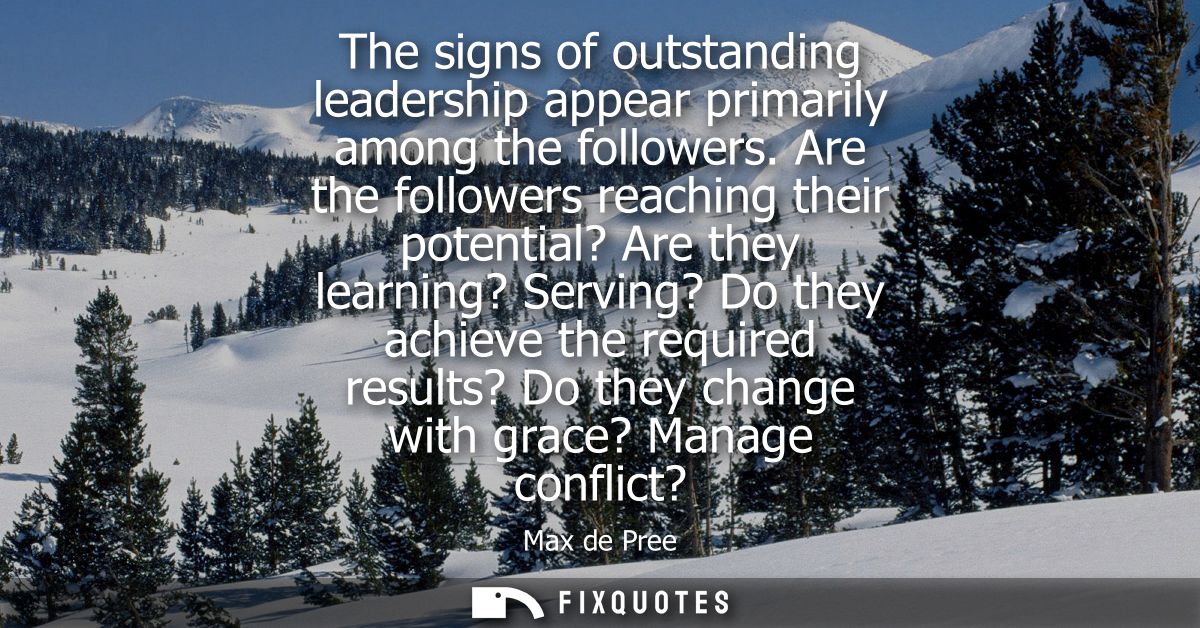
"The signs of outstanding leadership appear primarily among the followers. Are the followers reaching their potential? Are they learning? Serving? Do they achieve the required results? Do they change with grace? Manage conflict?"
About this Quote
The questions do the heavy lifting. “Reaching their potential” and “learning” signal a long-view commitment that clashes with quarterly thinking; leadership is measured in capacity built, not applause collected. “Serving” is the quiet provocation: in a business context, it smuggles in a moral standard that can’t be reduced to metrics, suggesting that organizations deform people when they treat them as inputs. Then de Pree snaps back to pragmatism: “required results.” He’s not letting leaders hide behind benevolence. Nurture without delivery is indulgence; delivery without nurture is extraction.
“Change with grace” and “manage conflict” reveal the real subtext: the leader’s job is to build social technology. Grace isn’t softness; it’s resilience without cruelty, adaptability without panic. Conflict management implies psychological safety and clear power dynamics - a place where disagreement doesn’t become character assassination or silent sabotage.
De Pree’s context matters. Writing out of late-20th-century American management, he offers an alternative to command-and-control: leadership as stewardship, where the leader’s legacy isn’t a market win but a better, more capable set of people left behind.
Quote Details
| Topic | Servant Leadership |
|---|---|
| Source | Help us find the source |
| Cite |
Citation Formats
APA Style (7th ed.)
Pree, Max de. (2026, January 16). The signs of outstanding leadership appear primarily among the followers. Are the followers reaching their potential? Are they learning? Serving? Do they achieve the required results? Do they change with grace? Manage conflict? FixQuotes. https://fixquotes.com/quotes/the-signs-of-outstanding-leadership-appear-92556/
Chicago Style
Pree, Max de. "The signs of outstanding leadership appear primarily among the followers. Are the followers reaching their potential? Are they learning? Serving? Do they achieve the required results? Do they change with grace? Manage conflict?" FixQuotes. January 16, 2026. https://fixquotes.com/quotes/the-signs-of-outstanding-leadership-appear-92556/.
MLA Style (9th ed.)
"The signs of outstanding leadership appear primarily among the followers. Are the followers reaching their potential? Are they learning? Serving? Do they achieve the required results? Do they change with grace? Manage conflict?" FixQuotes, 16 Jan. 2026, https://fixquotes.com/quotes/the-signs-of-outstanding-leadership-appear-92556/. Accessed 4 Apr. 2026.