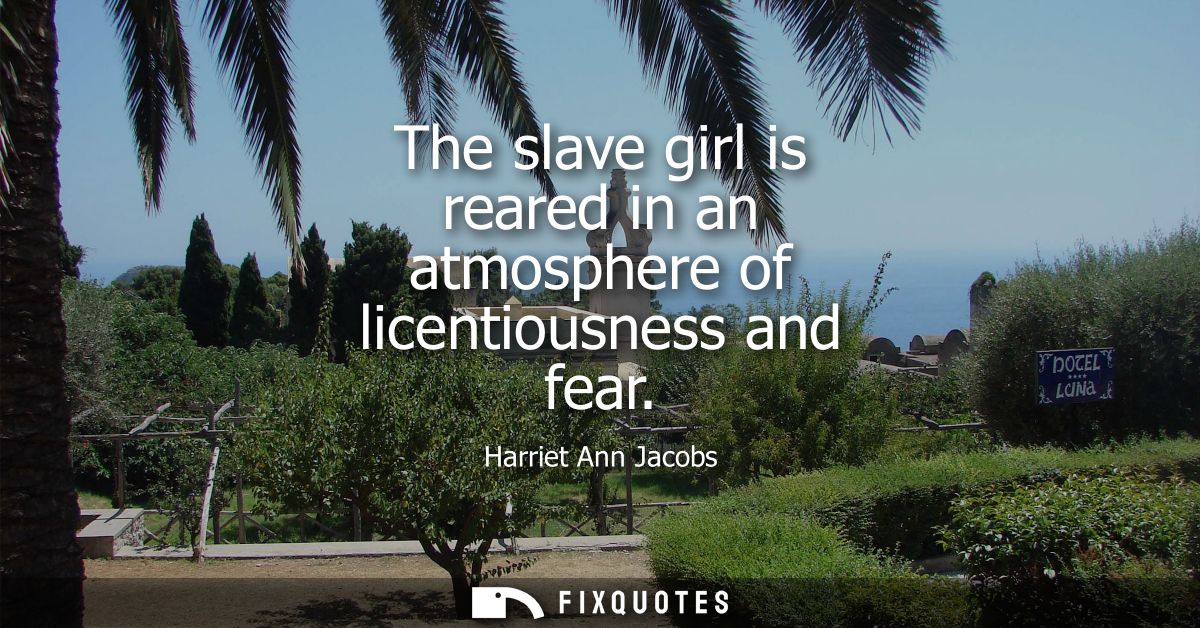
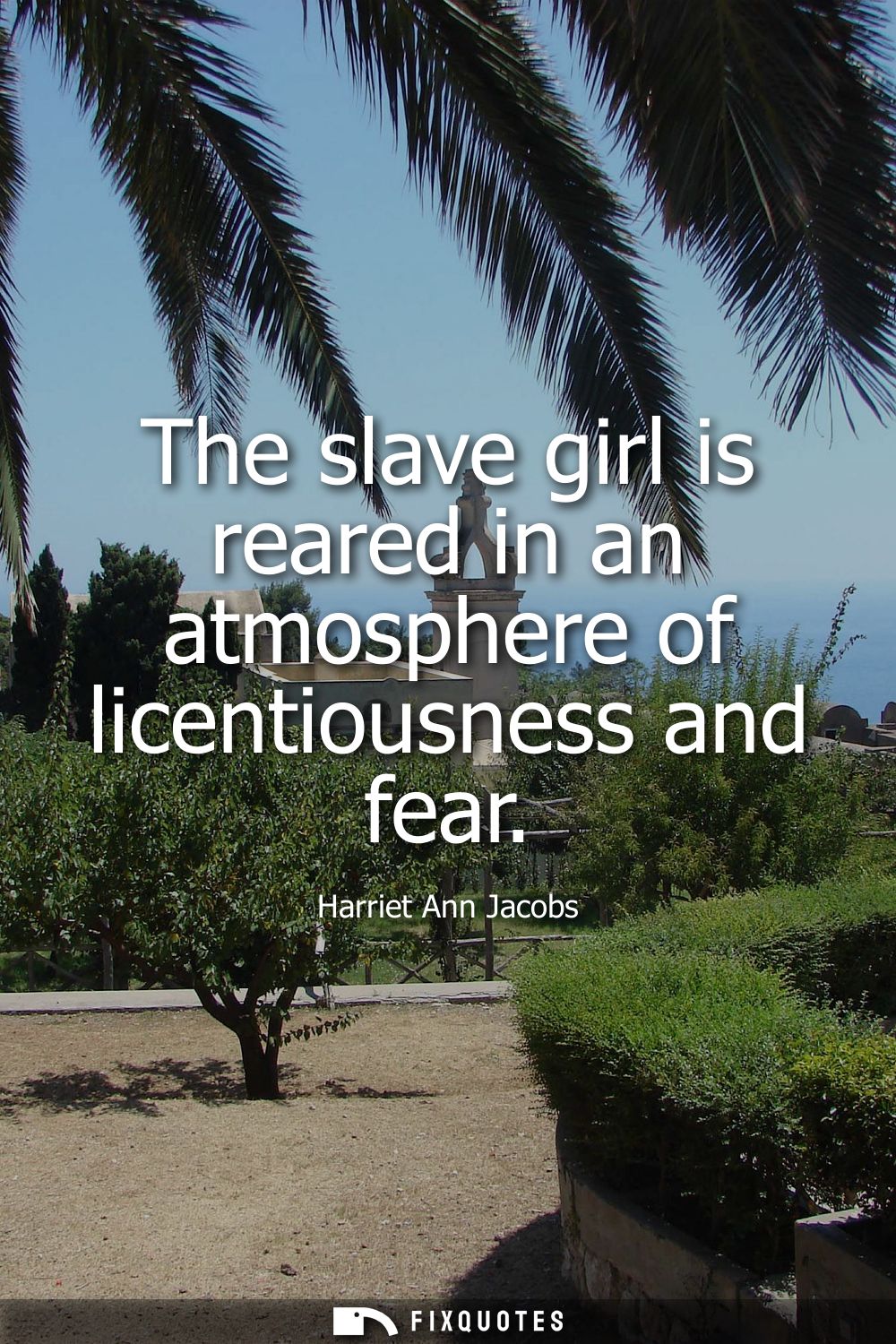
"The slave girl is reared in an atmosphere of licentiousness and fear"
About this Quote
Jacobs delivers the line like a quiet indictment, and its power comes from how efficiently it collapses two respectable-looking myths: that slavery was mainly about labor, and that Southern “morality” had any real standing. “Reared” is the key verb. It suggests childhood, formation, the long slow shaping of a person before she has language for what’s being done to her. Slavery, Jacobs implies, doesn’t merely exploit; it manufactures vulnerability as a condition of growing up.
Pairing “licentiousness” with “fear” is also a tactical move. Nineteenth-century readers understood licentiousness as sexual disorder, a failure of virtue. Jacobs uses that moral vocabulary, but she redirects blame away from the enslaved and toward the system that forces sexual exposure, coercion, and surveillance into the ordinary air a girl breathes. The subtext is blunt: the “promiscuity” slaveholders accused Black women of was often the byproduct of white male power and the absence of bodily autonomy. Fear isn’t incidental; it’s the management tool that keeps this sexual economy running.
Context matters. In Incidents in the Life of a Slave Girl, Jacobs writes to Northern women who might be moved by sentimental narratives of purity, family, and domestic security. She leverages those ideals not to flatter them, but to corner them: if you care about womanhood, you cannot look away from a regime that turns girlhood into a battlefield. The sentence is spare, but it drags an entire social order into court.
Pairing “licentiousness” with “fear” is also a tactical move. Nineteenth-century readers understood licentiousness as sexual disorder, a failure of virtue. Jacobs uses that moral vocabulary, but she redirects blame away from the enslaved and toward the system that forces sexual exposure, coercion, and surveillance into the ordinary air a girl breathes. The subtext is blunt: the “promiscuity” slaveholders accused Black women of was often the byproduct of white male power and the absence of bodily autonomy. Fear isn’t incidental; it’s the management tool that keeps this sexual economy running.
Context matters. In Incidents in the Life of a Slave Girl, Jacobs writes to Northern women who might be moved by sentimental narratives of purity, family, and domestic security. She leverages those ideals not to flatter them, but to corner them: if you care about womanhood, you cannot look away from a regime that turns girlhood into a battlefield. The sentence is spare, but it drags an entire social order into court.
Quote Details
| Topic | Human Rights |
|---|---|
| Source | Help us find the source |
| Cite |
Citation Formats
APA Style (7th ed.)
Jacobs, Harriet Ann. (2026, January 15). The slave girl is reared in an atmosphere of licentiousness and fear. FixQuotes. https://fixquotes.com/quotes/the-slave-girl-is-reared-in-an-atmosphere-of-62672/
Chicago Style
Jacobs, Harriet Ann. "The slave girl is reared in an atmosphere of licentiousness and fear." FixQuotes. January 15, 2026. https://fixquotes.com/quotes/the-slave-girl-is-reared-in-an-atmosphere-of-62672/.
MLA Style (9th ed.)
"The slave girl is reared in an atmosphere of licentiousness and fear." FixQuotes, 15 Jan. 2026, https://fixquotes.com/quotes/the-slave-girl-is-reared-in-an-atmosphere-of-62672/. Accessed 26 Mar. 2026.
More Quotes by Harriet
Add to List