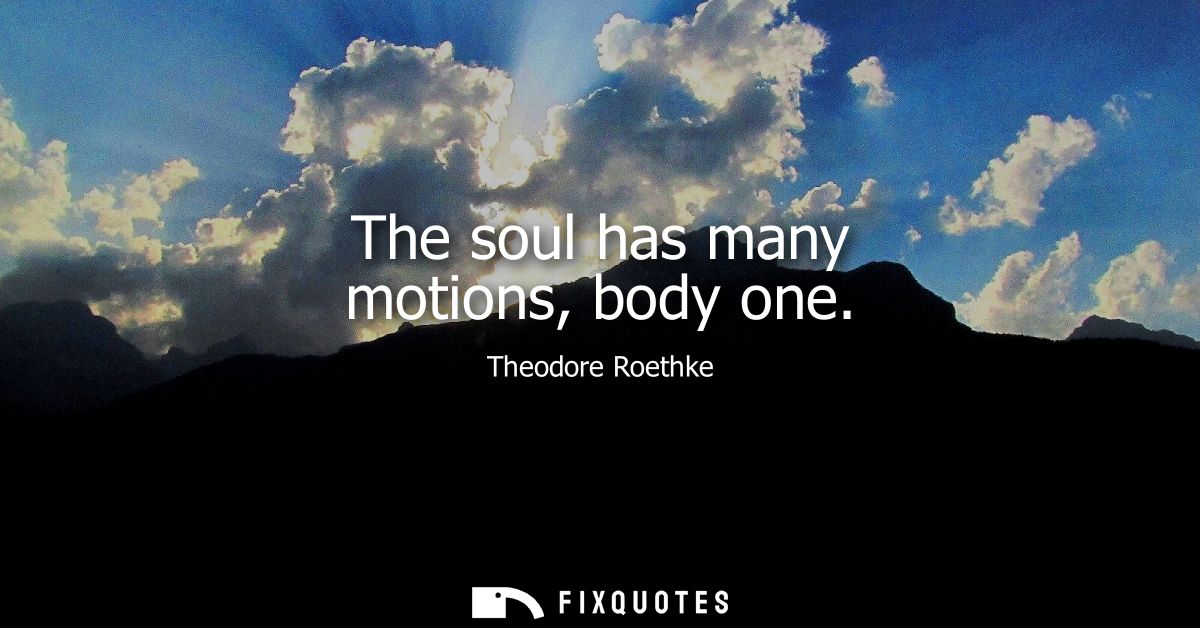
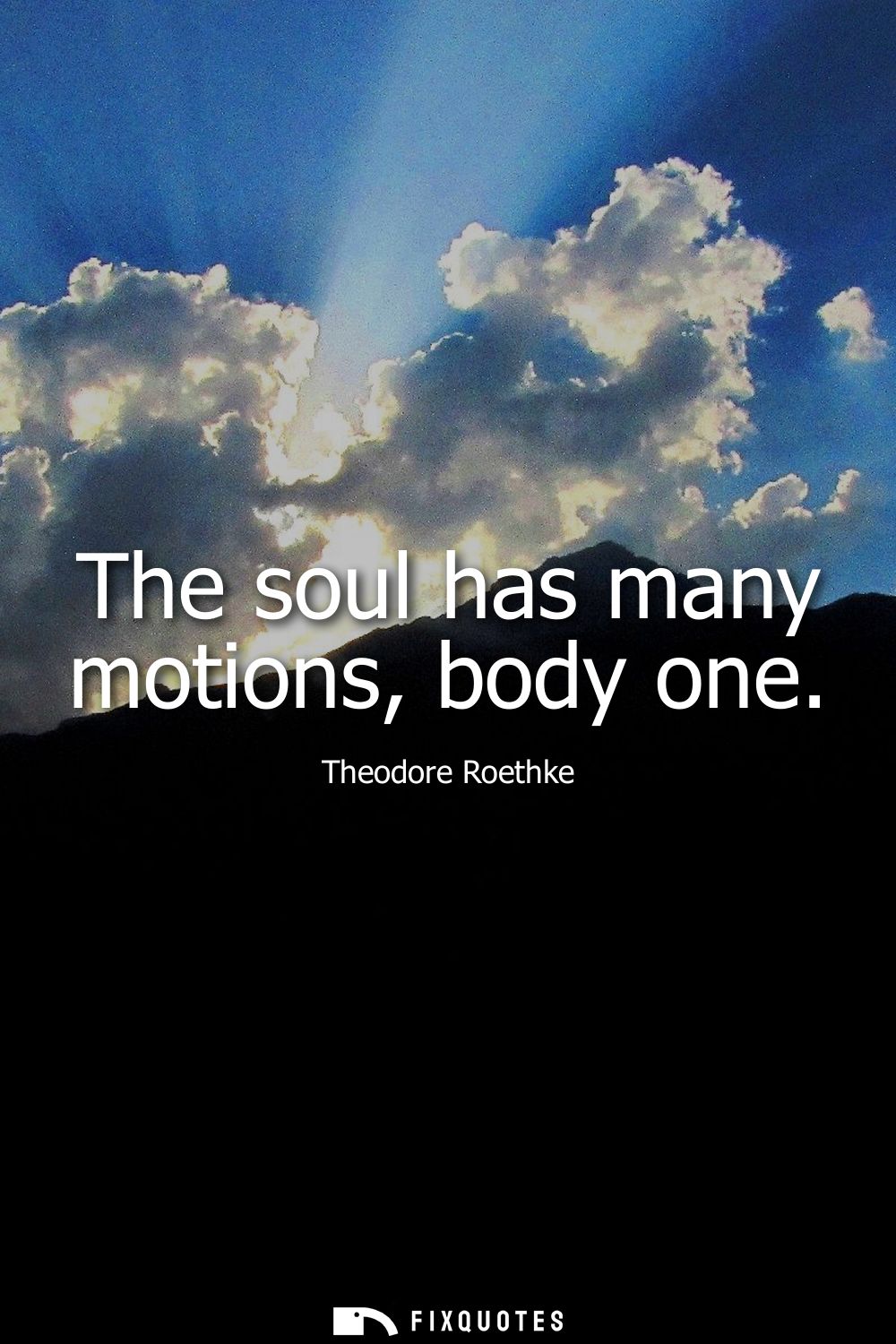
"The soul has many motions, body one"
About this Quote
Roethke’s line lands like a clean cut: the body is blunt instrument, the soul a restless choreography. “Many motions” gives the inner life a kinetic complexity - not just thoughts or feelings, but swerves, feints, backtracks. The phrasing carries a sly humility, too. He doesn’t claim the soul is pure or wise; it merely moves in more directions than the body can publicly register. The “one” is almost comic in its finality, a hard stop that makes flesh feel like a single-track machine.
The subtext is Roethke’s lifelong obsession with the mismatch between interior weather and outward behavior. He wrote out of a sensibility shaped by his father’s greenhouse business, where growth is visible but also regulated: things bloom, but under glass. That tension - abundance constrained - shadows the quote. The soul wants multiplicity; the body can only enact a limited script at any given moment. You can grieve, desire, envy, forgive, and self-sabotage in the span of a minute, yet your face might stay politely neutral.
Context matters because Roethke is a poet of embodiment, not a preacher of disembodiment. He doesn’t dismiss the body; he shows its stubborn singularity. The line also hints at mental health, an area Roethke knew personally. When the soul’s motions multiply too fast, the body can’t keep up, and you get the familiar modern condition: an inner life sprinting while the outer self sits in a meeting, nodding. It’s a compact argument for poetry itself - language as the extra set of limbs the soul invents when the body only has one way to move.
The subtext is Roethke’s lifelong obsession with the mismatch between interior weather and outward behavior. He wrote out of a sensibility shaped by his father’s greenhouse business, where growth is visible but also regulated: things bloom, but under glass. That tension - abundance constrained - shadows the quote. The soul wants multiplicity; the body can only enact a limited script at any given moment. You can grieve, desire, envy, forgive, and self-sabotage in the span of a minute, yet your face might stay politely neutral.
Context matters because Roethke is a poet of embodiment, not a preacher of disembodiment. He doesn’t dismiss the body; he shows its stubborn singularity. The line also hints at mental health, an area Roethke knew personally. When the soul’s motions multiply too fast, the body can’t keep up, and you get the familiar modern condition: an inner life sprinting while the outer self sits in a meeting, nodding. It’s a compact argument for poetry itself - language as the extra set of limbs the soul invents when the body only has one way to move.
Quote Details
| Topic | Deep |
|---|---|
| Source | Help us find the source |
| Cite |
Citation Formats
APA Style (7th ed.)
Roethke, Theodore. (2026, January 15). The soul has many motions, body one. FixQuotes. https://fixquotes.com/quotes/the-soul-has-many-motions-body-one-169732/
Chicago Style
Roethke, Theodore. "The soul has many motions, body one." FixQuotes. January 15, 2026. https://fixquotes.com/quotes/the-soul-has-many-motions-body-one-169732/.
MLA Style (9th ed.)
"The soul has many motions, body one." FixQuotes, 15 Jan. 2026, https://fixquotes.com/quotes/the-soul-has-many-motions-body-one-169732/. Accessed 31 Mar. 2026.
More Quotes by Theodore
Add to List