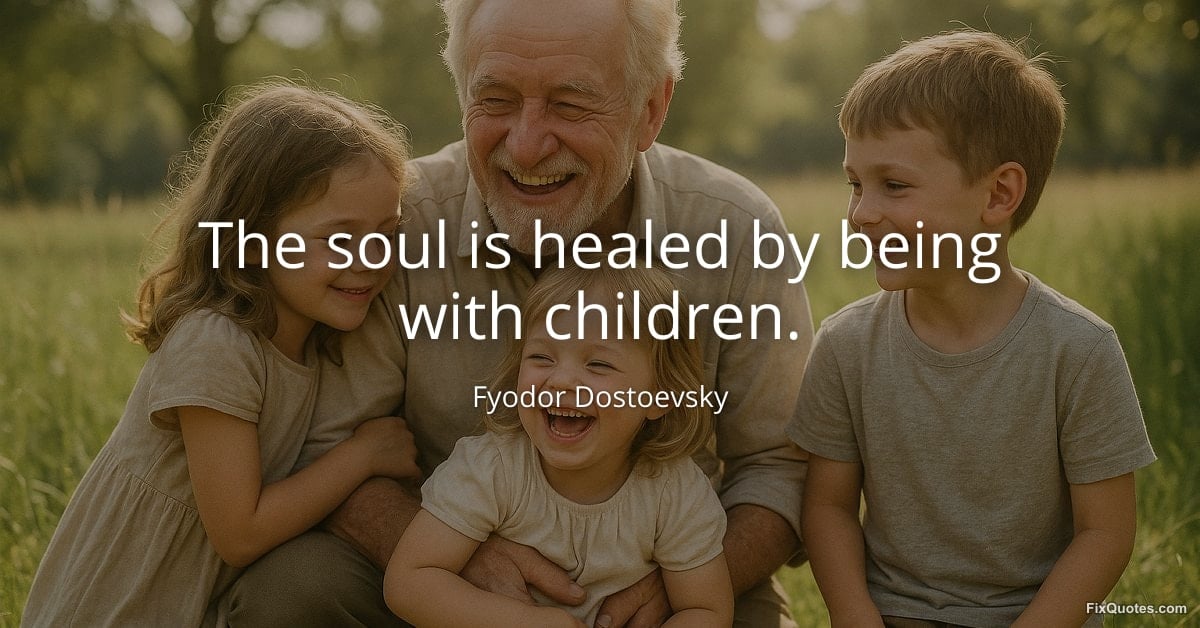
"The soul is healed by being with children"
About this Quote
Dostoevsky doesn’t romanticize children as decorative innocence; he uses them as a moral X-ray. “The soul is healed by being with children” lands with extra force because it comes from a novelist obsessed with guilt, humiliation, and the ways adults rationalize cruelty. In his world, the “soul” isn’t a poetic flourish, it’s a battered instrument - compromised by pride, ideology, and the constant self-justification required to keep moving through a corrupt society. Healing, then, can’t arrive as a grand philosophical system. It has to come as contact.
The subtext is almost accusatory: if your spirit can be repaired by proximity to children, that implies it’s been damaged by adult life - by ambition, by abstraction, by the transactional habits we call maturity. Children function as a kind of ethical antidote because they demand presence rather than performance. You can’t impress a child with a theory; you have to show up, listen, stoop down, answer plainly. That downward motion is the point. Dostoevsky keeps insisting that redemption is not self-mastery but self-emptying.
Context matters: he wrote after prison, after enforced closeness with suffering, and in a Russia convulsed by reformist certainty and revolutionary talk. Against the era’s booming ideologies, children represent something stubbornly non-ideological: vulnerable bodies, immediate needs, unprotected feeling. Being with them doesn’t erase sin; it interrupts the adult tendency to turn life into an argument. That interruption - tender, inconvenient, humiliating - is his version of grace.
The subtext is almost accusatory: if your spirit can be repaired by proximity to children, that implies it’s been damaged by adult life - by ambition, by abstraction, by the transactional habits we call maturity. Children function as a kind of ethical antidote because they demand presence rather than performance. You can’t impress a child with a theory; you have to show up, listen, stoop down, answer plainly. That downward motion is the point. Dostoevsky keeps insisting that redemption is not self-mastery but self-emptying.
Context matters: he wrote after prison, after enforced closeness with suffering, and in a Russia convulsed by reformist certainty and revolutionary talk. Against the era’s booming ideologies, children represent something stubbornly non-ideological: vulnerable bodies, immediate needs, unprotected feeling. Being with them doesn’t erase sin; it interrupts the adult tendency to turn life into an argument. That interruption - tender, inconvenient, humiliating - is his version of grace.
Quote Details
| Topic | Family |
|---|---|
| Source | Later attribution: The Journey Continues: from Groaning to Dancing (Richard Jones, 2022) modern compilationISBN: 9781665546348 · ID: 0EFbEAAAQBAJ
Evidence: ... Fyodor Dostoevsky said , " The soul is healed by being with children . " Yeah , I have found that to be true . Then there's the other side of the coin from a southern philosopher— “ Children are like mosquitoes . The moment they stop ... Other candidates (1) Dreams (Fyodor Dostoevsky) compilation37.5% 1916 auctorial induction the dream as i now know is not best served by making p |
| Featured | This quote was our Quote of the Day on October 1, 2025 |
| Cite |
Citation Formats
APA Style (7th ed.)
Dostoevsky, Fyodor. (2026, January 11). The soul is healed by being with children. FixQuotes. https://fixquotes.com/quotes/the-soul-is-healed-by-being-with-children-7148/
Chicago Style
Dostoevsky, Fyodor. "The soul is healed by being with children." FixQuotes. January 11, 2026. https://fixquotes.com/quotes/the-soul-is-healed-by-being-with-children-7148/.
MLA Style (9th ed.)
"The soul is healed by being with children." FixQuotes, 11 Jan. 2026, https://fixquotes.com/quotes/the-soul-is-healed-by-being-with-children-7148/. Accessed 30 Mar. 2026.
More Quotes by Fyodor
Add to List