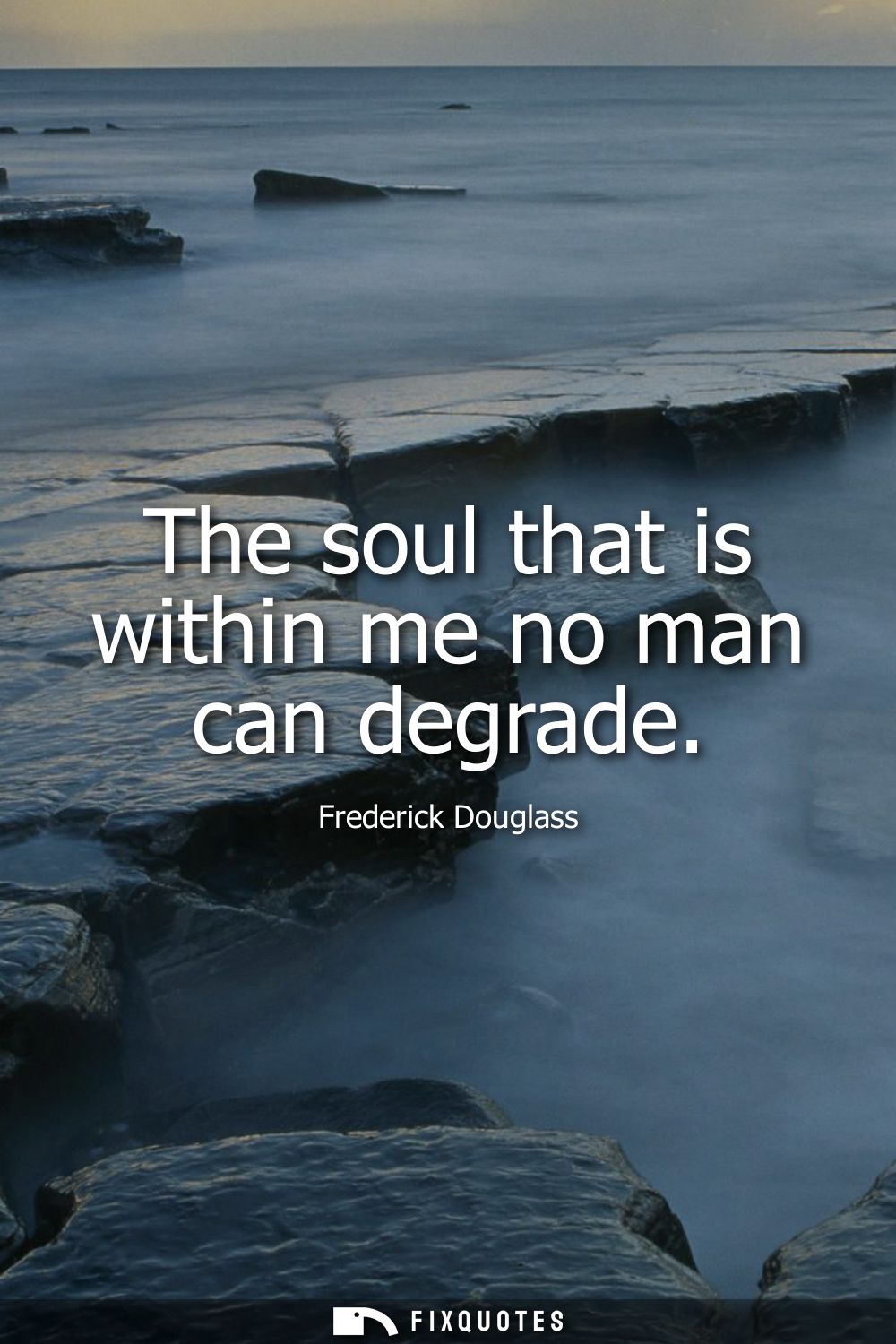
"The soul that is within me, no man can degrade"
About this Quote
Douglass isn’t asking to be recognized as human; he’s daring the world to test whether it can successfully unmake him. “The soul that is within me” shifts the battleground from the plantation ledger to the interior self, where ownership can’t be notarized. In an America built to convert Black bodies into property, he plants his flag in the one territory enslavers can’t legally seize: conscience, dignity, the stubborn sense of “I” that survives coercion. The line has the steel of a declaration and the intimacy of a private vow, a form of resistance that doesn’t require permission.
The genius is in the phrasing: “no man” is both a rebuke and a demotion. Slaveholders style themselves as masters, patriarchs, even benevolent guardians; Douglass strips them down to mere men, morally ordinary and therefore unqualified to pronounce anyone inferior. “Degrade” is the verb that exposes slavery’s true project. It’s not just forced labor; it’s a system engineered to collapse self-respect, to make the oppressed internalize the oppressor’s story. Douglass denies the final step. He understands that domination isn’t complete until the victim agrees.
Context matters: Douglass wrote and spoke as a former enslaved person who knew the daily theater of humiliation, and as an author who weaponized literacy against a culture that policed Black intellect. The sentence is rhetoric as self-defense: a compact, portable creed meant to outlast the whip, the law, and the sneer.
The genius is in the phrasing: “no man” is both a rebuke and a demotion. Slaveholders style themselves as masters, patriarchs, even benevolent guardians; Douglass strips them down to mere men, morally ordinary and therefore unqualified to pronounce anyone inferior. “Degrade” is the verb that exposes slavery’s true project. It’s not just forced labor; it’s a system engineered to collapse self-respect, to make the oppressed internalize the oppressor’s story. Douglass denies the final step. He understands that domination isn’t complete until the victim agrees.
Context matters: Douglass wrote and spoke as a former enslaved person who knew the daily theater of humiliation, and as an author who weaponized literacy against a culture that policed Black intellect. The sentence is rhetoric as self-defense: a compact, portable creed meant to outlast the whip, the law, and the sneer.
Quote Details
| Topic | Human Rights |
|---|---|
| Source | From Frederick Douglass, "What to the Slave Is the Fourth of July?" (speech, Rochester, NY, July 5, 1852). |
| Cite |
Citation Formats
APA Style (7th ed.)
Douglass, Frederick. (2026, February 20). The soul that is within me, no man can degrade. FixQuotes. https://fixquotes.com/quotes/the-soul-that-is-within-me-no-man-can-degrade-16614/
Chicago Style
Douglass, Frederick. "The soul that is within me, no man can degrade." FixQuotes. February 20, 2026. https://fixquotes.com/quotes/the-soul-that-is-within-me-no-man-can-degrade-16614/.
MLA Style (9th ed.)
"The soul that is within me, no man can degrade." FixQuotes, 20 Feb. 2026, https://fixquotes.com/quotes/the-soul-that-is-within-me-no-man-can-degrade-16614/. Accessed 22 Mar. 2026.
More Quotes by Frederick
Add to List