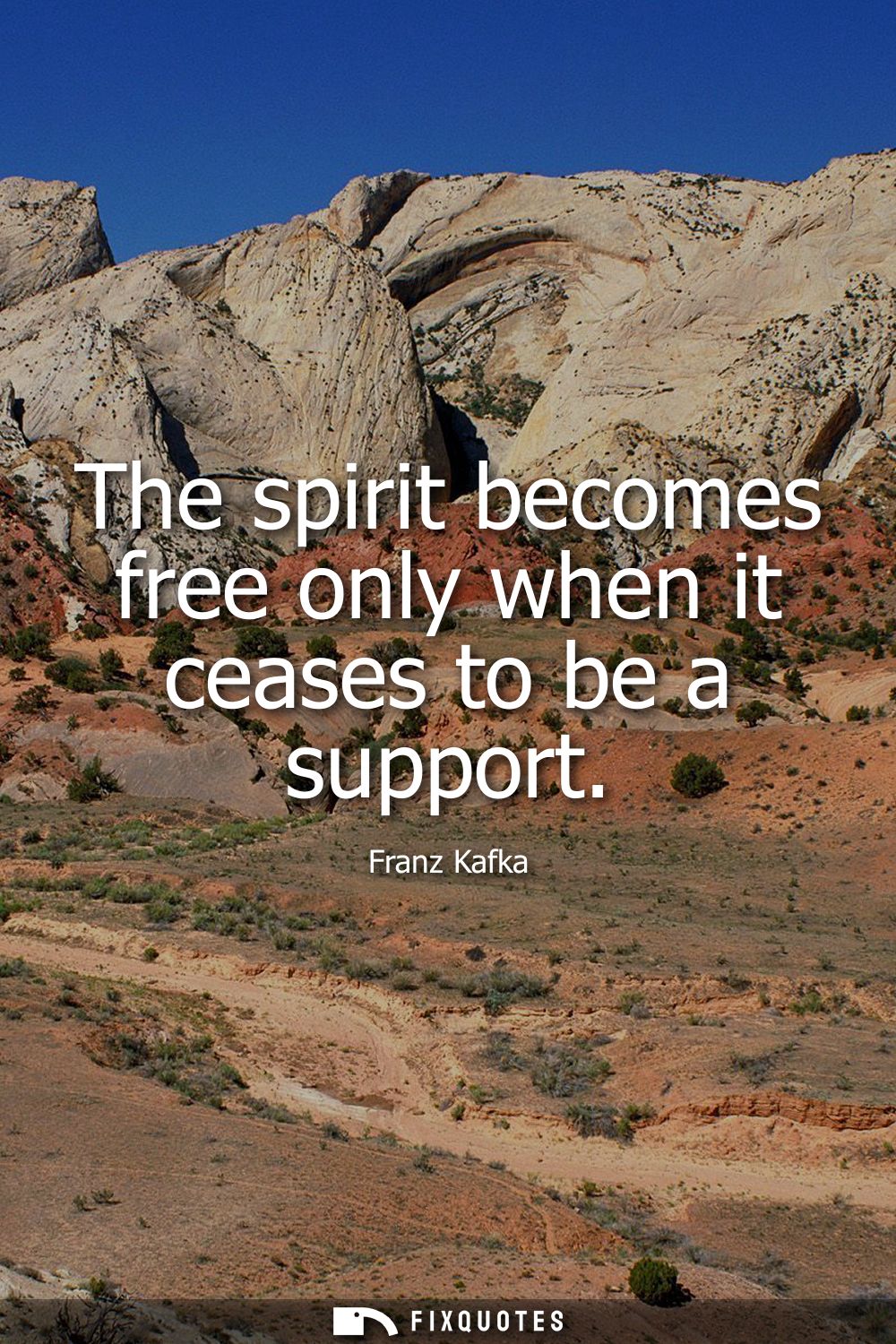
"The spirit becomes free only when it ceases to be a support"
About this Quote
Kafka’s line is a trapdoor disguised as self-help. “Support” sounds benign, even virtuous: being useful, being needed, holding something up. But in Kafka’s universe, usefulness is how the world gets its hooks in. To be a support is to be recruited into a structure you didn’t design, trapped in the moral blackmail of responsibility, function, and expectation. Freedom arrives not through self-assertion but through refusal.
The sentence works because it flips a cherished modern fantasy: that we become free by finding purpose. Kafka suggests the opposite. Purpose, in practice, often means serving as scaffolding for someone else’s bureaucracy, family narrative, or social order. “Spirit” here isn’t just mood; it’s the inner life that wants to move without a job title. The subtext is harsh: the moment you are indispensable, you are also captured.
Context matters. Kafka wrote from inside institutions - insurance offices, legalistic systems, the thick air of Austro-Hungarian administration - and his fiction keeps staging characters ground down by opaque demands they can’t satisfy. “Support” echoes the burdens in his letters too: filial duty, guilt, the sense that his existence must justify itself to authorities both external and internal.
The brilliance is the austerity. “Ceases” implies a clean break, not a better balance. Kafka isn’t romanticizing selfishness; he’s diagnosing how caretaking and compliance can become spiritual handcuffs. To stop propping up the machine is to risk collapse - and to discover what, if anything, in you can stand on its own.
The sentence works because it flips a cherished modern fantasy: that we become free by finding purpose. Kafka suggests the opposite. Purpose, in practice, often means serving as scaffolding for someone else’s bureaucracy, family narrative, or social order. “Spirit” here isn’t just mood; it’s the inner life that wants to move without a job title. The subtext is harsh: the moment you are indispensable, you are also captured.
Context matters. Kafka wrote from inside institutions - insurance offices, legalistic systems, the thick air of Austro-Hungarian administration - and his fiction keeps staging characters ground down by opaque demands they can’t satisfy. “Support” echoes the burdens in his letters too: filial duty, guilt, the sense that his existence must justify itself to authorities both external and internal.
The brilliance is the austerity. “Ceases” implies a clean break, not a better balance. Kafka isn’t romanticizing selfishness; he’s diagnosing how caretaking and compliance can become spiritual handcuffs. To stop propping up the machine is to risk collapse - and to discover what, if anything, in you can stand on its own.
Quote Details
| Topic | Letting Go |
|---|---|
| Source | Help us find the source |
| Cite |
Citation Formats
APA Style (7th ed.)
Kafka, Franz. (2026, January 18). The spirit becomes free only when it ceases to be a support. FixQuotes. https://fixquotes.com/quotes/the-spirit-becomes-free-only-when-it-ceases-to-be-19472/
Chicago Style
Kafka, Franz. "The spirit becomes free only when it ceases to be a support." FixQuotes. January 18, 2026. https://fixquotes.com/quotes/the-spirit-becomes-free-only-when-it-ceases-to-be-19472/.
MLA Style (9th ed.)
"The spirit becomes free only when it ceases to be a support." FixQuotes, 18 Jan. 2026, https://fixquotes.com/quotes/the-spirit-becomes-free-only-when-it-ceases-to-be-19472/. Accessed 9 Mar. 2026.
More Quotes by Franz
Add to List