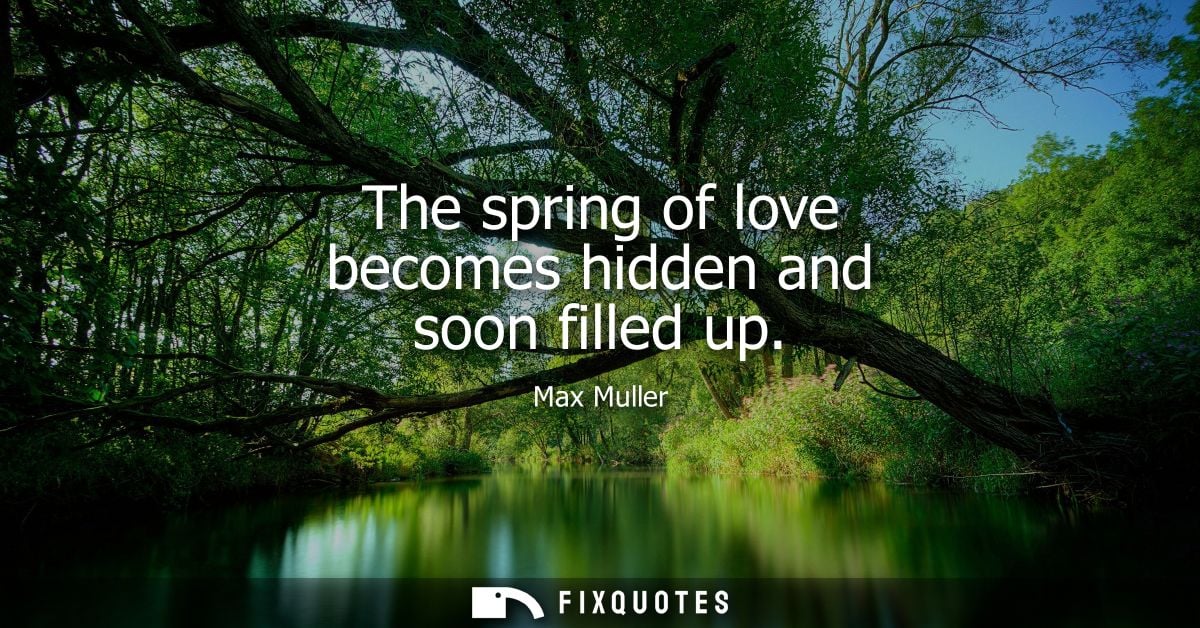
"The spring of love becomes hidden and soon filled up"
About this Quote
A spring is love at its most honest: not the grand ocean, not the curated fountain in a town square, but a quiet source that keeps running because it has to. Max Muller, a 19th-century educator best known for translating and popularizing sacred texts, chooses that image with a teacher’s precision. He isn’t talking about love as fireworks; he’s talking about love as infrastructure. The kind that feeds a life, a household, a community, often without anyone noticing.
“Becomes hidden” lands like a warning about modernity before modernity had a name. Victorian respectability prized restraint, privacy, and the tidying-up of feelings into something presentable. In that world, love doesn’t die so much as get covered over: by duty, by routine, by the social demand to appear composed. The subtext is less heartbreak than neglect. If you stop visiting the source, you stop believing it’s there.
“Soon filled up” is the harsher twist. Springs don’t fill themselves; they get clogged. With what? With the sediment of the everyday: unspoken resentments, small humiliations, busyness mistaken for purpose, the slow habit of not asking for what you need. Muller’s phrasing makes love feel both natural and fragile: renewable, but not invulnerable.
As an educator steeped in comparative religion, he’s also echoing a moral logic: inner life requires maintenance. The line works because it refuses melodrama. It frames love not as a feeling you either have or lose, but as a source you can bury - and, by implication, uncover again if you do the work.
“Becomes hidden” lands like a warning about modernity before modernity had a name. Victorian respectability prized restraint, privacy, and the tidying-up of feelings into something presentable. In that world, love doesn’t die so much as get covered over: by duty, by routine, by the social demand to appear composed. The subtext is less heartbreak than neglect. If you stop visiting the source, you stop believing it’s there.
“Soon filled up” is the harsher twist. Springs don’t fill themselves; they get clogged. With what? With the sediment of the everyday: unspoken resentments, small humiliations, busyness mistaken for purpose, the slow habit of not asking for what you need. Muller’s phrasing makes love feel both natural and fragile: renewable, but not invulnerable.
As an educator steeped in comparative religion, he’s also echoing a moral logic: inner life requires maintenance. The line works because it refuses melodrama. It frames love not as a feeling you either have or lose, but as a source you can bury - and, by implication, uncover again if you do the work.
Quote Details
| Topic | Heartbreak |
|---|---|
| Source | Help us find the source |
| Cite |
Citation Formats
APA Style (7th ed.)
Muller, Max. (2026, January 15). The spring of love becomes hidden and soon filled up. FixQuotes. https://fixquotes.com/quotes/the-spring-of-love-becomes-hidden-and-soon-filled-162477/
Chicago Style
Muller, Max. "The spring of love becomes hidden and soon filled up." FixQuotes. January 15, 2026. https://fixquotes.com/quotes/the-spring-of-love-becomes-hidden-and-soon-filled-162477/.
MLA Style (9th ed.)
"The spring of love becomes hidden and soon filled up." FixQuotes, 15 Jan. 2026, https://fixquotes.com/quotes/the-spring-of-love-becomes-hidden-and-soon-filled-162477/. Accessed 29 Mar. 2026.
More Quotes by Max
Add to List