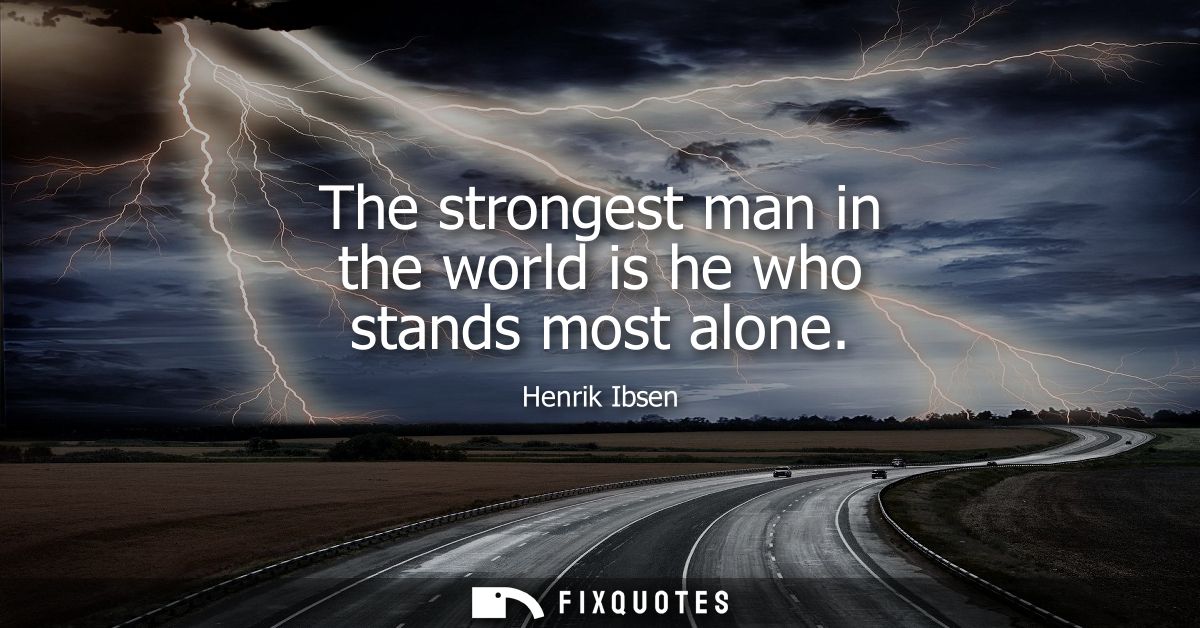
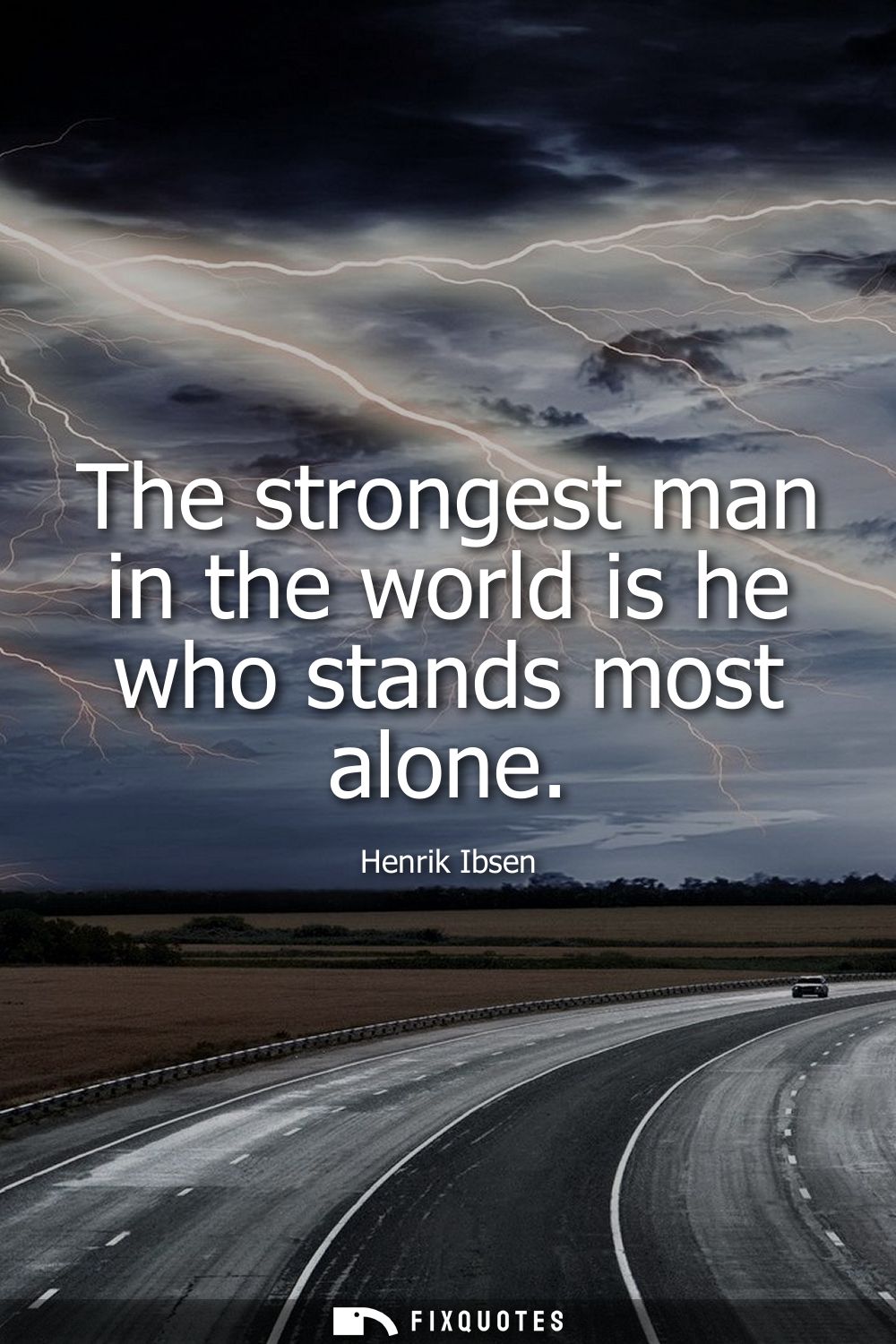
"The strongest man in the world is he who stands most alone"
About this Quote
Strength here isn’t brawn; it’s the nerve to be socially insolvent. Ibsen’s line elevates the loner not as a romantic pose but as a moral technology: when you can’t borrow legitimacy from the crowd, every choice has to be underwritten by your own judgment. The phrase “stands most alone” is doing the real work. It implies pressure, not preference. You don’t sit alone; you stand, taking the full wind of backlash.
In Ibsen’s Norway, that wind was stiff. Late-19th-century bourgeois respectability prized consensus, reputation, and the soothing fiction that the community’s comfort equals its virtue. Ibsen made a career of dramatizing the cost of that comfort: the small lies, the sanctioned hypocrisies, the way “public opinion” becomes a blunt instrument to keep inconvenient truths quiet. So the intent isn’t to praise isolation as purity; it’s to warn that real integrity often comes with a receipt: exile, ridicule, professional punishment, domestic fallout.
The subtext is almost political. If the majority can be wrong, then popularity is not evidence, it’s just volume. That makes loneliness a kind of stress test for truth-telling. Ibsen also slips in a modern anxiety: the fear that we’re only as real as we are recognized. His strongest man can survive without applause. That’s a provocation aimed at the audience, too: if you need the crowd to feel courageous, your courage is rented, not owned.
In Ibsen’s Norway, that wind was stiff. Late-19th-century bourgeois respectability prized consensus, reputation, and the soothing fiction that the community’s comfort equals its virtue. Ibsen made a career of dramatizing the cost of that comfort: the small lies, the sanctioned hypocrisies, the way “public opinion” becomes a blunt instrument to keep inconvenient truths quiet. So the intent isn’t to praise isolation as purity; it’s to warn that real integrity often comes with a receipt: exile, ridicule, professional punishment, domestic fallout.
The subtext is almost political. If the majority can be wrong, then popularity is not evidence, it’s just volume. That makes loneliness a kind of stress test for truth-telling. Ibsen also slips in a modern anxiety: the fear that we’re only as real as we are recognized. His strongest man can survive without applause. That’s a provocation aimed at the audience, too: if you need the crowd to feel courageous, your courage is rented, not owned.
Quote Details
| Topic | Resilience |
|---|---|
| Source | Help us find the source |
| Cite | Cite this Quote |
Citation Formats
APA Style (7th ed.)
Ibsen, Henrik. (2026, January 14). The strongest man in the world is he who stands most alone. FixQuotes. https://fixquotes.com/quotes/the-strongest-man-in-the-world-is-he-who-stands-32697/
Chicago Style
Ibsen, Henrik. "The strongest man in the world is he who stands most alone." FixQuotes. January 14, 2026. https://fixquotes.com/quotes/the-strongest-man-in-the-world-is-he-who-stands-32697/.
MLA Style (9th ed.)
"The strongest man in the world is he who stands most alone." FixQuotes, 14 Jan. 2026, https://fixquotes.com/quotes/the-strongest-man-in-the-world-is-he-who-stands-32697/. Accessed 3 Feb. 2026.
More Quotes by Henrik
Add to List