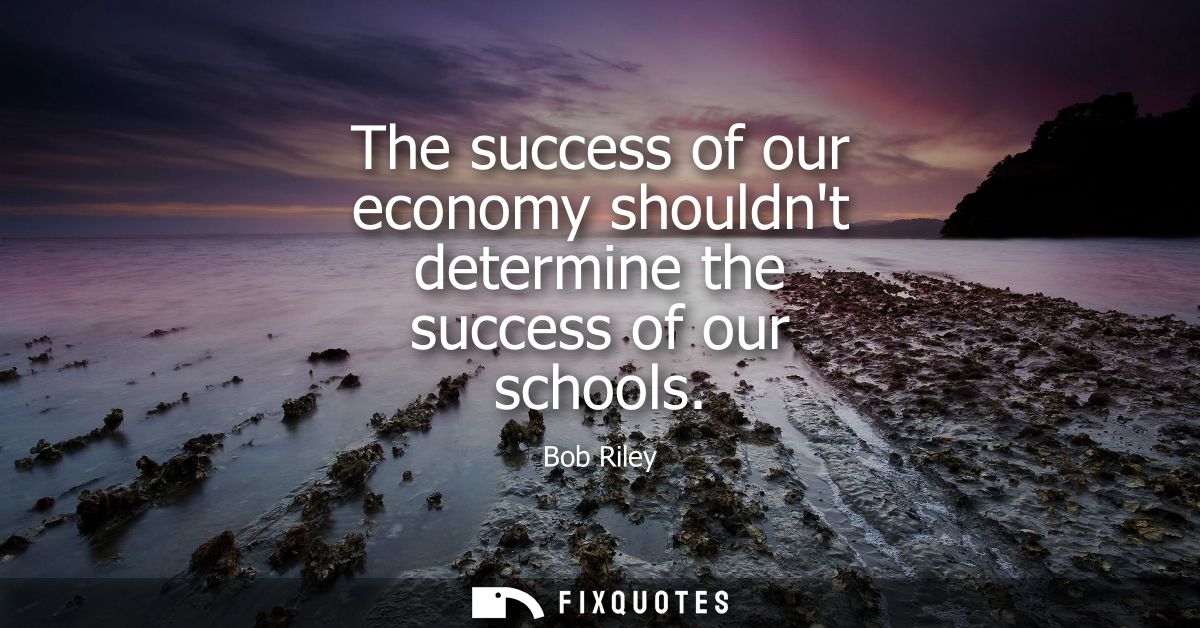
"The success of our economy shouldn't determine the success of our schools"
About this Quote
The intent is political triage. As a governor-era Republican voice associated with fiscal conservatism, Riley can’t easily argue for unlimited spending, but he can argue for a different standard of legitimacy: schooling as a civic obligation rather than a discretionary line item. The phrasing “our economy” and “our schools” binds audiences into a shared ownership, then sets up a dissonance between what we celebrate (economic “success”) and what we should protect (educational “success”). It’s less a policy blueprint than a values reset.
The subtext is also defensive: school outcomes shouldn’t be held hostage to recessions, tax-base swings, or the political fashion of austerity. Depending on the listener, it can read as a call for stable, insulated funding; or as a warning against letting workforce needs dictate curricula and define success only as job-readiness. Either way, it’s a bid to make education non-negotiable - a public good that shouldn’t have to audition for its budget every time the market sneezes.
Quote Details
| Topic | Learning |
|---|---|
| Source | Help us find the source |
| Cite |
Citation Formats
APA Style (7th ed.)
Riley, Bob. (2026, January 15). The success of our economy shouldn't determine the success of our schools. FixQuotes. https://fixquotes.com/quotes/the-success-of-our-economy-shouldnt-determine-the-140572/
Chicago Style
Riley, Bob. "The success of our economy shouldn't determine the success of our schools." FixQuotes. January 15, 2026. https://fixquotes.com/quotes/the-success-of-our-economy-shouldnt-determine-the-140572/.
MLA Style (9th ed.)
"The success of our economy shouldn't determine the success of our schools." FixQuotes, 15 Jan. 2026, https://fixquotes.com/quotes/the-success-of-our-economy-shouldnt-determine-the-140572/. Accessed 7 Apr. 2026.