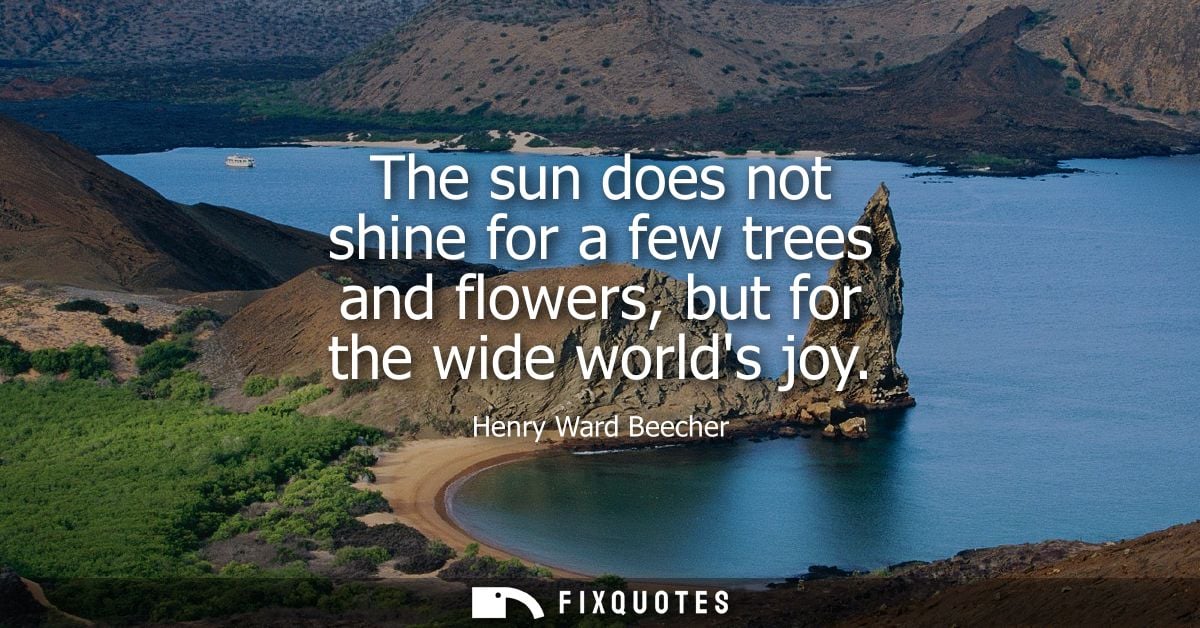
"The sun does not shine for a few trees and flowers, but for the wide world's joy"
About this Quote
The specific intent reads like pastoral instruction aimed at a 19th-century audience steeped in Protestant individualism and civic reform. Beecher, a prominent clergyman in an era of abolitionist agitation and expanding industrial capitalism, is preaching scale. Not private virtue as a potted plant kept alive for show, but public-minded care that assumes the world is bigger than one’s circle, denomination, or class. The “few trees and flowers” aren’t just literal; they stand in for pet causes, in-groups, the tidy moral projects that let people feel righteous without paying the cost of solidarity.
Subtextually, the sentence is also a defense of joy as a communal resource. “Wide world’s joy” nudges the listener away from suspicion of pleasure (a common religious reflex) and toward the idea that delight itself can be ethical when it’s shared, not hoarded. The rhetorical trick is that nature does the hard work: by making universality feel as obvious as daylight, Beecher turns narrow-heartedness into something like bad science. If the sun can’t be partisan, why should a decent person be?
Quote Details
| Topic | Nature |
|---|---|
| Source | Attributed to Henry Ward Beecher; listed on the Henry Ward Beecher Wikiquote page (quotation: "The sun does not shine for a few trees and flowers, but for the wide world's joy"). |
| Cite |
Citation Formats
APA Style (7th ed.)
Beecher, Henry Ward. (2026, January 17). The sun does not shine for a few trees and flowers, but for the wide world's joy. FixQuotes. https://fixquotes.com/quotes/the-sun-does-not-shine-for-a-few-trees-and-35082/
Chicago Style
Beecher, Henry Ward. "The sun does not shine for a few trees and flowers, but for the wide world's joy." FixQuotes. January 17, 2026. https://fixquotes.com/quotes/the-sun-does-not-shine-for-a-few-trees-and-35082/.
MLA Style (9th ed.)
"The sun does not shine for a few trees and flowers, but for the wide world's joy." FixQuotes, 17 Jan. 2026, https://fixquotes.com/quotes/the-sun-does-not-shine-for-a-few-trees-and-35082/. Accessed 5 Mar. 2026.