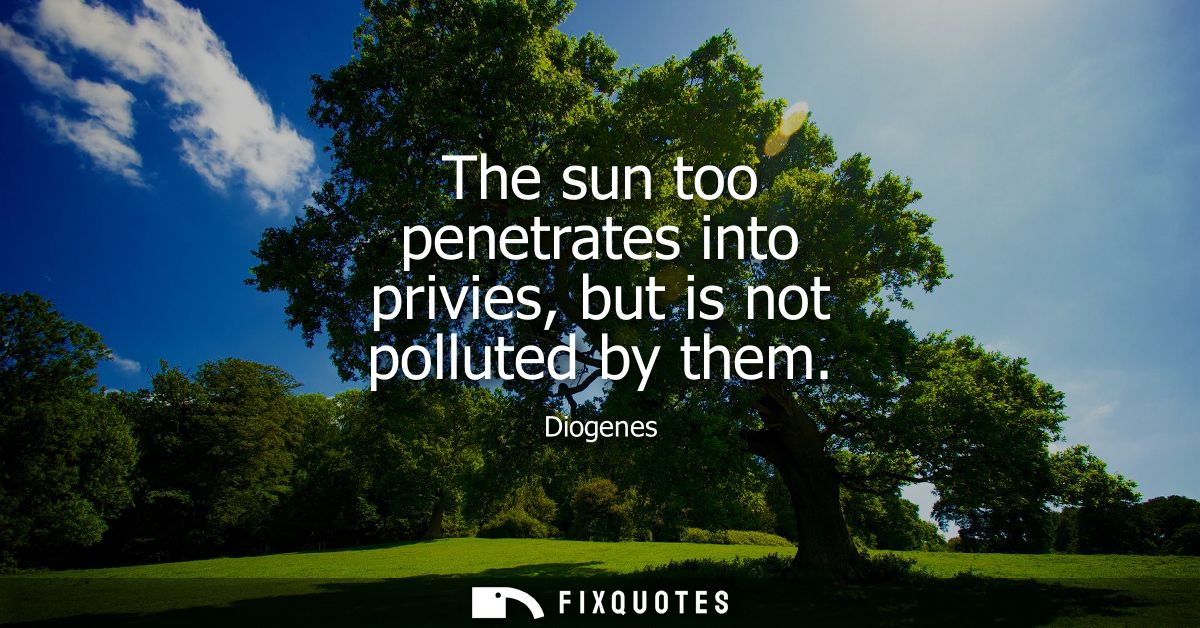
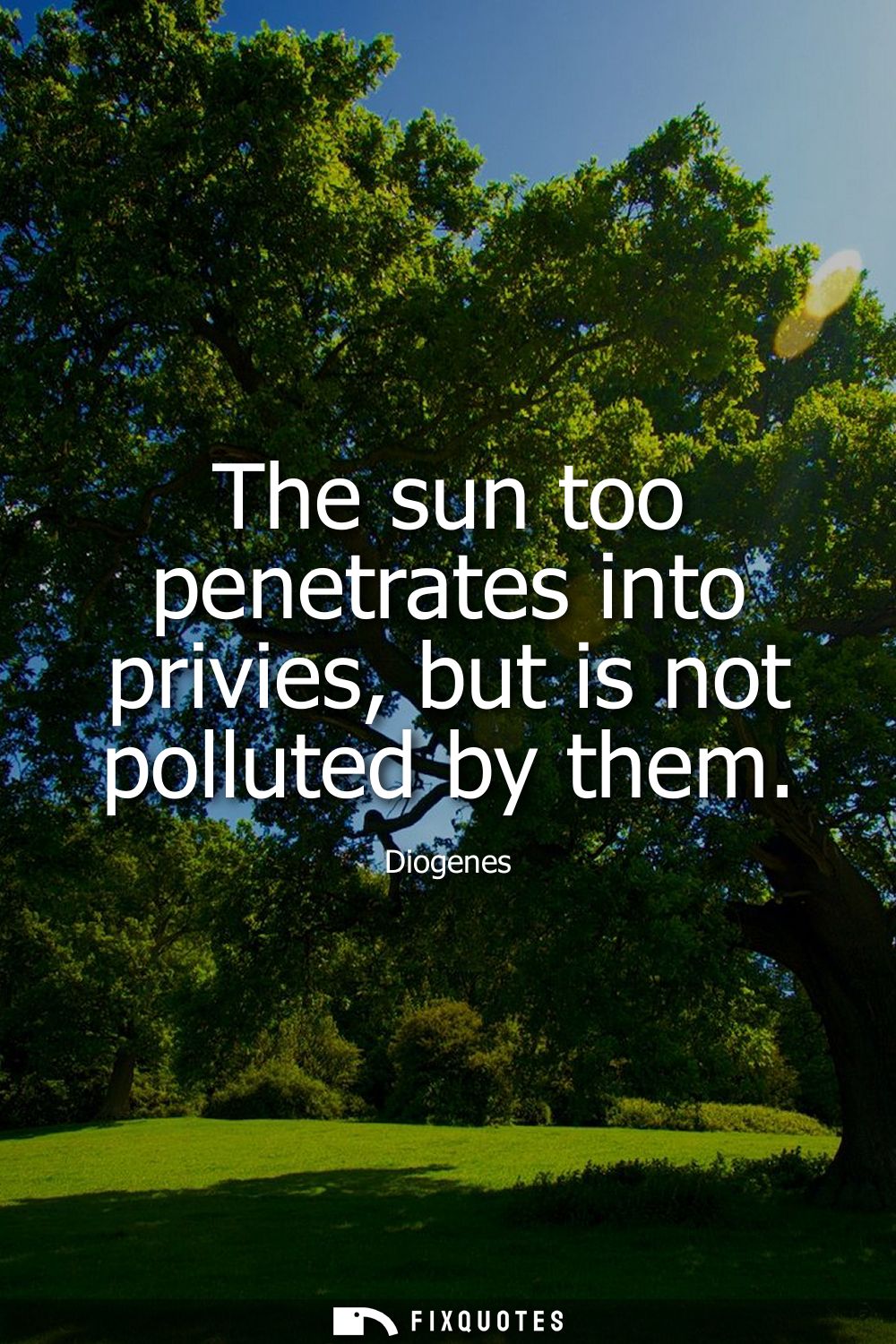
"The sun too penetrates into privies, but is not polluted by them"
About this Quote
Diogenes goes straight for the gutter because that is where philosophy stops being a parlor game. "Privies" is the point: the most literal site of human waste, the place polite society pretends doesn’t exist. By dragging the sun into it, he yokes cosmic purity to bodily fact, then lets the contrast do the shaming. The image is obscene in the old sense of the word: it stages what respectable people refuse to look at, and it dares them to call reality impure.
The intent is double-edged. On one level, it’s a defense of contact. The wise person can enter corrupt spaces, argue with fools, serve a flawed city, even handle dirty work, without becoming morally "polluted" by proximity. Virtue, like sunlight, is not a fragile white garment. On another level, it’s an attack on performative cleanliness: those who treat certain people, jobs, or places as contaminating are often protecting status, not ethics. Diogenes is saying: if the sun can reach the toilet and remain the sun, your soul can survive the marketplace without turning into what it touches.
Context matters: Cynicism was an anti-brand, a deliberate refusal of Athenian decorum, property, and hypocrisy. Diogenes lived his critique, embracing public discomfort to expose private pretenses. The line works because it collapses the metaphysical into the visceral. Instead of arguing about purity, it forces a sensory truth: illumination isn’t compromised by what it illuminates. The insult is implicit and surgical: if you feel tainted, maybe your virtue was never sunlight to begin with.
The intent is double-edged. On one level, it’s a defense of contact. The wise person can enter corrupt spaces, argue with fools, serve a flawed city, even handle dirty work, without becoming morally "polluted" by proximity. Virtue, like sunlight, is not a fragile white garment. On another level, it’s an attack on performative cleanliness: those who treat certain people, jobs, or places as contaminating are often protecting status, not ethics. Diogenes is saying: if the sun can reach the toilet and remain the sun, your soul can survive the marketplace without turning into what it touches.
Context matters: Cynicism was an anti-brand, a deliberate refusal of Athenian decorum, property, and hypocrisy. Diogenes lived his critique, embracing public discomfort to expose private pretenses. The line works because it collapses the metaphysical into the visceral. Instead of arguing about purity, it forces a sensory truth: illumination isn’t compromised by what it illuminates. The insult is implicit and surgical: if you feel tainted, maybe your virtue was never sunlight to begin with.
Quote Details
| Topic | Wisdom |
|---|---|
| Source | Help us find the source |
| Cite |
Citation Formats
APA Style (7th ed.)
Sinope, Diogenes of. (2026, January 18). The sun too penetrates into privies, but is not polluted by them. FixQuotes. https://fixquotes.com/quotes/the-sun-too-penetrates-into-privies-but-is-not-14235/
Chicago Style
Sinope, Diogenes of. "The sun too penetrates into privies, but is not polluted by them." FixQuotes. January 18, 2026. https://fixquotes.com/quotes/the-sun-too-penetrates-into-privies-but-is-not-14235/.
MLA Style (9th ed.)
"The sun too penetrates into privies, but is not polluted by them." FixQuotes, 18 Jan. 2026, https://fixquotes.com/quotes/the-sun-too-penetrates-into-privies-but-is-not-14235/. Accessed 23 Mar. 2026.
More Quotes by Diogenes
Add to List