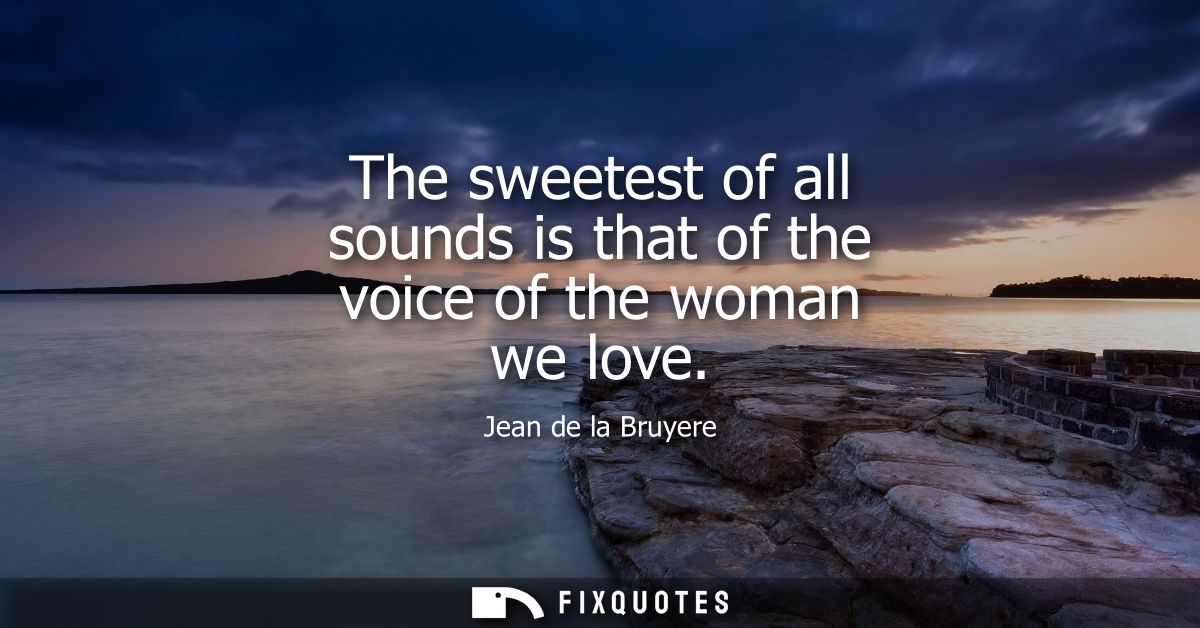
"The sweetest of all sounds is that of the voice of the woman we love"
About this Quote
The subtext is also social. La Bruyere writes in the courtly atmosphere of Louis XIV's France, where conversation is currency and salons train people to weaponize charm with language. In that setting, a woman's voice isn't just a sound; it's status, wit, and access. To praise the voice is to praise the entire apparatus of cultivated femininity that the era prized, while keeping the woman safely within the frame of what she provides to the listener.
There's a gentle possessiveness embedded in "the woman we love". She's defined relationally, not individually; her voice is sweetest because it is ours to be moved by. The line flatters love while quietly flattering the lover even more, casting him as the connoisseur who can hear what others can't. The brilliance is its soft authoritarianism: a private preference posed as a law of nature, dressed up in the elegance of a simple sentence.
Quote Details
| Topic | Romantic |
|---|---|
| Source | Jean de La Bruyère, Les Caractères (1688). French: "Le plus doux de tous les sons est celui de la voix de la femme qu'on aime." English: "The sweetest of all sounds is that of the voice of the woman we love." |
| Cite |
Citation Formats
APA Style (7th ed.)
Bruyère, Jean de La. (2026, January 15). The sweetest of all sounds is that of the voice of the woman we love. FixQuotes. https://fixquotes.com/quotes/the-sweetest-of-all-sounds-is-that-of-the-voice-33271/
Chicago Style
Bruyère, Jean de La. "The sweetest of all sounds is that of the voice of the woman we love." FixQuotes. January 15, 2026. https://fixquotes.com/quotes/the-sweetest-of-all-sounds-is-that-of-the-voice-33271/.
MLA Style (9th ed.)
"The sweetest of all sounds is that of the voice of the woman we love." FixQuotes, 15 Jan. 2026, https://fixquotes.com/quotes/the-sweetest-of-all-sounds-is-that-of-the-voice-33271/. Accessed 6 Feb. 2026.