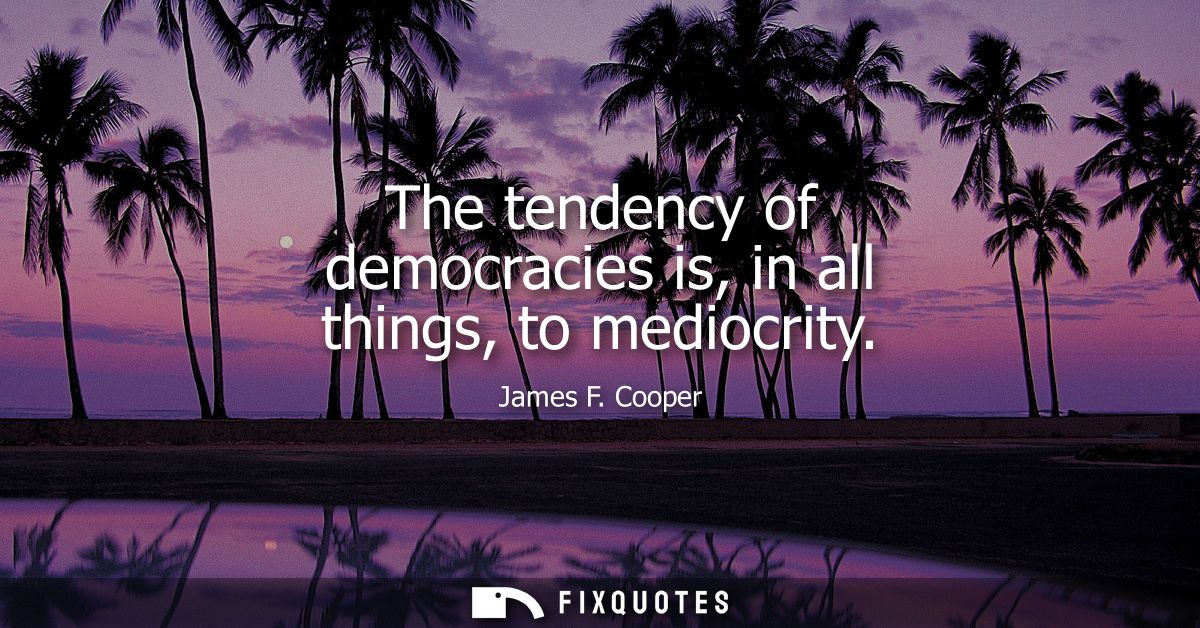
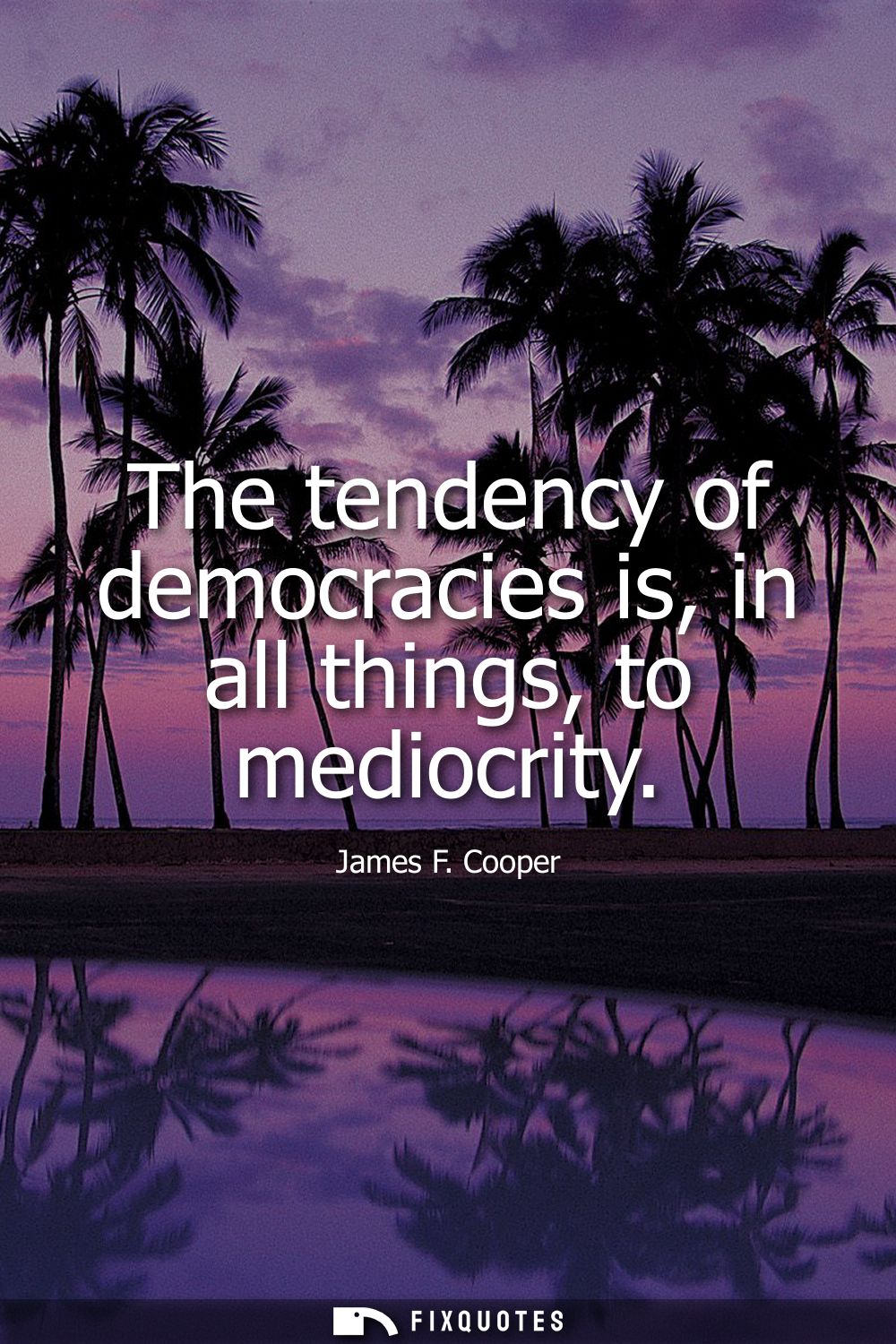
"The tendency of democracies is, in all things, to mediocrity"
About this Quote
Cooper’s line lands like an elegant insult: democracy, that vaunted engine of equality, supposedly runs best when it sands down anything sharp. “In all things” is the dagger. He isn’t just complaining about elections or policy; he’s suggesting a cultural physics where taste, ambition, art, and public life drift toward the safest average because the crowd rewards what feels familiar and punishes what looks elite.
The intent is less anti-freedom than anti-fashionable freedom. Cooper, a novelist of the early American republic, watched a young nation treat “the people” as both sacred and volatile. The subtext is a fear that majorities don’t merely govern; they adjudicate status. Once legitimacy comes from popular approval, excellence starts to look like arrogance, and complexity starts to look like betrayal. Mediocrity becomes a social truce: no one has to feel outclassed.
Context matters: this is a 19th-century writer from a society shedding old hierarchies while still anxious about what replaces them. Cooper’s own career fed the suspicion. He was famously touchy about criticism and at odds with an American press culture that was getting louder, cheaper, and more democratic. So the line doubles as self-defense: an artist bristling at being reviewed by the same leveling public he depends on.
What makes it work is its chilly generality. Cooper offers no policy prescription, only a mood: democracy as a machine that equalizes outcomes by equalizing expectations. It’s provocative because it flatters the reader’s desire to be the exception while blaming the crowd for the culture the reader already consumes.
The intent is less anti-freedom than anti-fashionable freedom. Cooper, a novelist of the early American republic, watched a young nation treat “the people” as both sacred and volatile. The subtext is a fear that majorities don’t merely govern; they adjudicate status. Once legitimacy comes from popular approval, excellence starts to look like arrogance, and complexity starts to look like betrayal. Mediocrity becomes a social truce: no one has to feel outclassed.
Context matters: this is a 19th-century writer from a society shedding old hierarchies while still anxious about what replaces them. Cooper’s own career fed the suspicion. He was famously touchy about criticism and at odds with an American press culture that was getting louder, cheaper, and more democratic. So the line doubles as self-defense: an artist bristling at being reviewed by the same leveling public he depends on.
What makes it work is its chilly generality. Cooper offers no policy prescription, only a mood: democracy as a machine that equalizes outcomes by equalizing expectations. It’s provocative because it flatters the reader’s desire to be the exception while blaming the crowd for the culture the reader already consumes.
Quote Details
| Topic | Wisdom |
|---|
More Quotes by James
Add to List