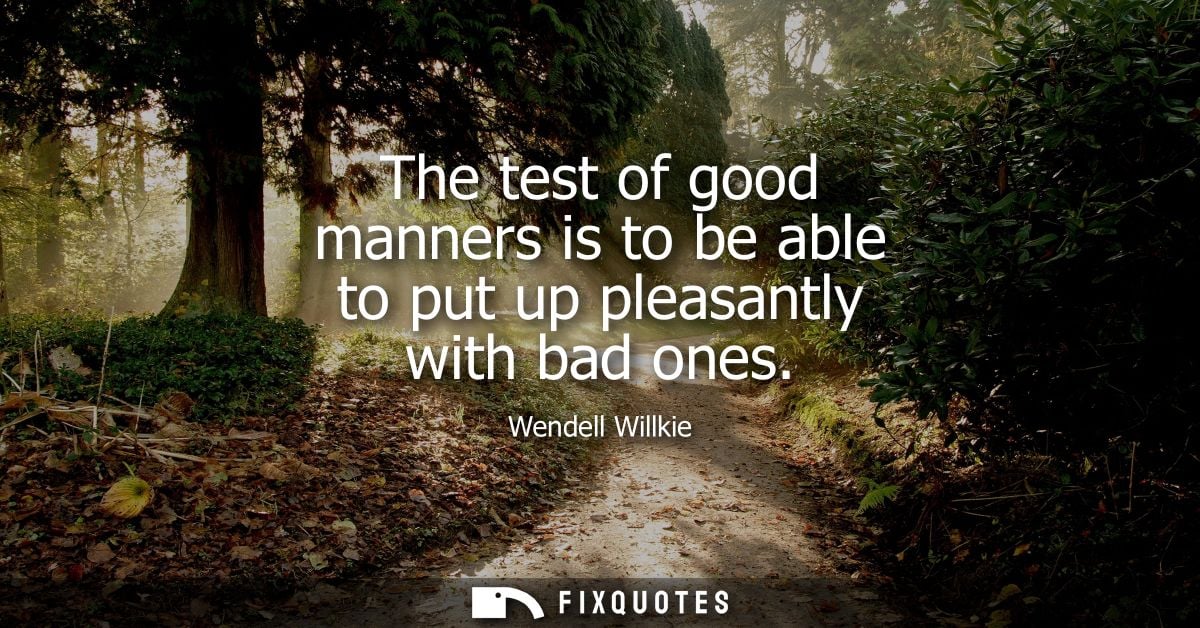
"The test of good manners is to be able to put up pleasantly with bad ones"
About this Quote
Willkie, a lawyer and high-profile political figure in the early 20th century, knew how much American public life runs on controlled conflict. Courtrooms, boardrooms, and campaigns are arenas where bad manners can be a tactic: intimidation, distraction, dominance. His intent reads as practical counsel for navigating adversarial spaces without surrendering your own standards. It’s also reputational strategy. In politics, composure is currency; losing it hands the other side the narrative.
The subtext is less saintly than it sounds. “Good manners” here can double as a tool for power: the ability to absorb insult and keep smiling is often the privilege of people who can afford to. For everyone else, being told to endure “pleasantly” can resemble social pressure to swallow disrespect. That tension is why the aphorism still lands today: it frames civility as character, while quietly acknowledging that civility is also performance, leverage, and sometimes a demand placed unevenly.
Quote Details
| Topic | Respect |
|---|---|
| Source | Help us find the source |
| Cite |
Citation Formats
APA Style (7th ed.)
Willkie, Wendell. (2026, January 15). The test of good manners is to be able to put up pleasantly with bad ones. FixQuotes. https://fixquotes.com/quotes/the-test-of-good-manners-is-to-be-able-to-put-up-108115/
Chicago Style
Willkie, Wendell. "The test of good manners is to be able to put up pleasantly with bad ones." FixQuotes. January 15, 2026. https://fixquotes.com/quotes/the-test-of-good-manners-is-to-be-able-to-put-up-108115/.
MLA Style (9th ed.)
"The test of good manners is to be able to put up pleasantly with bad ones." FixQuotes, 15 Jan. 2026, https://fixquotes.com/quotes/the-test-of-good-manners-is-to-be-able-to-put-up-108115/. Accessed 7 Feb. 2026.