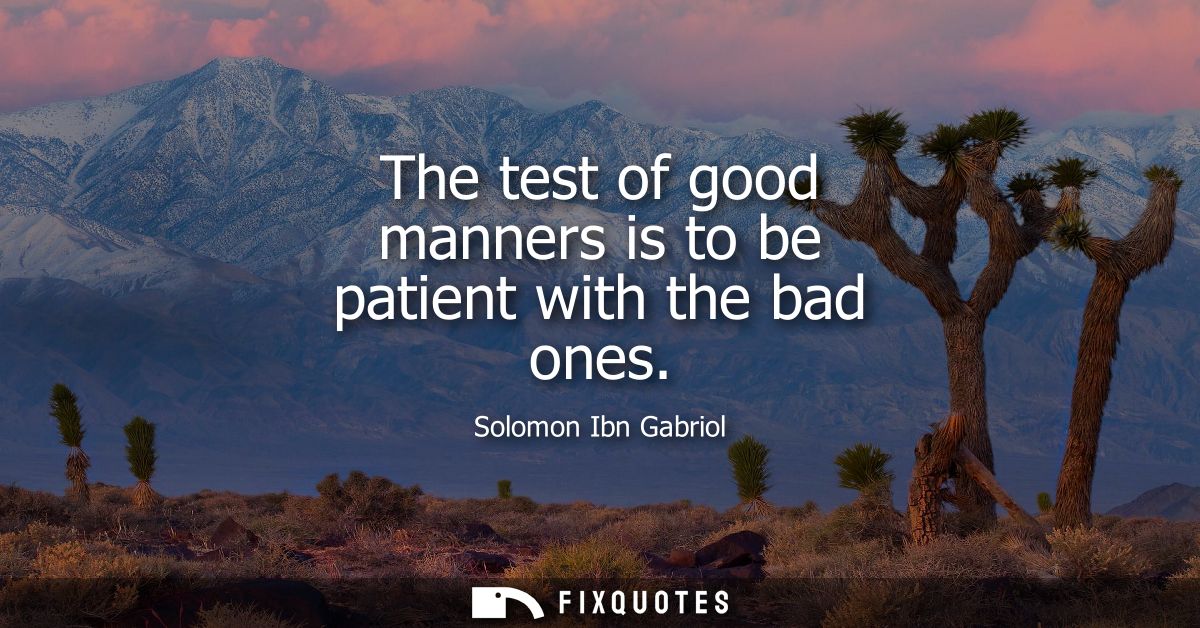
"The test of good manners is to be patient with the bad ones"
About this Quote
Good manners, Ibn Gabirol suggests, aren’t a set of polished gestures so much as a stress test: they only become legible when they’re least convenient. The line refuses to flatter the well-bred as naturally superior. Instead it relocates virtue to the moment of irritation, when someone else’s rudeness hands you a perfect excuse to be petty back. If you can’t resist that invitation, your “manners” were just social luck - the ease of being gracious among people who already play by your rules.
The subtext is quietly disciplinary, but not in a boot-on-the-neck way. Patience here isn’t passivity; it’s self-governance. In a culture where honor, reputation, and public conduct carry real consequences, the ability to absorb offense without escalating it becomes a form of power. The badly mannered person may control the temperature of the room, but patience controls the outcome. That makes the aphorism feel less like etiquette advice and more like a moral technology for living in crowded, status-sensitive worlds.
Context matters. Ibn Gabirol was a medieval Jewish poet and philosopher writing in Al-Andalus, a society of intense intellectual life and sharp social stratification, where communities navigated proximity and vulnerability. “Bad manners” can read as more than personal boorishness; it hints at the frictions of difference, the daily abrasions of being misread or slighted. The line offers a pragmatic ideal: dignity that doesn’t depend on receiving respect first.
The subtext is quietly disciplinary, but not in a boot-on-the-neck way. Patience here isn’t passivity; it’s self-governance. In a culture where honor, reputation, and public conduct carry real consequences, the ability to absorb offense without escalating it becomes a form of power. The badly mannered person may control the temperature of the room, but patience controls the outcome. That makes the aphorism feel less like etiquette advice and more like a moral technology for living in crowded, status-sensitive worlds.
Context matters. Ibn Gabirol was a medieval Jewish poet and philosopher writing in Al-Andalus, a society of intense intellectual life and sharp social stratification, where communities navigated proximity and vulnerability. “Bad manners” can read as more than personal boorishness; it hints at the frictions of difference, the daily abrasions of being misread or slighted. The line offers a pragmatic ideal: dignity that doesn’t depend on receiving respect first.
Quote Details
| Topic | Kindness |
|---|---|
| Source | Later attribution: METAPHYSICS OF SUCCESS (DR. P. S. RAMANI, 2020) modern compilationID: JH8IEAAAQBAJ
Evidence:
... The test of good manners is to be patient with the bad ones. Solomon Ibn Gabirol Self-discipline is one of the most valuable assets in life and is often imbibed during one's impressionable years as children, as they watch their elders ... |
| Cite |
Citation Formats
APA Style (7th ed.)
Gabriol, Solomon Ibn. (2026, February 24). The test of good manners is to be patient with the bad ones. FixQuotes. https://fixquotes.com/quotes/the-test-of-good-manners-is-to-be-patient-with-65484/
Chicago Style
Gabriol, Solomon Ibn. "The test of good manners is to be patient with the bad ones." FixQuotes. February 24, 2026. https://fixquotes.com/quotes/the-test-of-good-manners-is-to-be-patient-with-65484/.
MLA Style (9th ed.)
"The test of good manners is to be patient with the bad ones." FixQuotes, 24 Feb. 2026, https://fixquotes.com/quotes/the-test-of-good-manners-is-to-be-patient-with-65484/. Accessed 20 Mar. 2026.
More Quotes by Solomon
Add to List