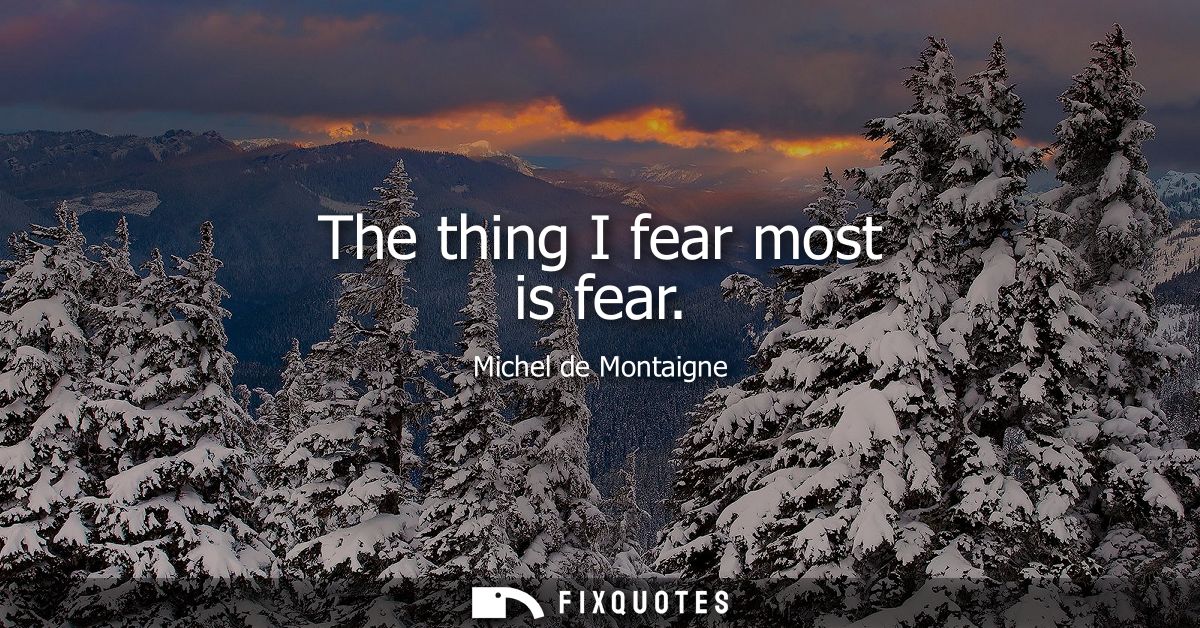
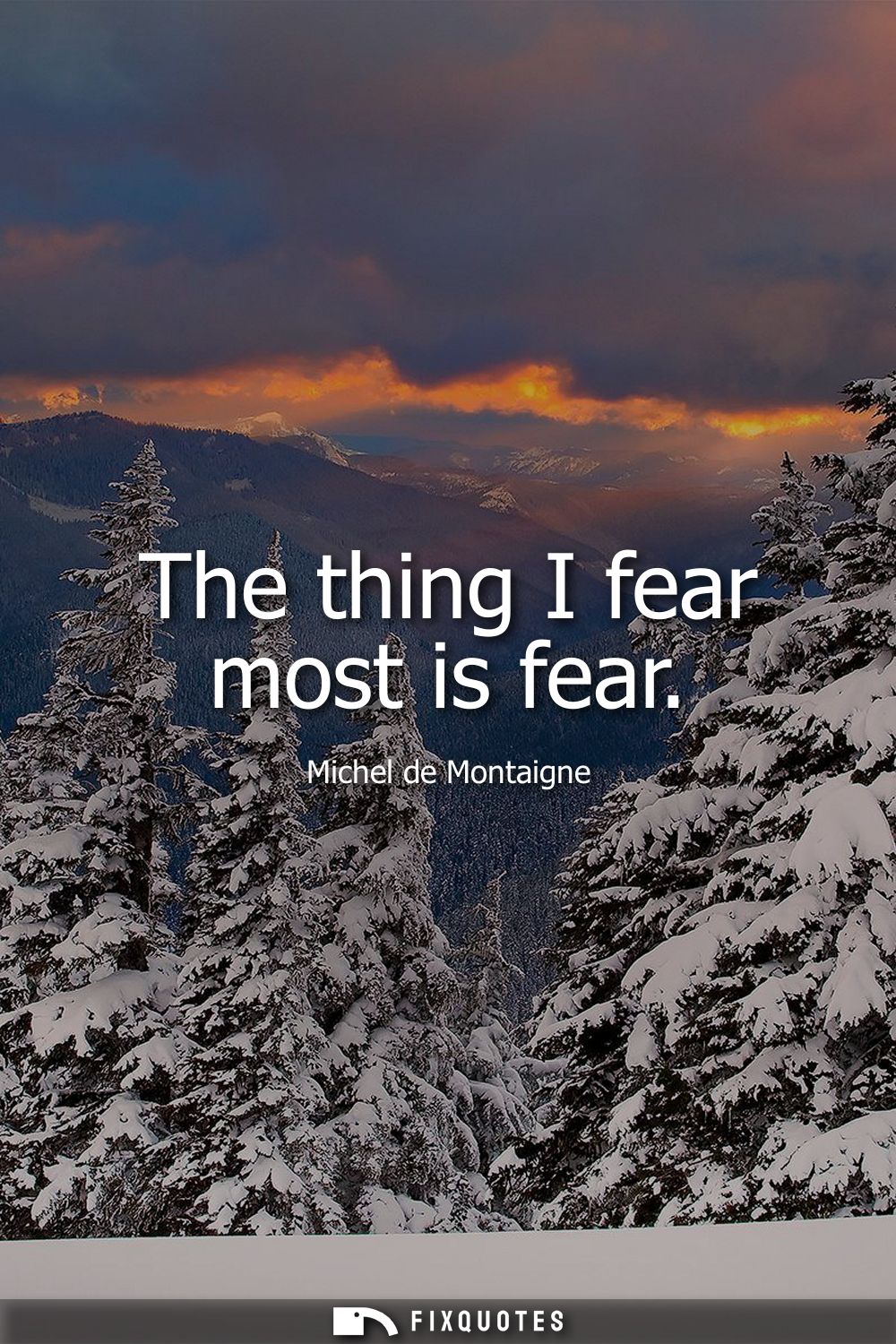
"The thing I fear most is fear"
About this Quote
Montaigne turns fear into its own boogeyman, and that reflex is the whole point: the most destabilizing force in human life isn’t the threat outside you but the panic that colonizes your judgment. The line is almost childlike in its simplicity, which is why it lands. It performs what it argues. By stripping the sentence down to a single repeating word, Montaigne mimics the mental loop of anxiety: fear feeding on itself, amplifying, multiplying, becoming an engine that runs without fresh evidence.
The intent isn’t bravado; it’s diagnosis. Montaigne is writing in an era of genuine instability - religious wars, political violence, plague, the ever-present possibility that public life could turn lethal overnight. He knows danger is real. What he’s tracking is how fear makes danger worse by making you suggestible, rash, and easy to govern. Panic invites bad bargains: surrendering liberty for safety, clarity for superstition, conscience for conformity. In that sense the line doubles as a civic warning, not just a private one.
The subtext carries Montaigne’s signature skepticism. He distrusts grand systems and heroic posturing, so he targets the more intimate tyrant: your own mind under stress. “Fear” becomes the solvent that dissolves reason, and his compact phrasing offers a counter-spell - name the mechanism, shrink it to size, refuse to let it sprawl. The real enemy isn’t the storm; it’s the stampede.
The intent isn’t bravado; it’s diagnosis. Montaigne is writing in an era of genuine instability - religious wars, political violence, plague, the ever-present possibility that public life could turn lethal overnight. He knows danger is real. What he’s tracking is how fear makes danger worse by making you suggestible, rash, and easy to govern. Panic invites bad bargains: surrendering liberty for safety, clarity for superstition, conscience for conformity. In that sense the line doubles as a civic warning, not just a private one.
The subtext carries Montaigne’s signature skepticism. He distrusts grand systems and heroic posturing, so he targets the more intimate tyrant: your own mind under stress. “Fear” becomes the solvent that dissolves reason, and his compact phrasing offers a counter-spell - name the mechanism, shrink it to size, refuse to let it sprawl. The real enemy isn’t the storm; it’s the stampede.
Quote Details
| Topic | Fear |
|---|---|
| Source | Help us find the source |
| Cite |
Citation Formats
APA Style (7th ed.)
Montaigne, Michel de. (2026, January 18). The thing I fear most is fear. FixQuotes. https://fixquotes.com/quotes/the-thing-i-fear-most-is-fear-17419/
Chicago Style
Montaigne, Michel de. "The thing I fear most is fear." FixQuotes. January 18, 2026. https://fixquotes.com/quotes/the-thing-i-fear-most-is-fear-17419/.
MLA Style (9th ed.)
"The thing I fear most is fear." FixQuotes, 18 Jan. 2026, https://fixquotes.com/quotes/the-thing-i-fear-most-is-fear-17419/. Accessed 9 Mar. 2026.
More Quotes by Michel
Add to List