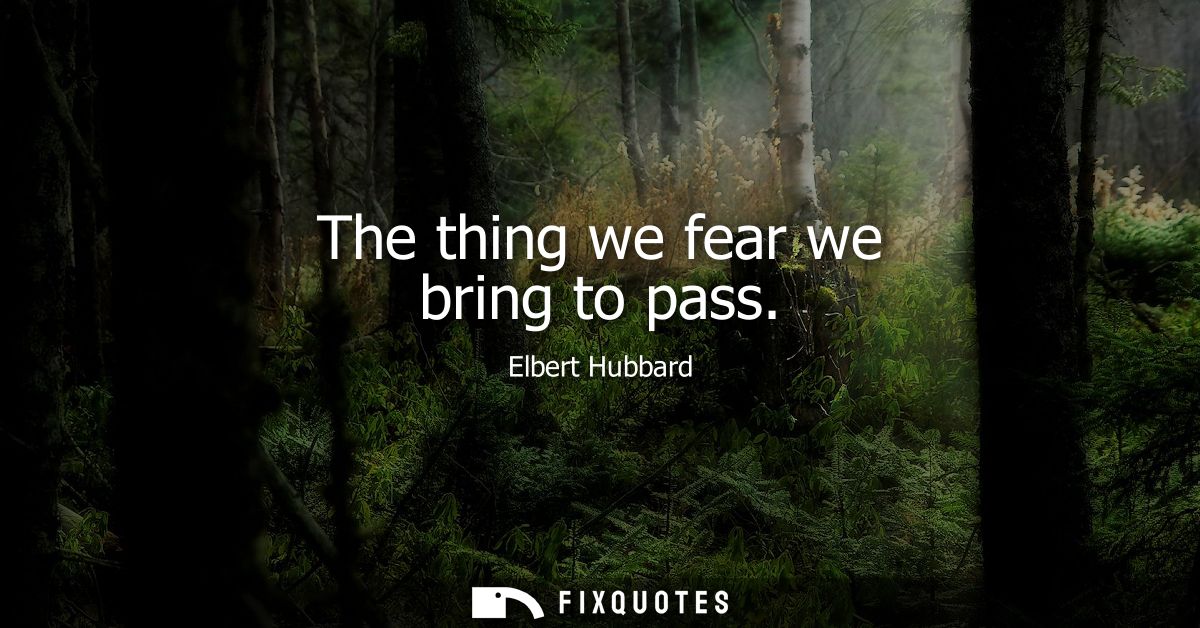
"The thing we fear, we bring to pass"
About this Quote
Anxiety, in Hubbard's hands, isn't just an emotion; it's a manufacturing process. "The thing we fear we bring to pass" compresses an entire moral psychology into nine blunt words, with that slyly accusatory "we" doing most of the work. It's not fate that gets you, Hubbard suggests. It's your own nervous choreography: the rehearsals, the flinching, the preemptive compromises that make a feared outcome more likely. The line lands because it flips the usual script of fear as a warning system. Here, fear is a collaborator.
Hubbard was a writer-entrepreneur of the American self-improvement era, a moment when "character" was pitched like a technology: trainable, optimizable, profitable. That context matters. The quote isn't therapy-talk; it's a discipline manual. It implies agency, even guilt. If your dread becomes real, the uncomfortable implication is that you helped build it.
The subtext is both empowering and harsh. On one level, it's a nudge toward courage: stop feeding the monster with attention and evasions. On another, it's a critique of how fear distorts behavior socially and politically. People hoard, scapegoat, censor, strike first because they're scared - then point to the chaos as proof their fear was justified. Hubbard anticipates the modern feedback loop where anticipation becomes causation: worrying your way into a breakup, micromanaging your way into a revolt, "risk-managing" your way into fragility. The sentence works because it feels like a diagnosis and an indictment at the same time.
Hubbard was a writer-entrepreneur of the American self-improvement era, a moment when "character" was pitched like a technology: trainable, optimizable, profitable. That context matters. The quote isn't therapy-talk; it's a discipline manual. It implies agency, even guilt. If your dread becomes real, the uncomfortable implication is that you helped build it.
The subtext is both empowering and harsh. On one level, it's a nudge toward courage: stop feeding the monster with attention and evasions. On another, it's a critique of how fear distorts behavior socially and politically. People hoard, scapegoat, censor, strike first because they're scared - then point to the chaos as proof their fear was justified. Hubbard anticipates the modern feedback loop where anticipation becomes causation: worrying your way into a breakup, micromanaging your way into a revolt, "risk-managing" your way into fragility. The sentence works because it feels like a diagnosis and an indictment at the same time.
Quote Details
| Topic | Fear |
|---|---|
| Source | Help us find the source |
| Cite |
Citation Formats
APA Style (7th ed.)
Hubbard, Elbert. (2026, February 20). The thing we fear, we bring to pass. FixQuotes. https://fixquotes.com/quotes/the-thing-we-fear-we-bring-to-pass-19264/
Chicago Style
Hubbard, Elbert. "The thing we fear, we bring to pass." FixQuotes. February 20, 2026. https://fixquotes.com/quotes/the-thing-we-fear-we-bring-to-pass-19264/.
MLA Style (9th ed.)
"The thing we fear, we bring to pass." FixQuotes, 20 Feb. 2026, https://fixquotes.com/quotes/the-thing-we-fear-we-bring-to-pass-19264/. Accessed 21 Mar. 2026.
More Quotes by Elbert
Add to List