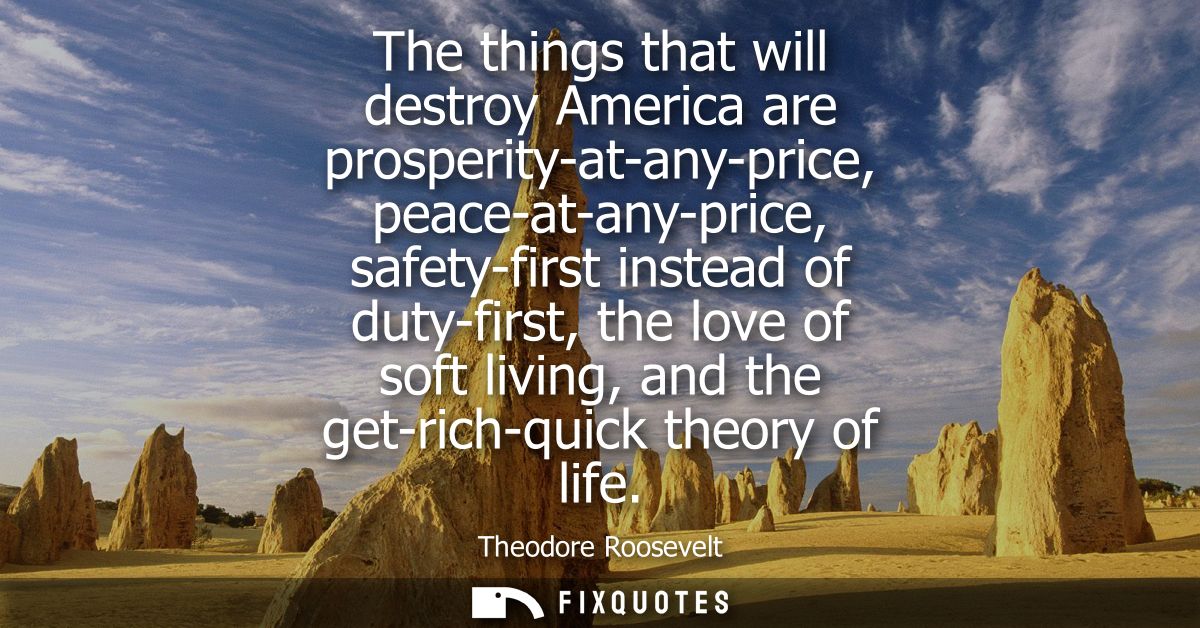
"The things that will destroy America are prosperity-at-any-price, peace-at-any-price, safety-first instead of duty-first, the love of soft living, and the get-rich-quick theory of life"
About this Quote
The subtext is Roosevelt’s lifelong feud with complacency. This is the gospel of the “strenuous life” in a darker register: the fear that modern abundance turns citizens into consumers and politics into customer service. “Safety-first instead of duty-first” doesn’t reject safety; it rejects safety as the highest civic value. Duty implies risk, sacrifice, and an obligation that can’t be reduced to personal comfort or quarterly gains.
Context matters. Roosevelt governed a fast-industrializing, newly imperial America, where fortunes were minted overnight and public life was being reshaped by corporate power, mass advertising, and a widening distance between work and reward. His target is the “get-rich-quick theory of life” not as envy but as a civic toxin: a culture trained to chase winnings will tolerate corruption, exploitation, and a thinner, transactional patriotism.
Rhetorically, the quote works because it’s a list that accelerates, each clause tightening the same screw: a republic dies not only from crisis, but from the anesthetic of ease.
Quote Details
| Topic | Ethics & Morality |
|---|---|
| Source | Help us find the source |
| Cite |
Citation Formats
APA Style (7th ed.)
Roosevelt, Theodore. (2026, January 16). The things that will destroy America are prosperity-at-any-price, peace-at-any-price, safety-first instead of duty-first, the love of soft living, and the get-rich-quick theory of life. FixQuotes. https://fixquotes.com/quotes/the-things-that-will-destroy-america-are-83481/
Chicago Style
Roosevelt, Theodore. "The things that will destroy America are prosperity-at-any-price, peace-at-any-price, safety-first instead of duty-first, the love of soft living, and the get-rich-quick theory of life." FixQuotes. January 16, 2026. https://fixquotes.com/quotes/the-things-that-will-destroy-america-are-83481/.
MLA Style (9th ed.)
"The things that will destroy America are prosperity-at-any-price, peace-at-any-price, safety-first instead of duty-first, the love of soft living, and the get-rich-quick theory of life." FixQuotes, 16 Jan. 2026, https://fixquotes.com/quotes/the-things-that-will-destroy-america-are-83481/. Accessed 5 Mar. 2026.