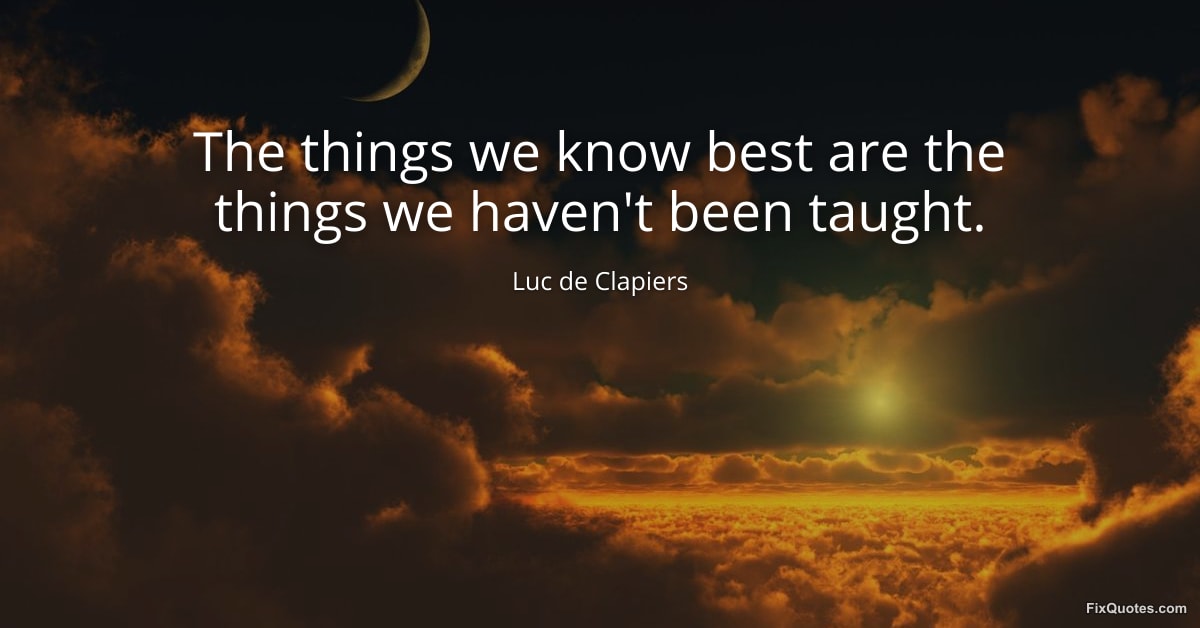
"The things we know best are the things we haven't been taught"
About this Quote
A line like this doesn’t flatter ignorance; it indicts the way “education” can mistake transfer for understanding. Luc de Clapiers, the Marquis de Vauvenargues, wrote in the French moralist tradition where aphorisms are scalpels: short, polished, and meant to cut through social pretension. In an era when salon wit and inherited status often passed for wisdom, he’s quietly re-ranking knowledge. The highest form, he implies, isn’t what you can recite, but what has settled into you through living.
The intent is pointed: there are truths that arrive before instruction and despite it. Hunger teaches more reliably than a lecture on poverty; grief outperforms any treatise on mortality. “Haven’t been taught” doesn’t mean anti-intellectual so much as anti-credential. It’s a jab at secondhand certainty, the kind that thrives in fashionable conversation because it sounds learned while remaining untested.
The subtext is also a defense of instinct and observation. Vauvenargues had a short, sickly life and a thwarted military career; his writing carries the perspective of someone for whom experience was hard-won and time was scarce. That biographical pressure makes the aphorism feel less like a romantic celebration of the “natural” and more like a pragmatic hierarchy: the mind trusts what the body and conscience have verified.
Rhetorically, the paradox does the work. It turns “taught” into a slightly suspicious category, forcing the reader to ask which of their convictions are truly theirs and which are borrowed furniture arranged by teachers, priests, or polite society.
The intent is pointed: there are truths that arrive before instruction and despite it. Hunger teaches more reliably than a lecture on poverty; grief outperforms any treatise on mortality. “Haven’t been taught” doesn’t mean anti-intellectual so much as anti-credential. It’s a jab at secondhand certainty, the kind that thrives in fashionable conversation because it sounds learned while remaining untested.
The subtext is also a defense of instinct and observation. Vauvenargues had a short, sickly life and a thwarted military career; his writing carries the perspective of someone for whom experience was hard-won and time was scarce. That biographical pressure makes the aphorism feel less like a romantic celebration of the “natural” and more like a pragmatic hierarchy: the mind trusts what the body and conscience have verified.
Rhetorically, the paradox does the work. It turns “taught” into a slightly suspicious category, forcing the reader to ask which of their convictions are truly theirs and which are borrowed furniture arranged by teachers, priests, or polite society.
Quote Details
| Topic | Wisdom |
|---|---|
| Source | Help us find the source |
| Cite |
Citation Formats
APA Style (7th ed.)
Clapiers, Luc de. (2026, January 15). The things we know best are the things we haven't been taught. FixQuotes. https://fixquotes.com/quotes/the-things-we-know-best-are-the-things-we-havent-72495/
Chicago Style
Clapiers, Luc de. "The things we know best are the things we haven't been taught." FixQuotes. January 15, 2026. https://fixquotes.com/quotes/the-things-we-know-best-are-the-things-we-havent-72495/.
MLA Style (9th ed.)
"The things we know best are the things we haven't been taught." FixQuotes, 15 Jan. 2026, https://fixquotes.com/quotes/the-things-we-know-best-are-the-things-we-havent-72495/. Accessed 22 Mar. 2026.
More Quotes by Luc
Add to List