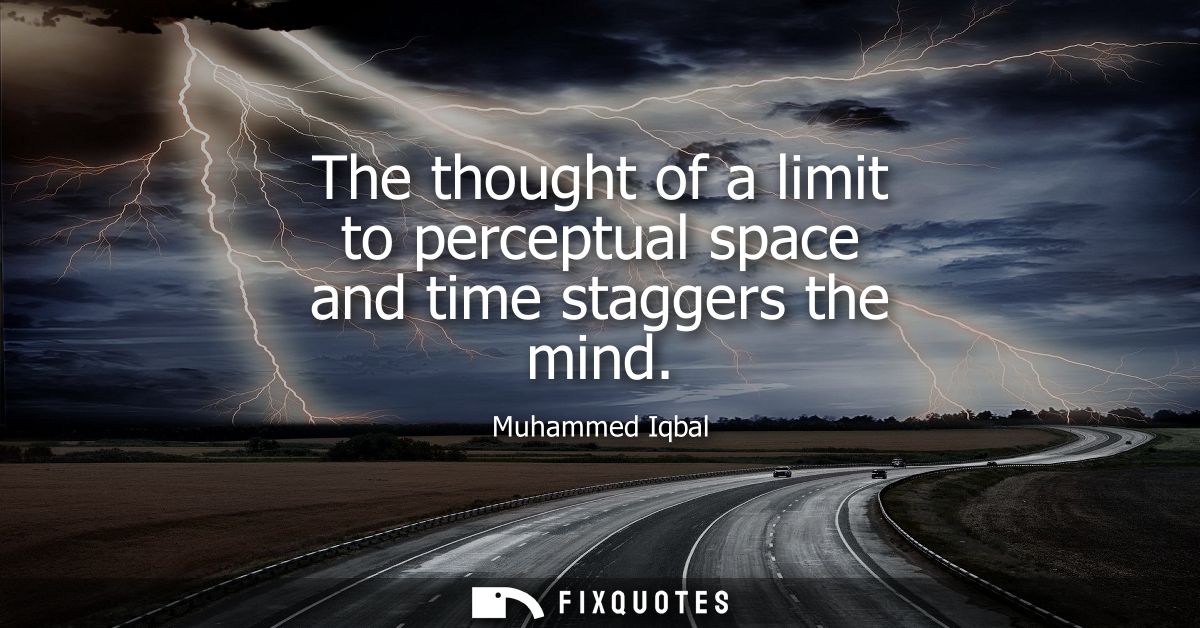
"The thought of a limit to perceptual space and time staggers the mind"
About this Quote
As a poet-philosopher writing in the early 20th century, Iqbal is speaking into a world where old cosmologies were being rattled by modern physics, and where colonial modernity was pressuring Muslim intellectual life to either retreat into nostalgia or imitate Europe. He chooses a third move: treat the limits of perception as a prompt for spiritual and creative ambition. The subtext is a quiet rebellion against intellectual complacency. If your “space” and “time” are only what your senses (and inherited habits of thought) can register, then the self is not a passive spectator; it’s an engine that can be refined, expanded, remade.
There’s also a political undertow. For Iqbal, the imagination isn’t escapism; it’s a form of agency. A colonized society is trained to accept boundaries as natural facts. By stressing how mind-blowing a “limit” really is, he makes boundaries feel suspect, provisional, even challengeable. The staggering, then, is productive: a destabilization that clears room for renewal, not just awe.
Quote Details
| Topic | Deep |
|---|---|
| Source | Help us find the source |
| Cite |
Citation Formats
APA Style (7th ed.)
Iqbal, Muhammed. (2026, January 16). The thought of a limit to perceptual space and time staggers the mind. FixQuotes. https://fixquotes.com/quotes/the-thought-of-a-limit-to-perceptual-space-and-108581/
Chicago Style
Iqbal, Muhammed. "The thought of a limit to perceptual space and time staggers the mind." FixQuotes. January 16, 2026. https://fixquotes.com/quotes/the-thought-of-a-limit-to-perceptual-space-and-108581/.
MLA Style (9th ed.)
"The thought of a limit to perceptual space and time staggers the mind." FixQuotes, 16 Jan. 2026, https://fixquotes.com/quotes/the-thought-of-a-limit-to-perceptual-space-and-108581/. Accessed 4 Apr. 2026.