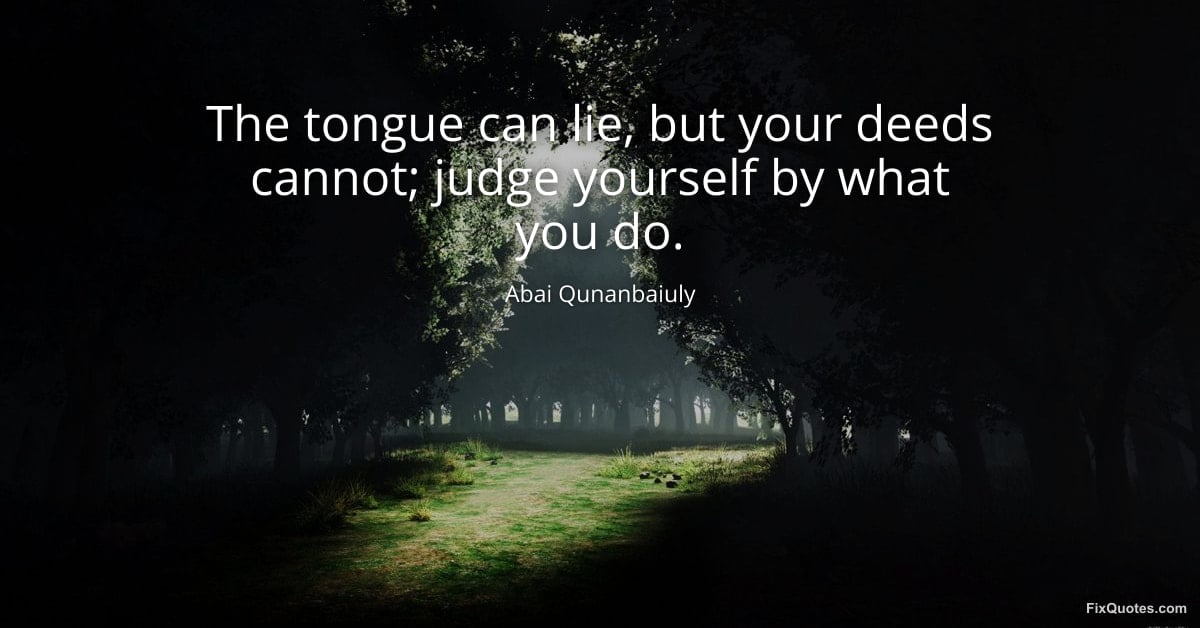
"The tongue can lie, but your deeds cannot; judge yourself by what you do"
About this Quote
The specific intent feels double-edged. On the surface, it’s ethical instruction: measure yourself by conduct, not rhetoric. Underneath, it’s a critique of a culture where status is performed through talk - boasts, oaths, public piety, the right affiliations - while responsibility can be endlessly postponed. Abai, a reform-minded poet and thinker writing in a Kazakh steppe society undergoing intense political and cultural pressure from the Russian Empire, often targeted complacency, corruption, and the soothing myths communities tell themselves. This line reads like his antidote to hollow eloquence: stop litigating your virtue in conversation; demonstrate it.
The subtext also turns the knife inward. “Judge yourself” doesn’t outsource accountability to gossip, elders, or institutions. It demands a private standard, a modern-sounding insistence on integrity over optics. That’s why the quote still lands: it speaks to any era where language is abundant - sermons, slogans, posts - and asks the only question that can’t be spin-doctored: what did you actually do?
Quote Details
| Topic | Honesty & Integrity |
|---|---|
| Source | The Book of Words (Kara Sozder), on integrity, 19th century. [translated] |
| Cite |
Citation Formats
APA Style (7th ed.)
Qunanbaiuly, Abai. (2026, February 14). The tongue can lie, but your deeds cannot; judge yourself by what you do. FixQuotes. https://fixquotes.com/quotes/the-tongue-can-lie-but-your-deeds-cannot-judge-185313/
Chicago Style
Qunanbaiuly, Abai. "The tongue can lie, but your deeds cannot; judge yourself by what you do." FixQuotes. February 14, 2026. https://fixquotes.com/quotes/the-tongue-can-lie-but-your-deeds-cannot-judge-185313/.
MLA Style (9th ed.)
"The tongue can lie, but your deeds cannot; judge yourself by what you do." FixQuotes, 14 Feb. 2026, https://fixquotes.com/quotes/the-tongue-can-lie-but-your-deeds-cannot-judge-185313/. Accessed 29 Mar. 2026.