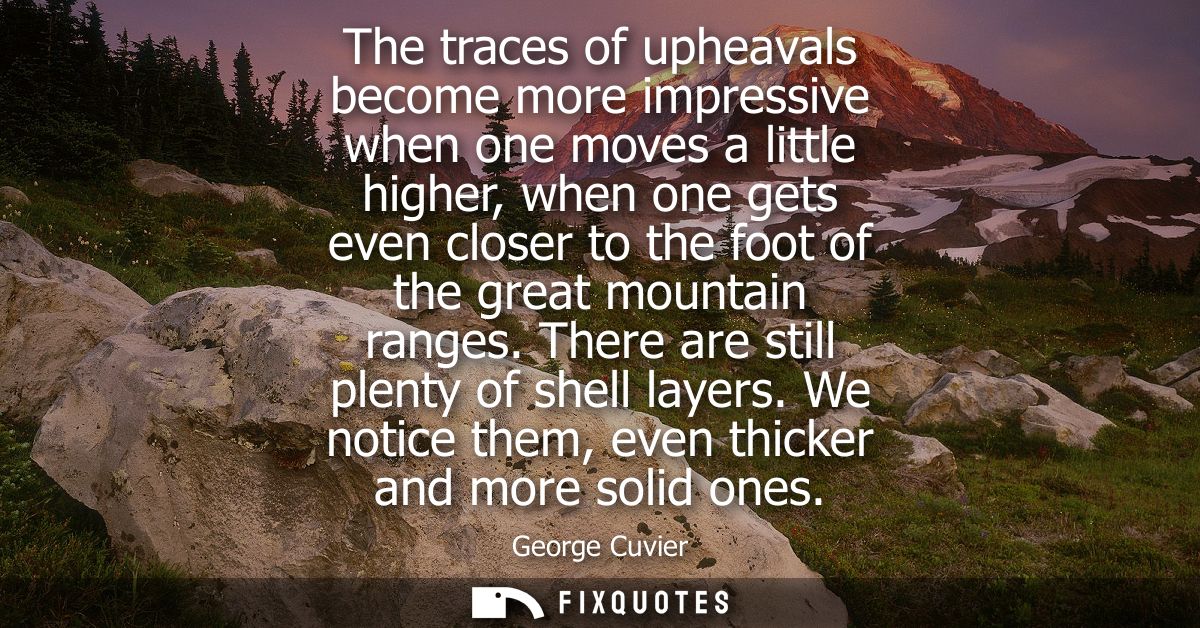
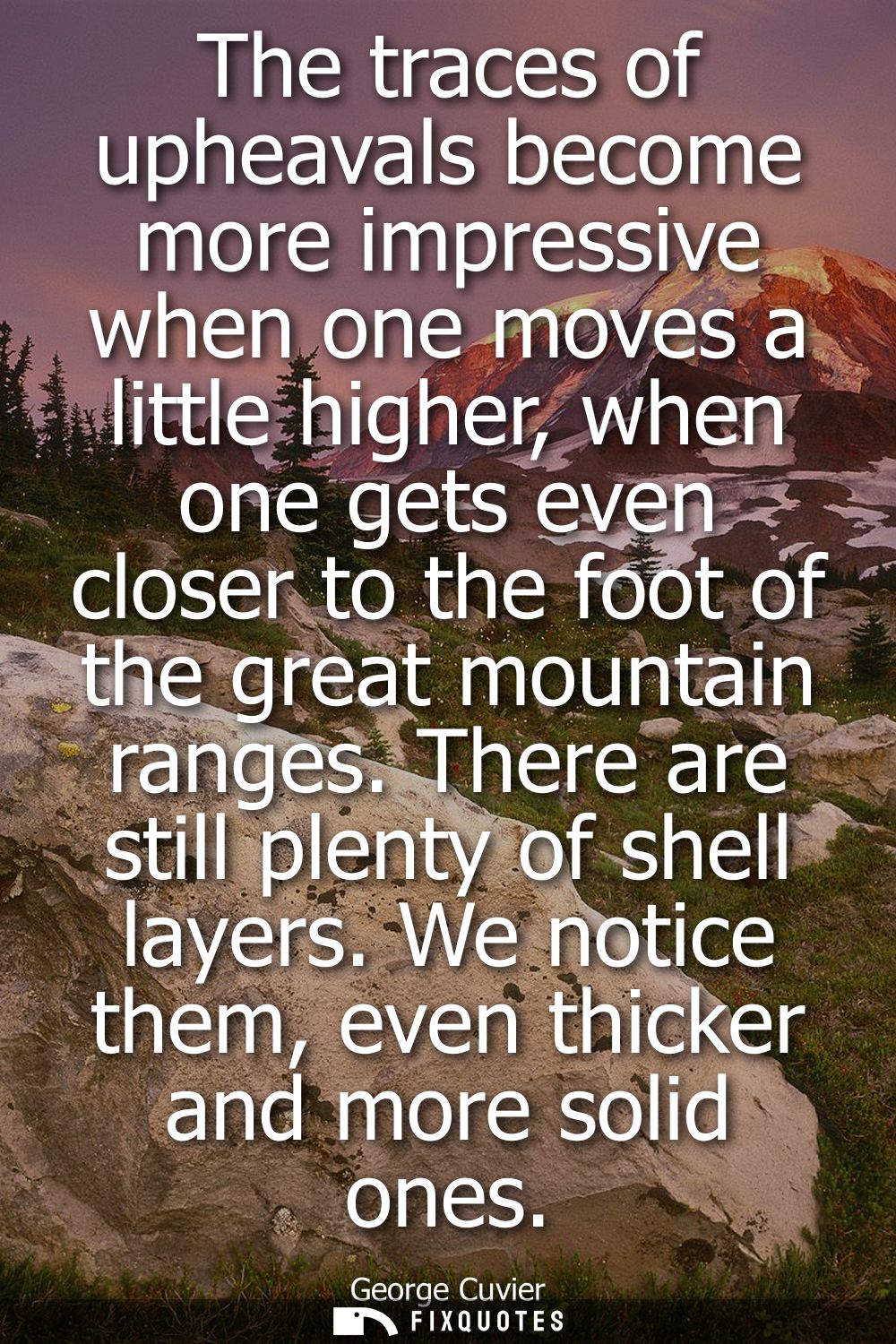
"The traces of upheavals become more impressive when one moves a little higher, when one gets even closer to the foot of the great mountain ranges. There are still plenty of shell layers. We notice them, even thicker and more solid ones!"
About this Quote
The phrasing matters. “Traces of upheavals” sounds almost modest, like scuff marks, until he tightens the frame: higher altitude, thicker layers, more solid proof. Cuvier’s method is rhetoric disguised as observation: he’s coaching the reader’s eye to notice what everyday perception filters out. The mountain becomes a natural archive, and the shells are receipts for events violent enough to heave seabeds upward.
Context is everything. Writing in the late 18th and early 19th centuries, Cuvier helped found vertebrate paleontology and pushed catastrophism: Earth’s history punctuated by sudden, transformative disruptions. This was a direct challenge to the soothing uniformitarian idea that slow, continuous processes explain the past. It also had theological aftershocks, because “upheavals” could be read alongside flood narratives, even as Cuvier kept his claims grounded in anatomy and geology.
Subtext: trust the material record over inherited story. The mountain doesn’t care what you believe; it keeps layering its rebuttal.
Quote Details
| Topic | Mountain |
|---|---|
| Source | Help us find the source |
| Cite |
Citation Formats
APA Style (7th ed.)
Cuvier, George. (2026, February 19). The traces of upheavals become more impressive when one moves a little higher, when one gets even closer to the foot of the great mountain ranges. There are still plenty of shell layers. We notice them, even thicker and more solid ones! FixQuotes. https://fixquotes.com/quotes/the-traces-of-upheavals-become-more-impressive-48295/
Chicago Style
Cuvier, George. "The traces of upheavals become more impressive when one moves a little higher, when one gets even closer to the foot of the great mountain ranges. There are still plenty of shell layers. We notice them, even thicker and more solid ones!" FixQuotes. February 19, 2026. https://fixquotes.com/quotes/the-traces-of-upheavals-become-more-impressive-48295/.
MLA Style (9th ed.)
"The traces of upheavals become more impressive when one moves a little higher, when one gets even closer to the foot of the great mountain ranges. There are still plenty of shell layers. We notice them, even thicker and more solid ones!" FixQuotes, 19 Feb. 2026, https://fixquotes.com/quotes/the-traces-of-upheavals-become-more-impressive-48295/. Accessed 2 Apr. 2026.