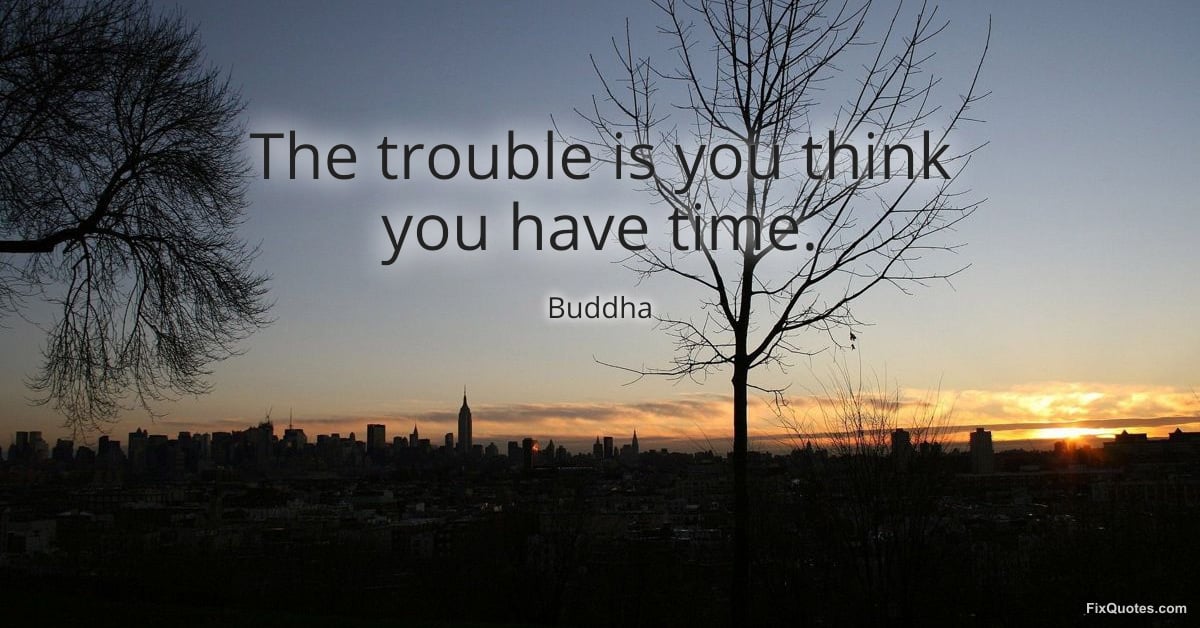
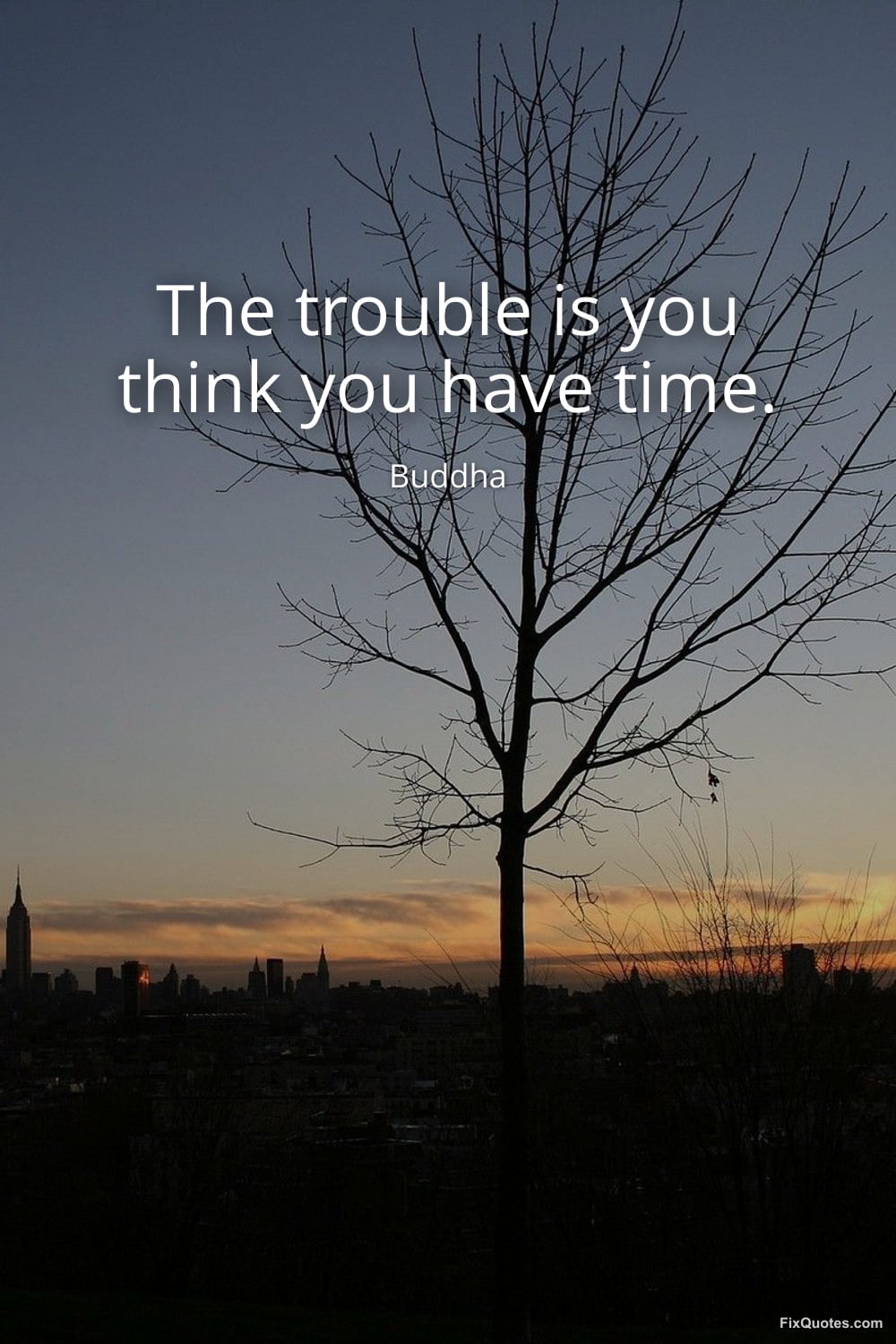
"The trouble is you think you have time"
About this Quote
Fourteen words, and it lands like a verdict. "The trouble is you think you have time" works because it identifies a psychological habit, not a scheduling problem. The target is self-deception: the deeply human tendency to treat life as expandable, to assume there will be a later version of ourselves more disciplined, more loving, more awake. Buddha's phrasing is almost surgical. "The trouble" sounds plain, even gentle, but what follows is devastating. The real obstacle is not fate, bad luck, or external oppression. It is the mind's fantasy of endless deferral.
That idea sits squarely inside Buddhist teaching. Impermanence is not an abstract doctrine here; it is the pressure point. Everything changes, everything passes, and the ego survives by pretending not to notice. If death were kept fully in view, procrastination would look less like laziness and more like denial. The quote strips away that denial. It pushes the listener out of passive existence and into attention.
Its force also comes from what it refuses to do. There is no ornate spirituality, no promise of reward, no melodrama. Just a blunt diagnosis. That rhetorical economy gives it moral weight. It feels less like inspiration than confrontation.
In historical context, Buddha's teaching repeatedly returned to suffering, attachment, and the illusions that keep people trapped in cycles of dissatisfaction. Time, in this formulation, is one more attachment: we cling to the idea that tomorrow belongs to us. The quote punctures that ownership. Its enduring power lies in how modern it feels. In an age built on postponement, it reads less like ancient wisdom than an indictment.
That idea sits squarely inside Buddhist teaching. Impermanence is not an abstract doctrine here; it is the pressure point. Everything changes, everything passes, and the ego survives by pretending not to notice. If death were kept fully in view, procrastination would look less like laziness and more like denial. The quote strips away that denial. It pushes the listener out of passive existence and into attention.
Its force also comes from what it refuses to do. There is no ornate spirituality, no promise of reward, no melodrama. Just a blunt diagnosis. That rhetorical economy gives it moral weight. It feels less like inspiration than confrontation.
In historical context, Buddha's teaching repeatedly returned to suffering, attachment, and the illusions that keep people trapped in cycles of dissatisfaction. Time, in this formulation, is one more attachment: we cling to the idea that tomorrow belongs to us. The quote punctures that ownership. Its enduring power lies in how modern it feels. In an age built on postponement, it reads less like ancient wisdom than an indictment.
Quote Details
| Topic | Time |
|---|---|
| Source | Help us find the source |
| Cite |
Citation Formats
APA Style (7th ed.)
Buddha. (2026, March 10). The trouble is you think you have time. FixQuotes. https://fixquotes.com/quotes/the-trouble-is-you-think-you-have-time-185822/
Chicago Style
Buddha. "The trouble is you think you have time." FixQuotes. March 10, 2026. https://fixquotes.com/quotes/the-trouble-is-you-think-you-have-time-185822/.
MLA Style (9th ed.)
"The trouble is you think you have time." FixQuotes, 10 Mar. 2026, https://fixquotes.com/quotes/the-trouble-is-you-think-you-have-time-185822/. Accessed 3 Apr. 2026.
More Quotes by Buddha
Add to List