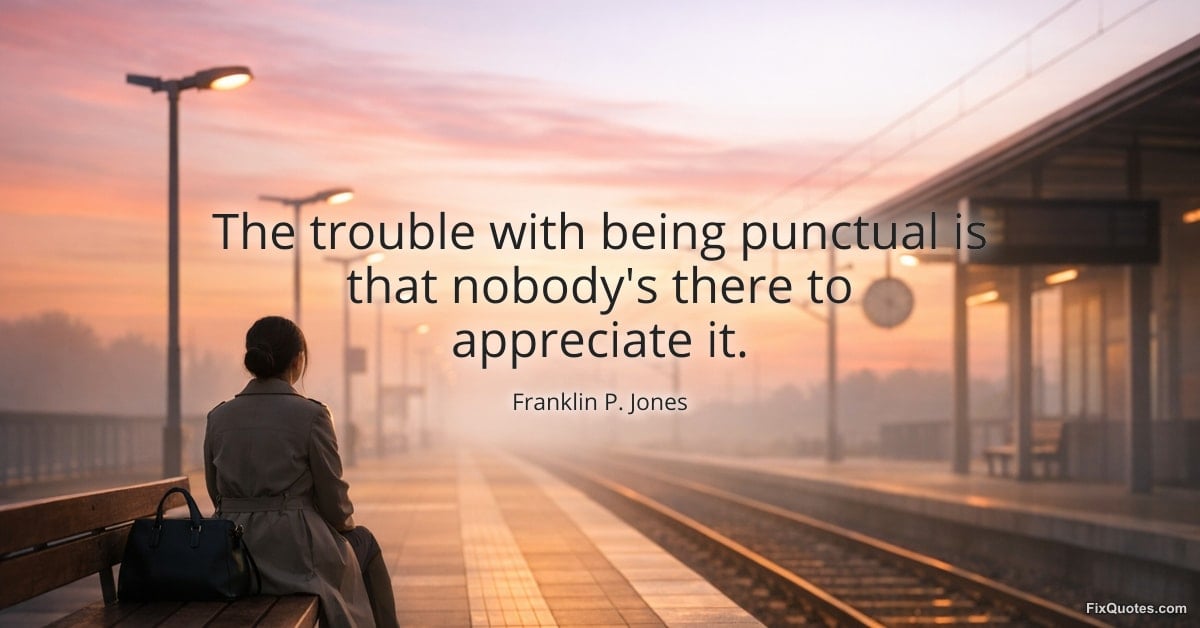
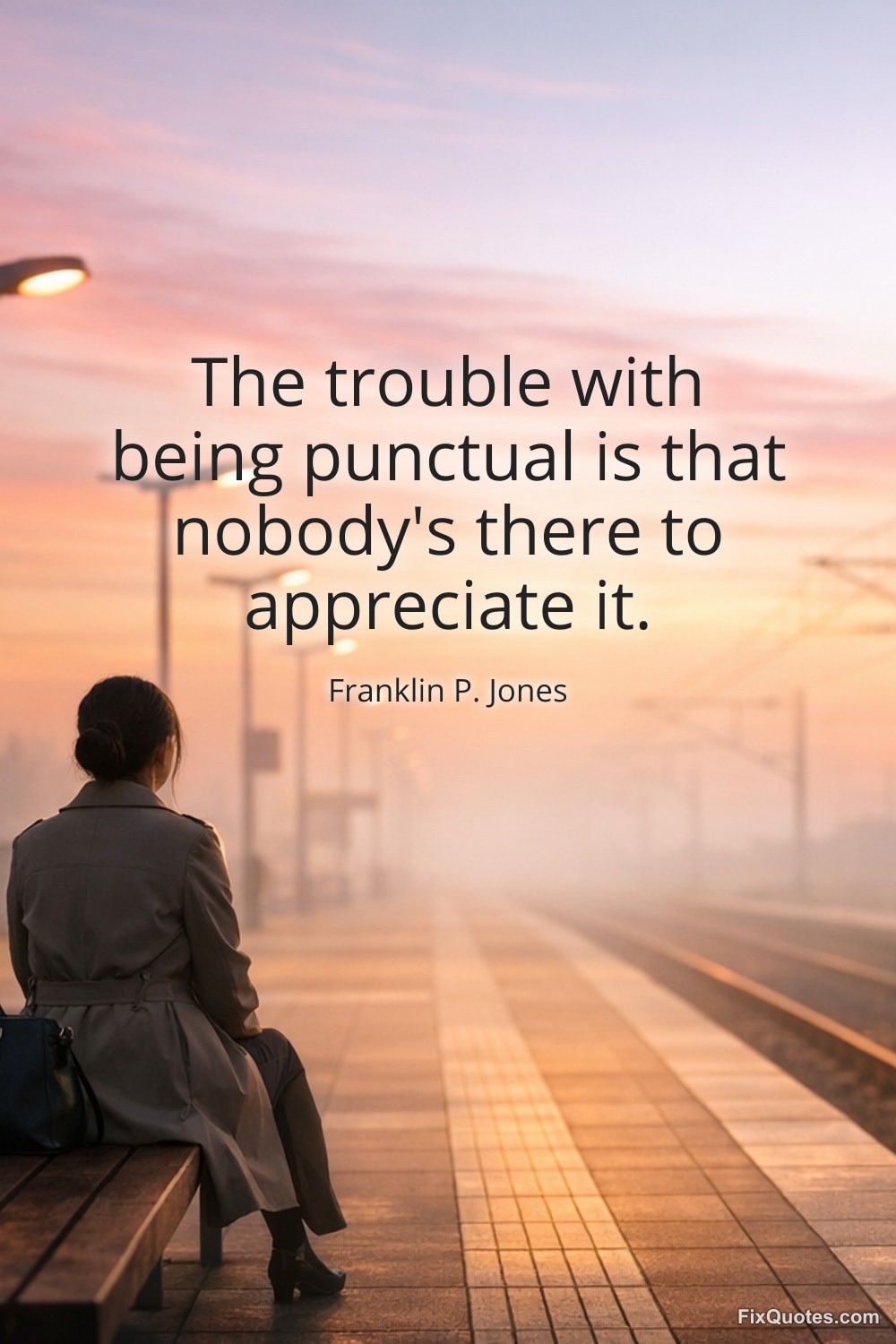
"The trouble with being punctual is that nobody's there to appreciate it"
About this Quote
The intent is comic, but the comedy is edged with workplace and middle-class realism. Punctual people don’t just lose minutes; they lose recognition. Being early becomes a kind of unpaid labor, performed in the hope that someone will witness it. Jones’s subtext is that social value is not inherent in the act; it’s conferred by an audience. Without witnesses, virtue feels like wasted effort.
As a mid-century journalist, Jones was writing from inside a culture obsessed with schedules: commuter trains, punch clocks, meetings, and the growing mythology of “efficiency.” His cynicism targets that era’s belief that time discipline equals character. The punchline lands because we all know the person who is “always five minutes late” and, infuriatingly, still sets the rhythm for everyone else. The punctual person’s reward is silence and a half-lit room.
Underneath the gag is a small, bitter truth about modern life: coordination is power. The late arrival commandeers attention; the early arrival merely proves they’re controllable. Jones isn’t arguing against punctuality so much as against the fantasy that it will be appreciated.
Quote Details
| Topic | Witty One-Liners |
|---|---|
| Source | Later attribution: The Most Unusual Quiz Book in the World Volume 1 modern compilationID: CLhhyi9kfsAC
Evidence: Famous. Quotes. "The trouble with being punctual is that nobody's there to appreciate it." (Franklin P. Jones) "Love is the answer, but while you are waiting for the answer sex raises some pretty good questions." (Woody Allen) "All my ... Other candidates (1) Benjamin Franklin (Franklin P. Jones) compilation36.0% themselves and became richer there is no country in the world where so many provisions |
| Cite |
Citation Formats
APA Style (7th ed.)
Jones, Franklin P. (2026, January 16). The trouble with being punctual is that nobody's there to appreciate it. FixQuotes. https://fixquotes.com/quotes/the-trouble-with-being-punctual-is-that-nobodys-66776/
Chicago Style
Jones, Franklin P. "The trouble with being punctual is that nobody's there to appreciate it." FixQuotes. January 16, 2026. https://fixquotes.com/quotes/the-trouble-with-being-punctual-is-that-nobodys-66776/.
MLA Style (9th ed.)
"The trouble with being punctual is that nobody's there to appreciate it." FixQuotes, 16 Jan. 2026, https://fixquotes.com/quotes/the-trouble-with-being-punctual-is-that-nobodys-66776/. Accessed 7 Apr. 2026.